Frank
Frank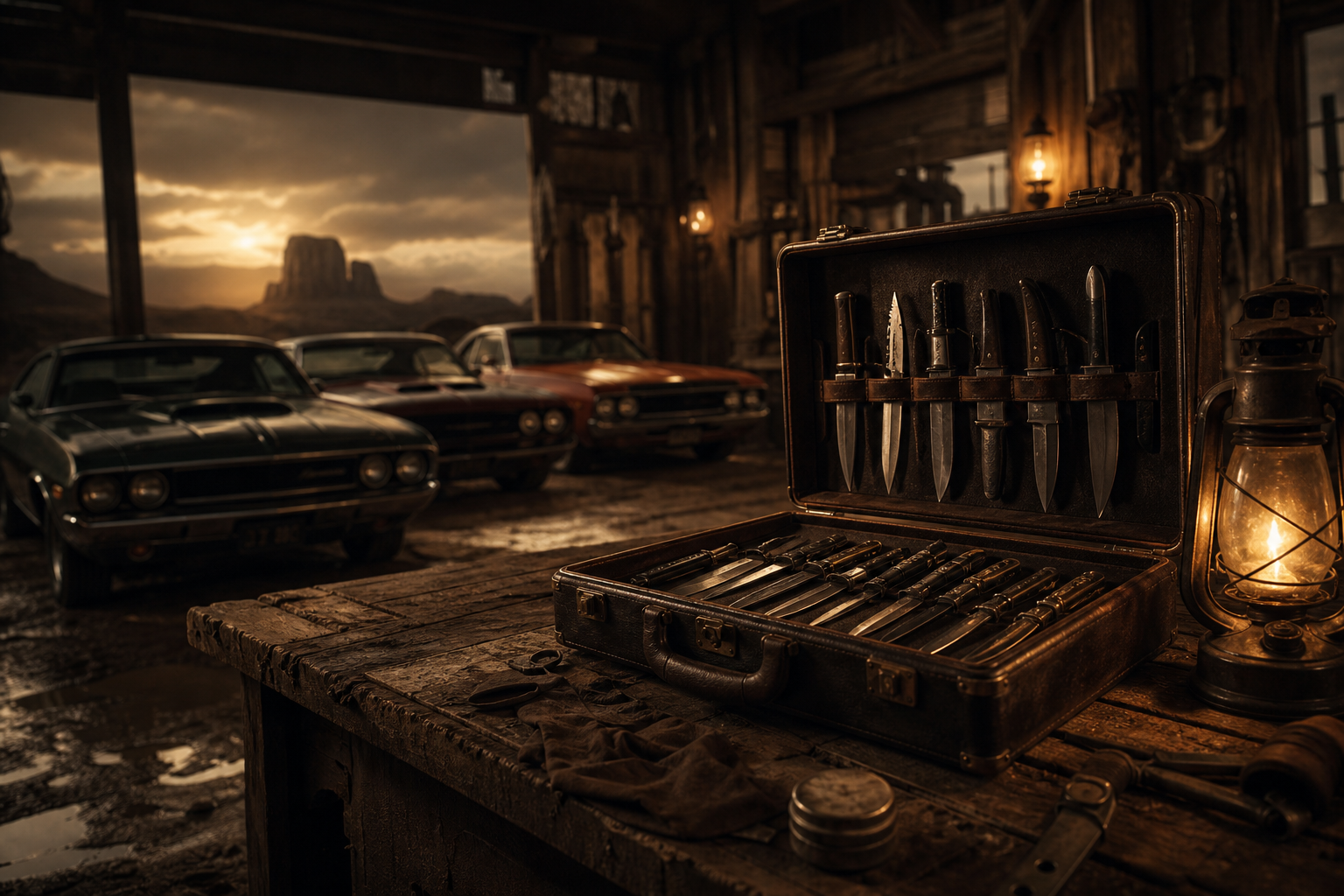
Ford Showed Up to the Fight with a Briefcase Full of Knives
There’s a version of the muscle car story where Ford is the afterthought. Chevy gets the volume, Mopar gets the mystique, and Pontiac gets credit for starting the whole thing. Ford, in that telling, is just the company that built the Mustang.
That version is wrong.
From 1968 through 1971, Ford fielded a lineup of performance engines that covered every racing discipline and every street use case, sometimes in the same car, sometimes in ways that made almost no practical sense. They had a torque monster for the street, a NASCAR refugee that barely fit under the hood, a small-block that would spin to 7,500 rpm on race day, a long-stroke Cleveland that outlived the whole era, and a purpose-built drag racing engine they built specifically to humiliate Chrysler and then never sold to the public. That last one deserves its own section, and it gets one.
If Part 2 was about Mopar’s depth of lineup, this post is about Ford’s range. They weren’t always the best at any single thing. But the spread of what they attempted during this era is genuinely impressive, and a few of these engines belong in any serious conversation about the best of the period.
The 428 Cobra Jet: Ford’s Most Honest Street Engine
Ford rated the 428 Cobra Jet at 335 horsepower when it debuted in the 1968 Mustang. Nobody believed that number then, and nobody believes it now. Independent dyno testing has consistently put the CJ in the 410 to 420 horsepower range at the crank, which puts it right in the same underrating conversation we laid out in Part 1 when we talked about the insurance-era fiction factory numbers represent.
The 428 CJ was not a sophisticated engine. It was a stroked version of the 428 Police Interceptor block, dressed up with bigger heads, a better intake manifold, and a solid carburetor setup. What it did have was torque. The 428 made roughly 440 pound-feet of torque at a very low rpm, which means it pulled hard from almost anywhere in the rev range without you having to work for it. In a heavy car like a Torino or a Mach 1, that characteristic mattered more than peak horsepower.
The Super Cobra Jet variant, which came standard on any CJ car ordered with a 3.91 or 4.30 rear gear, added an engine oil cooler, a stronger bottom end, and the legendary Le Mans connecting rods. It was still rated at 335 horsepower. The factory was not even trying to be believable at this point.
Where the 428 CJ/SCJ split gets interesting is the street-versus-strip personality. The standard CJ was genuinely excellent on the street: tractable, torquey, relatively easy to live with. The SCJ was built with more durability in mind for hard launches, but the practical street difference was minimal. Where the SCJ earned its keep was in sustained abuse, repeated quarter-mile runs, and high-rpm operation that would eventually stress the bottom end of a standard CJ.
Ford sold these engines in Mustangs, Torinos, Cougars, and Fairlanes, which means they’re not mythically rare. They are, however, consistently climbing in value, and finding a numbers-matching SCJ car today requires serious money. We’ll come back to pricing realities in Part 8.
The Boss 429: Built for NASCAR, Barely Tamed for the Street
Here is where Ford’s ambition ran slightly ahead of its practicality.
The Boss 429 exists because NASCAR required manufacturers to validate engines by selling them in street cars. Ford needed the 429 in production vehicles to go racing. What they ended up with was one of the most technically sophisticated engines of the entire era, squeezed into an engine bay that was never designed to hold it, in a car that needed significant chassis modifications to make the installation work.
Kar Kraft, a Ford contractor, handled the Boss 429 conversions. The front suspension towers had to be moved outward to clear the massive heads. The battery relocated to the trunk. The result was a Mustang that looked relatively normal from the outside and had an absolute monster under the hood, except that monster was optimized for high-rpm NASCAR use, not stoplight-to-stoplight street driving.
This is the core criticism of the Boss 429 as a street car: the engine wanted to rev. The combustion chambers were enormous, the porting was designed for high-speed airflow, and the low-end torque that made the 428 CJ so usable was simply not the Boss 429’s priority. Contemporary road tests were respectful but honest. The car made big power, but it needed to be pushed to find it.
What the Boss 429 absolutely was, and remains, is one of the most technically interesting engines Ford ever built. The semi-hemispherical combustion chambers, the massive cylinder heads, the overall engineering ambition at a time when Ford could have just put a bigger carburetor on an existing block and called it done, it all reflects genuine commitment to performance engineering. The engine deserves its legend. The legend just needs an asterisk about what kind of driver it rewarded.
The Boss 302: The High-Revver That Actually Delivered
While the Boss 429 was wrestling with its own enormity, the Boss 302 was busy being excellent.
Ford built the Boss 302 for Trans-Am racing certification, which required a production car with an engine displacing under 305 cubic inches. The 302 used large-port Cleveland-style heads on a Windsor small-block bottom end, a combination that gave it significantly better breathing than a standard 302 and a rev ceiling that most big-blocks couldn’t approach.
The Boss 302 was rated at 290 horsepower. It made more than that. More importantly, it made its power the right way for road racing: willingly, across a broad rpm range, with the kind of high-revving character that rewarded a driver who knew how to use a gearbox. On a road course, a Boss 302 Mustang in competent hands could humiliate cars with more cubic inches, because the game on a road course is momentum and engine response, not sheer torque at the line.
For street use, the Boss 302 occupied a different niche than the 428 CJ. It was less forgiving at low rpm, demanded more attention, and returned the favor with a driving experience that felt genuinely sporting rather than just powerful. These are two different propositions, and both are valid.
The 351 Cleveland: The Platform That Outlasted Everyone
If longevity is a criteria, and in any realistic assessment of an engine’s historical impact it has to be, the 351 Cleveland deserves more respect than it typically receives in muscle era conversations.
The Cleveland entered production in 1970 with genuinely excellent heads, a strong bottom end, and a design philosophy that prioritized airflow in a way the older Windsor-based engines did not. The 4-barrel Cleveland, especially the high-compression versions available in 1970 and 1971, made real power with real manners. The 2-barrel versions that followed as emissions tightened are a different and considerably less exciting story.
What the Cleveland has going for it in 2026 is community support, parts availability, and a strong aftermarket that has kept the platform relevant for restomod and hot rod builds long after the factory walked away from it. The Boss 302’s Cleveland-derived heads are part of this same family tree. When we get to Part 8 and talk about what’s still accessible for a working-guy builder, the Cleveland family is going to be part of that conversation.
Sidebar: The Cammer That Never Got Its Day
In 1964, Ford built a 427 cubic inch single overhead cam engine specifically to destroy Chrysler at the drag strip. The SOHC 427, called the “Cammer” almost immediately by everyone who encountered it, made somewhere between 600 and 650 horsepower in race tune and represented a level of engineering ambition that was genuinely startling for American production-adjacent engine manufacturing at the time.
NASCAR banned it before it ever competed. NHRA restricted it to experimental classes. Ford, having nowhere to run the thing legally, never put it in a production car.
What the Cammer became instead was a what-if. It ran in match races and exhibition events. It made noise. It generated publicity. And it demonstrated, in the clearest possible terms, that Ford’s engineering department was capable of building something that would have reset the entire conversation about what an American V8 could be.
The Cammer never got its day. The engines that exist now are extraordinarily rare and extraordinarily valuable, which puts them firmly in hedge-fund territory by the time we reach Part 8’s pricing discussion.
Ford’s production arsenal was deep and legitimate even without it. With it, the conversation might have gone differently. That’s the kind of footnote that keeps gear-heads arguing in comment sections for decades, which is exactly where that argument belongs.
Next up, we cross to the other side of the General Motors house and deal with Chevrolet’s considerable catalog, including an engine the factory rated at 430 horsepower that made considerably more than that, an all-aluminum ZL1 that almost nobody actually bought, and a 454 that genuinely was as good as advertised.