Frank
Frank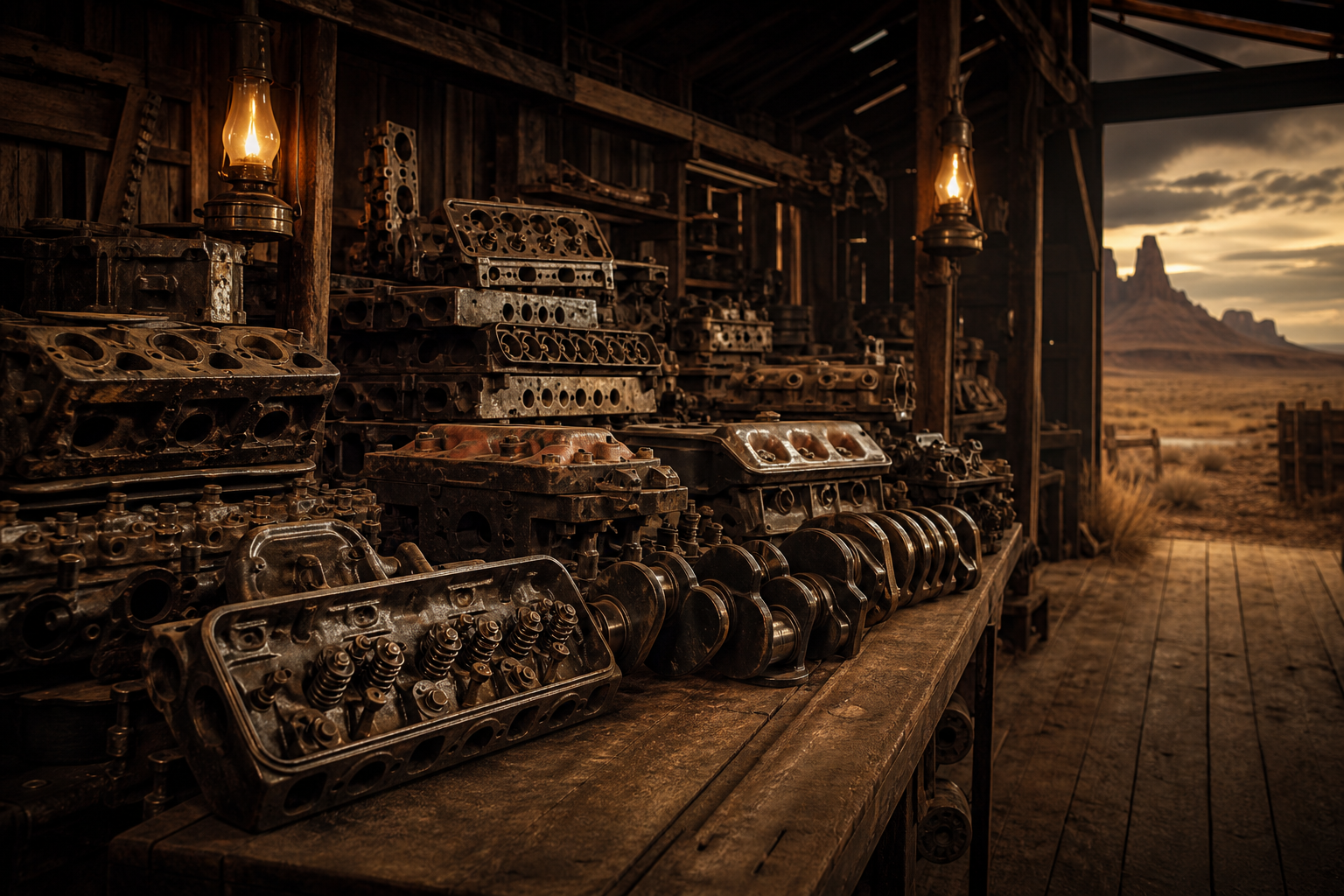
The Most Dangerous Thing About Chevy Was the Volume
Walk into any swap meet in the country and you’ll find Chevy parts. Big-block heads, small-block cranks, intake manifolds stacked three deep against a folding table run by a guy in a faded Snap-on hat. That accessibility is Chevrolet’s legacy in the performance world, and it cuts two ways. On one hand, you can still build a credible 427 for street use without selling your house. On the other hand, the sheer volume of Chevy production means the truly rare stuff got lost in the noise. A ZL1 Camaro sitting next to a garden-variety 327 hardtop at a show doesn’t announce itself. The numbers do the talking, and most people don’t know what numbers to look for.
That’s the paradox of Chevy’s muscle era catalog. They made everything from grocery-getter six-cylinders to engines that required race fuel to survive a warm-up lap, and they sold them all through the same dealerships, sometimes to the same customers who didn’t fully understand what they were buying. The L88 is the clearest example of that deliberate confusion, and it’s where this story starts.
The L88: Chevy Lied to Your Face and You Should Thank Them
The 427 L88 was rated at 430 horsepower from the factory. That number is a lie so obvious that Chevrolet engineers who were still alive to discuss it have essentially said, yes, we made that up. The actual output was somewhere north of 550 horsepower, with some estimates pushing 560 or 580 depending on the specific build year and configuration. Chevy rated it low for two reasons. Insurance companies used horsepower figures to set rates, and the factory didn’t want to be responsible for what happened when a street buyer got hold of an engine tuned for endurance racing at Le Mans.
Because that’s what the L88 was. It wasn’t a street engine with a wink. It was a racing engine that technically met the criteria for production-car approval, shoved into the Corvette option list with a 430hp badge and a list of “discouragements” that were almost comical. The owner’s manual section for the L88 told you it wasn’t suitable for street use. The engine required 103-octane minimum fuel. It had no provisions for a choke, which made cold starts somewhere between difficult and impossible on a normal morning. Chevy charged extra for the privilege and then spent the rest of the order process trying to talk you out of it.
Key L88 facts that matter:
-
- Produced from 1967 to 1969, with 1969 being the highest production year at roughly 116 units
-
- Total production across all three years was approximately 216 Corvettes
-
- The open-chamber aluminum heads, solid lifter cam, and 12.5:1 compression ratio were genuinely race-spec
-
- A numbers-matching L88 Corvette today is collector territory in the mid-six figures minimum
If you own one, congratulations. If you want to buy one, you’ll need the kind of patience that comes with setting up a Google alert and waiting for an estate sale.
The ZL1: The Engine That Barely Existed
If the L88 was rare, the ZL1 is practically theoretical. Chevrolet built the all-aluminum 427 ZL1 because drag racers wanted the weight savings that aluminum offered over the cast-iron L88 block. The result was an engine that was mechanically similar to the L88 but shed somewhere around 100 pounds by replacing every iron component possible with aluminum. It was also rated at 430 horsepower. That fiction wasn’t even worth challenging by this point.
The ZL1’s production history involves two different conversations. Chevrolet installed the engine in 69 Camaros through the COPO ordering system, which I cover in more detail in Part 7 of this series. There were also a handful of Corvettes with ZL1 engines. Total COPO Camaro ZL1 production came to 69 cars, which is either a strangely poetic number or a coincidence depending on how you feel about numerology.
The ZL1 Camaro cost approximately $4,160 in option pricing on top of the base car, which in 1969 was more than the base price of the Camaro itself. Chevrolet expected dealers to absorb the loss and then recoup it through performance-minded buyers who would pay anything for the real thing. A handful of dealers, most famously Fred Gibb Chevrolet in La Harpe, Illinois, ordered them in numbers and then couldn’t sell them fast enough to avoid cash flow problems. The cars sat on lots while the dealer tried to figure out how to move a $7,000 Camaro in a town where that was a serious sum of money.
What those cars are worth now doesn’t bear thinking about if you missed your chance.
The LS6 454: The Peak Before the Drop
Here is where the story gets both more accessible and more melancholy. The 454 LS6 that came in the 1970 Chevelle is the legitimate high-water mark of the big-block muscle era, and it was also almost immediately killed by the same forces that would eventually end the whole party. Rated at 450 horsepower gross, the LS6 produced real numbers. Dyno sessions have confirmed figures in the high 400s to low 500s depending on the specific car and its tune, making it one of the few engines of the era where the factory rating was at least in the neighborhood of honest.
The LS6 option was available in the Chevelle and in the Corvette, though the Corvette version had slightly different specifications. Production was substantial enough that these cars actually exist in the market, though a numbers-matching LS6 Chevelle will cost you serious money. What made the LS6 exceptional was the combination of solid lifters, four-bolt mains, rectangular port heads, and a Holley four-barrel that was actually calibrated for performance rather than emissions compromise. It was, in short, a big-block built correctly at a moment when Chevrolet still had the freedom to do it that way.
By 1971 the LS6 was gone, the compression ratio on everything was dropping, and the story of factory muscle was starting its long goodbye.
The 396 L78 and the DZ302: The Engines That Actually Reached People
Not every Chevy performance engine lived in the stratosphere of production rarity. The 396 L78, rated at 375 horsepower gross, was the engine that regular performance buyers actually got their hands on during the late 1960s. It used solid lifters and rectangular port heads in a package that was genuinely strong without requiring a racing fuel exemption or a relationship with the right dealer. L78-equipped Chevelles, Camaros, and Novas came out of dealerships in real numbers. These cars exist. The parts are largely available. A competent builder can still put together a credible L78-spec engine from sourced components, and that accessibility is worth something when you’re talking about keeping a car alive on a budget.
Then there’s the DZ302, which almost nobody outside of Trans-Am history buffs discusses with the seriousness it deserves. Chevrolet built the DZ302 specifically for Trans-Am racing, which required a production version of the engine to be available in a street car. The result was a high-revving small-block with a 0.030-over bore on a 283 crank that achieved exactly 302 cubic inches, fitting the Trans-Am class limit. It went into the Z/28 Camaro with solid lifters, an 11:1 compression ratio, and a dual four-barrel carburetor setup that was rated at 290 horsepower for insurance purposes while producing significantly more at the top of the rev range.
What made the DZ302 different from other small-blocks:
-
- It was built to rev, not to torque. Peak power came high in the RPM range, unlike most muscle era engines
-
- The cross-ram dual carb intake was eventually replaced with a single Holley for street versions
-
- It earned the Z/28 a genuine race record in Trans-Am competition, which is more than most factory muscle claims can say
-
- The engine shares almost no practical parts with a standard 302 or 327, so sourcing correct components requires research
Nobody put a DZ302 in a Chevelle or a full-size. It was Camaro-only, small-displacement by muscle car standards, and built for a specific purpose. That specificity is exactly why it belongs in this conversation alongside the monsters with bigger cubic inches.
What’s Coming Next
Chevrolet had the widest range, from genuinely accessible to genuinely mythical, of any manufacturer in this era. But the GM story doesn’t end with the Bow Tie. In Part 5, we move to Pontiac, where a different engineering philosophy produced engines that were often underrated on paper and overperforming on the street. The Ram Air IV specifically deserves a longer argument than it usually gets, and the 455 Super Duty’s late-era appearance is one of the more defiant engineering stories in the whole bracket. Don’t miss it.