Monkeywrench
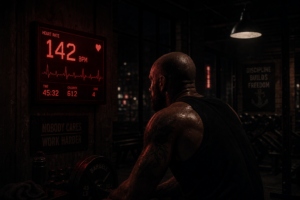
It was a Tuesday evening and I was forty-five minutes into a walk on the treadmill I had no business being on, my lungs filing a formal complaint with HR, and I started doing the thing you do when the body wants to quit. I started thinking about shoes.
Not the walk. Not my stride. Not the fact that I had maybe pushed the pace out of the gate and was now paying the compound interest on that bad decision. I started thinking about whether carbon fiber plates were actually worth the price jump and whether my current shoes were the problem.
They were not the problem.
I was the problem. I just didn’t want to think about that.
Here’s the thing about gear culture that nobody says plainly: it is, in large part, a coping mechanism. Not a pathology. Not something to be ashamed of. A coping mechanism. You’re doing something hard, progress is slow and nonlinear, and the gear conversation is fast, concrete, and produces the pleasant brain chemicals that come from research and acquisition. The gear gives you something to control when the thing you actually want to control, your fitness, your speed, your endurance, refuses to respond to your preferred timeline.
I’ve watched myself do this with running shoes, with GPS watches, with hydration vests that have more pockets than most cargo pants. I have kept mental notes on the bugs in my own behavior the way I keep mental notes on bugs in a script that’s doing something weird at 2 a.m. This one keeps repeating. New gear arrives. I feel good about the purchase. I go on approximately two walks. The gear does not magically transfer its potential into me. I continue to be exactly as fast as I was before, which is to say, not very.
And yet.
The GPS watch actually does something. Not because it has a VO2 max estimate that updates with the confidence of a man who has never been wrong in his life, but because data changes your relationship with the work. I started exercising with heart rate zones because I thought it was what serious “athletes” did. What actually happened was I realized I had been going too hard on easy days for years. The watch didn’t make me better. It made me curious. That curiosity made me change behavior. The changed behavior, over about six months, made me better. The chain of causation runs through the miles. The gear just opened a door I hadn’t tried yet.
That’s a genuinely different thing than the shoe situation.
The shoes are mostly theater. I have a sixth sense for this, honed by years of watching vendors walk into conference rooms with decks full of words that meant nothing and confidence that meant everything. Gear marketing is the enterprise software pitch of the fitness world. “Engineered for maximum energy return.” “Proprietary foam compound.” Okay. Sure. My stats remain what they are regardless of how much the foam cost to engineer.
There’s a legitimate version of the shoe argument, to be clear. Elite runners at the margins of human performance, shaving seconds off world records, those people have a real use case for this junk. When the difference between winning and losing is a fraction of a percent, you optimize the fraction. But I am not those people. I am a middle-aged IT guy doing four miles on a Tuesday because my doctor used the word “concerning” in a tone I didn’t like. The carbon plate is not the constraint.
My aerobic base is the constraint. My consistency is the constraint. The fact that I took three weeks off because work got loud and I told myself I’d get back to it is the constraint.
So why do I still find the shoe conversation genuinely enjoyable?
Because it is enjoyable. That’s actually the whole answer, and I think people get into trouble when they dress it up as something else. The gear conversation is fun because it’s tangible, because there are real opinions to have, because there is history and craft and actual engineering involved, and because the community around it is often full of people who care deeply about something that doesn’t matter very much, which is my favorite kind of person. They’re not pretending the shoes are magic. They just like shoes.
The problem isn’t liking gear. The problem is using gear as a substitute for honest accounting.
If you haven’t exercised in three weeks and you’re researching insoles at midnight, you know what you’re doing. You’re doing the fun version of the hard thing. The hard version is putting the shoes you already own on your feet tomorrow morning at 5:30 and going out in the dark when it’s cold and your motivation is somewhere in the bottom of a coffee cup.
The miles are boring. They accumulate invisibly. You don’t feel faster while you’re getting faster. You feel tired, then recovered, then tired again, and somewhere in there, after enough repetitions and enough time, you run a pace you couldn’t have held six months ago and you briefly understand what the work was actually buying.
The gear doesn’t do that. The gear just shows up in the mail in a nice box.
I’m not saying stop buying the gear. I’m saying know which box you’re in. Are you researching because the research is going to change something you actually do, or are you researching because the research feels like progress and progress feels like exercising without the inconvenience of it?
Both things can be true on the same Tuesday evening. They were for me.
I finished that walk, by the way. Slower than I wanted. Harder than it should have been. Same shoes.
The shoes were fine.