 Monkeywrench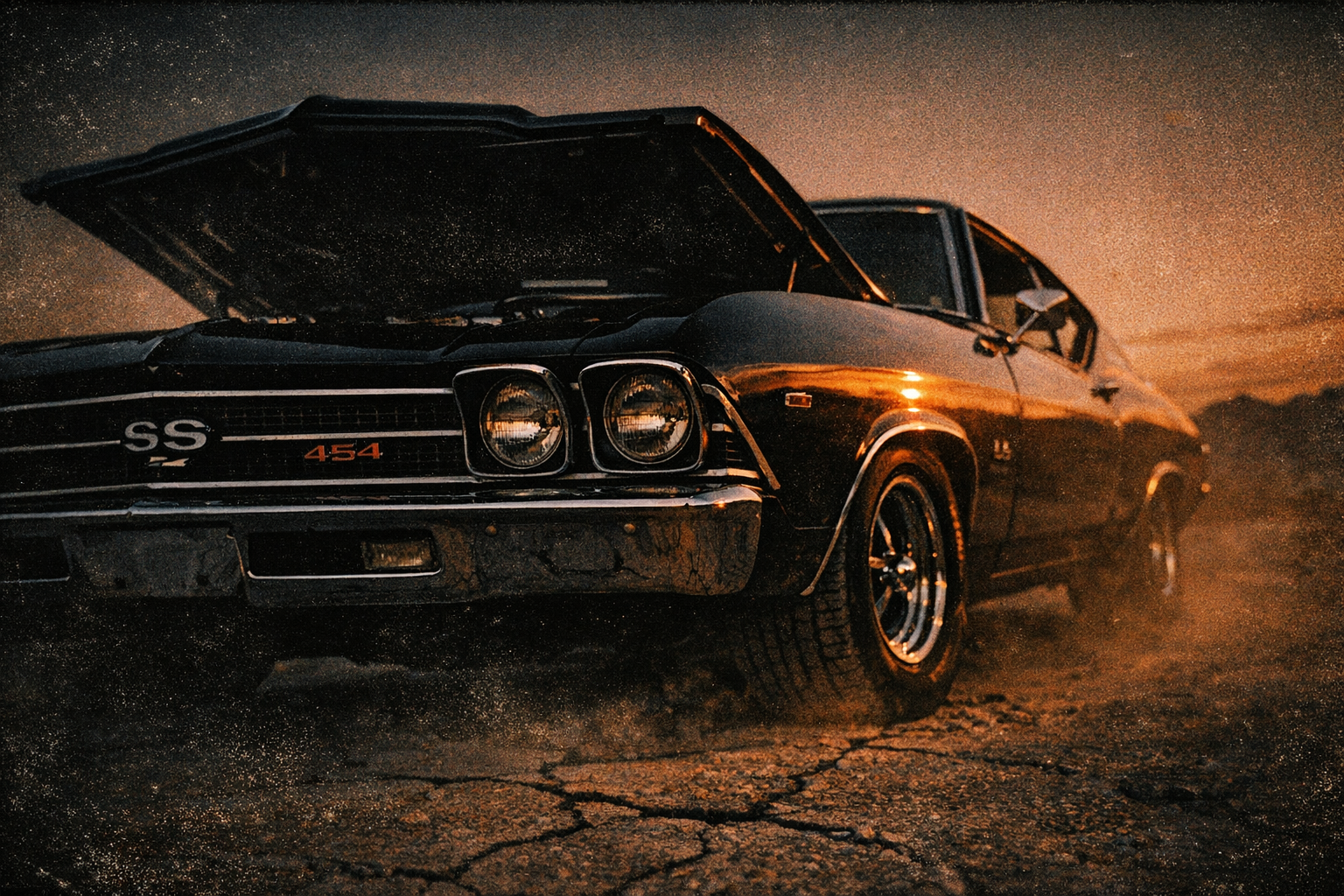
500 horsepower. No traction control. Tires seven inches wide. A car that weighed 3,800 pounds and had exactly zero opinions about whether you were ready for it.
The 1969 Chevelle SS454 is that machine.
Modern muscle cars are faster. Safer. More refined. The Hellcat will eat a Chevelle alive on a track. The new Mustang GT500 has more technology in its suspension alone than the entire 1969 Chevy lineup. I know all of this.
None of it changes what I’m about to say.
Modern muscle has gotten very good at being a product. The Chevelle was built to be an argument.
What “454” Actually Meant in 1969
Let’s be specific. Specificity is where the truth lives.
The LS6 454 cubic inch V8 was rated at 450 horsepower from the factory. That number is widely believed to be sandbagged. GM was under pressure from insurance companies and regulators who were already side-eyeing anything with too many horses. So the official number was conservative. How conservative is a matter of debate. Some estimates put real output closer to 500 horsepower. At the crank. In a car with no traction control, no stability management, and tires that would look laughably narrow on a modern compact car.
That’s not a performance specification. That’s a threat.
To understand what 454 cubic inches meant to someone standing in a dealership in 1969, you need the context. This wasn’t the age of turbocharged four-cylinders making surprise power numbers. No computer-managed fuel curves. No variable valve timing. No torque vectoring. What you got was displacement. Raw, inefficient, glorious displacement. A motor that made torque the way a sledgehammer makes a point, not through cleverness but through sheer mass and commitment.
The 454 produced 500 lb-ft of torque. Peak torque arrived low. You didn’t have to wind it up. You didn’t have to wait. You pressed the pedal and the car made a decision for you.
The Honesty Problem With Modern Muscle
Here’s the quiet part said loud.
Modern muscle cars are technically superior in almost every measurable way. They’re also, in a very specific sense, dishonest.
A Dodge Challenger Hellcat makes 717 horsepower. Impressive number. It’s also a 4,400-pound car with so much electronic intervention between you and the road that what you’re actually driving is a software system with a big engine bolted to it. The computer is managing your throttle input. It’s deciding how much of that power you actually receive. It’s protecting you from yourself at every moment.
The Chevelle had no such opinions.
When you gave a 1969 Chevelle SS454 full throttle on a wet road, it took that as a sincere request and honored it completely. Whatever happened next was a collaboration between you, the tires, and physics. The car was not a partner in your safety. It was a participant in your choices.
That’s not nostalgia talking. That’s a genuine philosophical difference in what a car is supposed to be.
Modern performance cars are designed with a failure mode in mind. The assumption is that the driver will eventually make a mistake, and the car should survive it. The Chevelle was built with no such assumption. The assumption was that you were going to drive the thing, and if you didn’t know what you were doing, that was your problem to solve.
I’m not saying one approach is better for road safety. I’m saying one approach produces a more honest relationship between driver and machine.
Steel, Weight, and the Lie We Tell About Progress
The 1969 Chevelle SS was built from full-body-on-frame construction with steel thick enough that a good body shop could work on it with basic hand tools for the next hundred years. There are shops in the South working on these cars right now. Not waiting on dealer-approved diagnostics equipment or software licenses. Working metal.
Modern unibody construction is objectively more rigid, safer in a crash, and better engineered by any structural metric. I’m not disputing that. What I’m pointing out is that a 1969 Chevelle SS454 that’s been garaged and maintained is still a complete, functional, serviceable machine. Not a museum piece. A driver.
A 2015 Dodge Charger SRT with a seized module or a proprietary sensor that’s no longer manufactured is a sculpture.
There’s a version of progress that makes things better. Then there’s a version that makes things disposable. The automotive industry somewhere around 2000 made a quiet decision to build the second kind of thing and call it the first.
The Chevelle exists outside that bargain. It was built before planned obsolescence was a design principle. The result is a car that can be maintained, modified, restored, and driven by a competent mechanic with a good parts catalog and a willingness to get dirty. No subscription. No diagnostic dongle. No firmware update that accidentally bricks your throttle body.
The Sound Is Not Nostalgia. It’s Physics.
People get sentimental about the sound of old V8s and I understand why that looks like nostalgia from the outside. It isn’t.
The sound of a big block 454 at full throttle is physically distinct from modern engines because it is mechanically different in fundamental ways. Large displacement, low-revving engines produce sound at different frequencies. The exhaust note is lower. The harmonics are different. There’s a visceral, tactile quality to it because the vibration translates through the frame, through the seat, into your spine.
Modern performance cars pipe engine noise through the speakers. Some synthesize it entirely. Someone in a meeting decided how much engine noise you should hear and at what frequency, and then a software engineer implemented it.
A 454 sounds the way it sounds because that’s what 454 cubic inches of combustion actually sounds like. No filter. No adjustment. The engine makes the noise and the car transmits it, and you receive it whether you want to or not.
That’s not better or worse in every context. But it’s real in a way that a curated audio experience is not. And I think people can feel that difference even when they can’t articulate it, which is why a 1969 Chevelle SS at a car show still draws a crowd that a modern Charger Hellcat parked next to it does not.
People are not responding to history. They’re responding to authenticity.
What Detroit Lost When It Got Smart
The late 1960s were the peak of something that couldn’t last and didn’t. Cheap fuel, minimal regulation, a postwar economy with disposable income, and an industry genuinely competing on performance rather than features lists. The Big Three were building cars to win arguments in stoplight drag races, the engineers knew it, and the result was a specific kind of machine that has never been replicated.
It couldn’t be replicated now even if someone wanted to. The regulatory environment won’t allow it. The insurance actuaries won’t allow it. The lawyers definitely won’t allow it. A modern automaker could not ship a car with 500 horsepower, no traction control, drum brakes, and tires that measure 7 inches wide and call it a performance vehicle. The liability calculus doesn’t work. The safety ratings don’t work. The whole structure of how cars get made and sold in the 21st century works against it.
So instead we get a different deal. More horsepower, distributed through systems designed to make it manageable. More speed, wrapped in a cocoon of electronic oversight. More performance, delivered with a layer of abstraction between you and the actual experience.
It’s not a worse deal in every dimension. People don’t die in 2024 Mustangs at the same rate they died in 1969 Chevelles and that matters. I’m not going to pretend otherwise.
But something was lost. A specific kind of directness. A specific kind of trust that the machine extends to the driver, the assumption that you are capable and that the car’s job is to respond, not to manage.
That’s what people are really mourning when they talk about the muscle car era. Not the inefficiency or the danger. The respect.
The Chevelle as a Philosophical Object
I’m going to get a little strange here. I’m fine with that.
A 1969 Chevelle SS454 is an argument made in steel and iron about what a car should be. It says: a car should be powerful enough that you have to pay attention. Simple enough that you can understand it. Honest enough that it tells you the truth about what’s happening.
Modern performance cars are arguments made in aluminum and software about what a car can be optimized to do. They’re impressive arguments. Technically superior arguments. They win on almost every objective metric.
And yet.
The people who know cars, the ones who’ve driven both and worked on both, they don’t talk about the Hellcat the way they talk about the Chevelle. They don’t tell stories about the Hellcat. They don’t name them. The Chevelle has a gravity to it that transcends its specifications.
That gravity comes from the fact that it exists as a complete, unconflicted object. It was built to do one thing and it does that thing without reservation. No safety net. No apology. No “here’s a sport mode that makes it slightly more intense.” It’s already intense. It started there.
The things that last, the things people remember and return to and keep in their garages and talk about with a specific kind of reverence, are rarely the things that tried to be everything to everyone. They’re the things that committed completely to what they were.
The 1969 Chevelle SS454 committed. It committed the way things commit when nobody was second-guessing the engineers in a product review meeting. It committed the way things commit when the goal was to build something real, not something safe.
Modern muscle is faster. Safer. More capable. More refined.
It’s also, in the most important way, a little bit afraid.
The Chevelle wasn’t scared of a single damn thing.
