Frank
Frank
The first time I sat behind the wheel of a full-size American car from the mid-sixties, I was probably ten years old and it belonged to somebody’s uncle. I don’t remember the exact model. What I remember is that the seat felt like a couch, the steering wheel was roughly the diameter of a hula hoop, and the whole car seemed to float over the road like it was annoyed that asphalt even existed. That was not a criticism. That was the whole point.
There’s a category of American automobile that has never quite fit into the collector car world the way muscle cars or hot rods do. Nobody’s putting them on magazine covers. Barrett-Jackson doesn’t get misty-eyed over them. They don’t have massive club followings or dedicated restoration parts suppliers with slick websites. But they exist in this strange and beautiful space between junk and icon, and if I could go back and talk to myself five or six years ago when I was starting to really think about what kind of car I’d eventually want to have sitting in my garage, the first thing I’d say is: stop sleeping on the led sleds.
A led sled, for the uninitiated, is generally any big, heavy, low-slung American car that’s been modified, lowered, or in some cases just left alone long enough to look intentional. The original led sleds were the custom culture cars of the late forties and fifties, the Mercurys and Lincolns and Fords that guys would chop and channel and mold in lead body filler until they looked like something that shouldn’t be able to move but definitely could. The term drifted over time. Now it covers a whole spectrum of big American iron that gets treated more like a style statement than a performance vehicle. And a hooptie is a hooptie, which is to say: a car that has seen some things, costs almost nothing, runs when it wants to, and still has more personality than anything built in the last decade.
What I wish I’d understood earlier is that these cars occupy a completely different lane than muscle cars, and I mean that literally and figuratively. A muscle car is about a number. The quarter mile time, the horsepower rating, the matching numbers documentation. There’s a whole scoreboard and people take it seriously. A led sled or a period-correct hooptie doesn’t care about your scoreboard. A 1974 Cadillac Coupe DeVille doesn’t need to beat anything in a straight line. It IS the destination. You don’t drive a car like that to get somewhere fast; you drive it so that arriving is an event.
The thing that connects my two completely different obsessions, old American iron and modern tech, is actually the same principle: systems thinking. When I’m troubleshooting an Exchange issue, I’m not looking at one thing in isolation. I’m looking at the connective tissue between things, how this dependency affects that one, how the failure path traces back through three components that looked unrelated. Figuring out a barn find led sled is exactly the same mental exercise. You walk around the car and you start tracing. The body needs this. That affects the frame here. The suspension geometry was changed by whoever lowered it in 1987 and that created a problem in the steering that the previous owner tried to compensate for by doing something strange to the tie rods. It’s all connected. And working through it is genuinely satisfying in the same way.
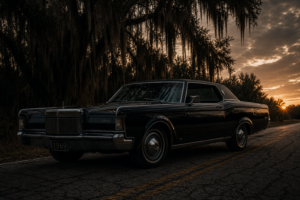
The mistake I see people make, and the mistake I would have made if I hadn’t slowed down and paid attention, is treating these cars like they need to be fixed into something they aren’t. Somebody finds a 1970 Lincoln Continental, a car that weighs almost two and a half tons and rides like a cloud made of velvet, and they immediately start talking about swapping in a modern engine and doing a full suspension upgrade to make it handle. And I understand the impulse. But you just ruined the entire point of the car. That Lincoln doesn’t handle like a sports car because it was never supposed to. It was supposed to be the most comfortable and luxurious thing a middle-class American could own. That was the mission. Respect the mission.
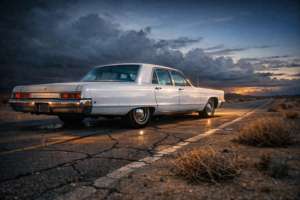
The other thing I’d tell myself is to stop waiting for the perfect example. Five years ago I had a chance to pick up a mid-seventies Chrysler New Yorker that was rough but solid underneath. The body was tired, the interior was wrecked, but the bones were good. I passed on it because I was thinking about all the work. That car is gone now and I still think about it occasionally. The reality is that there is no perfect example in this end of the car world. Everything has been driven, parked in a field, partially restored by someone who ran out of money, modified by someone with questionable taste, or some combination of all of those. You find the one that speaks to you and you deal with what it comes with.
The market for these cars is also doing something interesting right now. Anything that was obviously desirable has been priced up. Real muscle cars are deep into collector territory. Even second-tier stuff is expensive. But genuine led sled territory, the big personal luxury coupes, the full-size sedans from the era when Detroit was building rolling drawing rooms with opera windows and vinyl roofs and pillow-tuck interiors, those are still accessible. Not cheap exactly, but accessible. The window won’t stay open forever. It never does.
The cars nobody wanted have a way of becoming the cars everybody wishes they’d bought when they had the chance. I’ve watched it happen with enough things to recognize the pattern. The hooptie sitting behind somebody’s barn right now, the one with the flat tire and the cracked dash that looks like a lost cause, might be exactly what I’m describing. And it’ll cost you less than a decent set of tires for a new truck.
That says something about priorities, and I think it says it pretty clearly.