Frank
Frank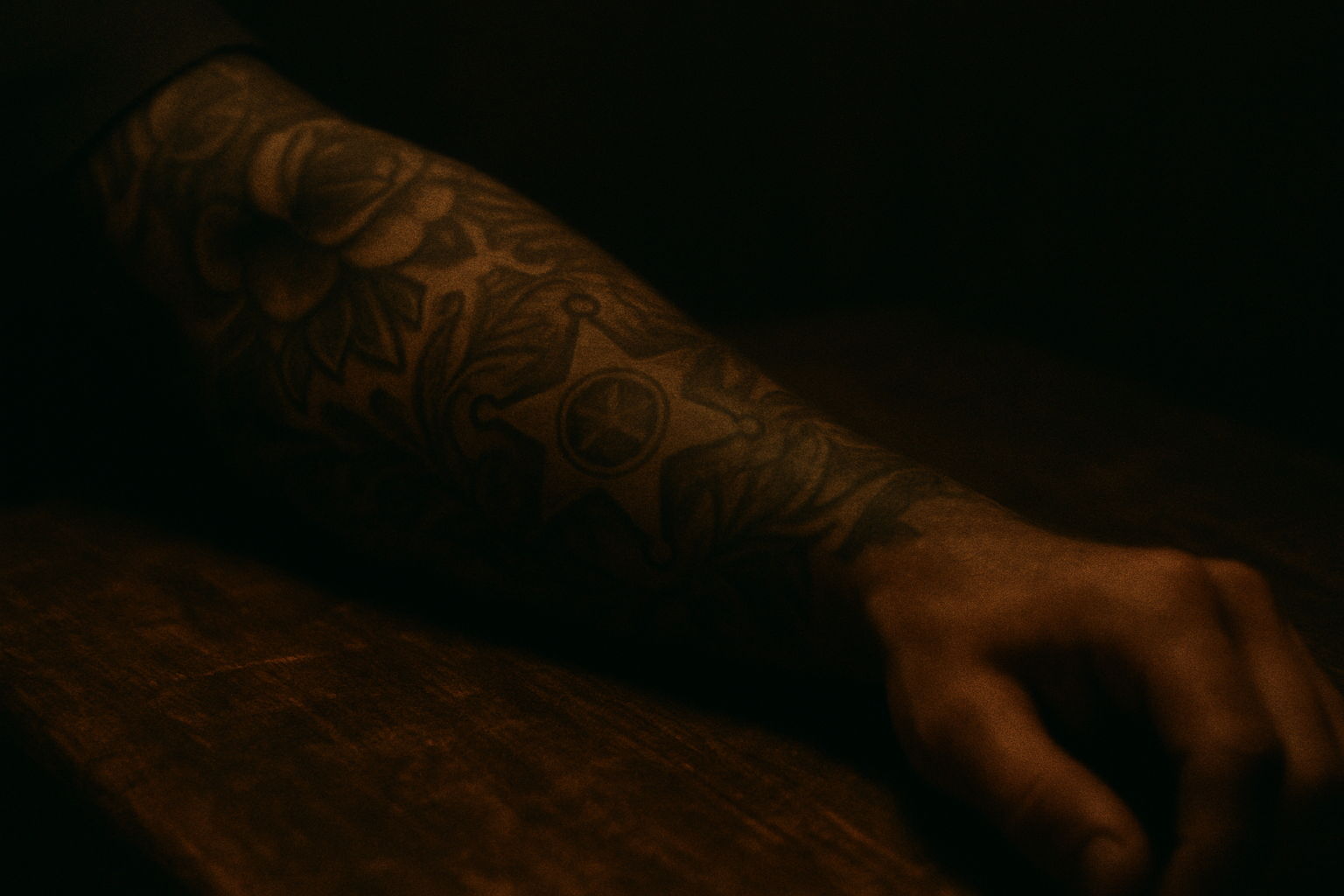
The needle hits and you realize pretty fast that the thing you imagined in your head for three decades doesn’t translate directly to skin.
That’s not a complaint. That’s just the truth of it.
I got my first tattoo at fifty-two. Most people start that journey in their twenties. I started it after my kids were grown, after I’d buried a dog, after I’d watched my brother’s killer get executed in a Georgia prison, after I’d spent nearly thirty years carrying something I didn’t have a name for.
You Don’t Plan the First One. You Just Finally Do It.
David Watson at The Tattoo Shop in Forsyth did my first piece, and he’s done all seven since. Good man. Steady hand. He doesn’t ask too many questions, which is exactly what you want when you’re sitting in that chair processing things you can’t fully articulate out loud anyway.
William was twenty-six, a Baldwin County Sheriff’s Deputy, and my older brother. We were roommates for years, from our childhood bedroom on Lakeside Drive to the home we shared as adults – a bond that never faded, even as life moved forward. We were thick like that; while some brothers drift apart, we never did. We were thick like that. Some brothers drift. We didn’t.
December 17th, 1995. I’ve written about that day already and I won’t go back over the bones of it here. What I haven’t written about is the specific kind of helplessness that comes with having no physical place to put grief. No ritual. No object. Just absence, everywhere, every day.
What Ink Can and Cannot Do
Here’s what I didn’t understand until I was in the chair the first time: a tattoo doesn’t contain a feeling. It marks the fact that the feeling exists.
That’s a real difference.
I thought, on some level, that putting something permanent on my skin would create a kind of closure. Like the thing would finally have a container. Twenty-five years of carrying William’s memory, and maybe now I’d have somewhere to set it down for a minute.
That’s not how it works. What actually happens is closer to acknowledgment. You’re not releasing anything. You’re just saying, out loud in a way that can’t be undone, this happened, this mattered, this person was real and so is what I lost.
That’s not nothing. That’s actually quite a bit. It just isn’t the thing you thought you were getting.
Seven Tattoos and None of Them Are Finished
I have seven now. Started at fifty-two, still adding. Every one of them is connected to something I needed to stop pretending wasn’t part of me.
Some people look at a guy my age with ink and assume midlife crisis. Fine. Let them. What they’re actually looking at is someone who spent half a century not having the vocabulary, and finally decided that if words weren’t going to get it done, maybe something else could try.
You can’t really sum up William or what our family went through with just one tattoo. It’s impossible to capture nineteen years of legal battles, the trials, the constant appeals, and the endless Supreme Court hearings. On that final, empty moment in a room in Jackson, Georgia, even after it was all over and we were riding home, there wasn’t any real sense of closure, just the heavy reality that nothing had actually changed.
The Permanence Is the Point
People ask if I regret any of them. I don’t. And that surprises me, because I second and triple guess almost everything.
I think the reason is this: regret requires believing you could have made a different choice. But I didn’t get these tattoos on impulse. I waited until I was fifty-two. I thought about them for years before I ever made an appointment. By the time David put needle to skin, I’d already decided that these things were true and weren’t going away.
The tattoo doesn’t say everything. It never could. But it says: this was real, and so was the person, and so am I.
That’s as close as I’ve ever gotten to enough.