Frank
Frank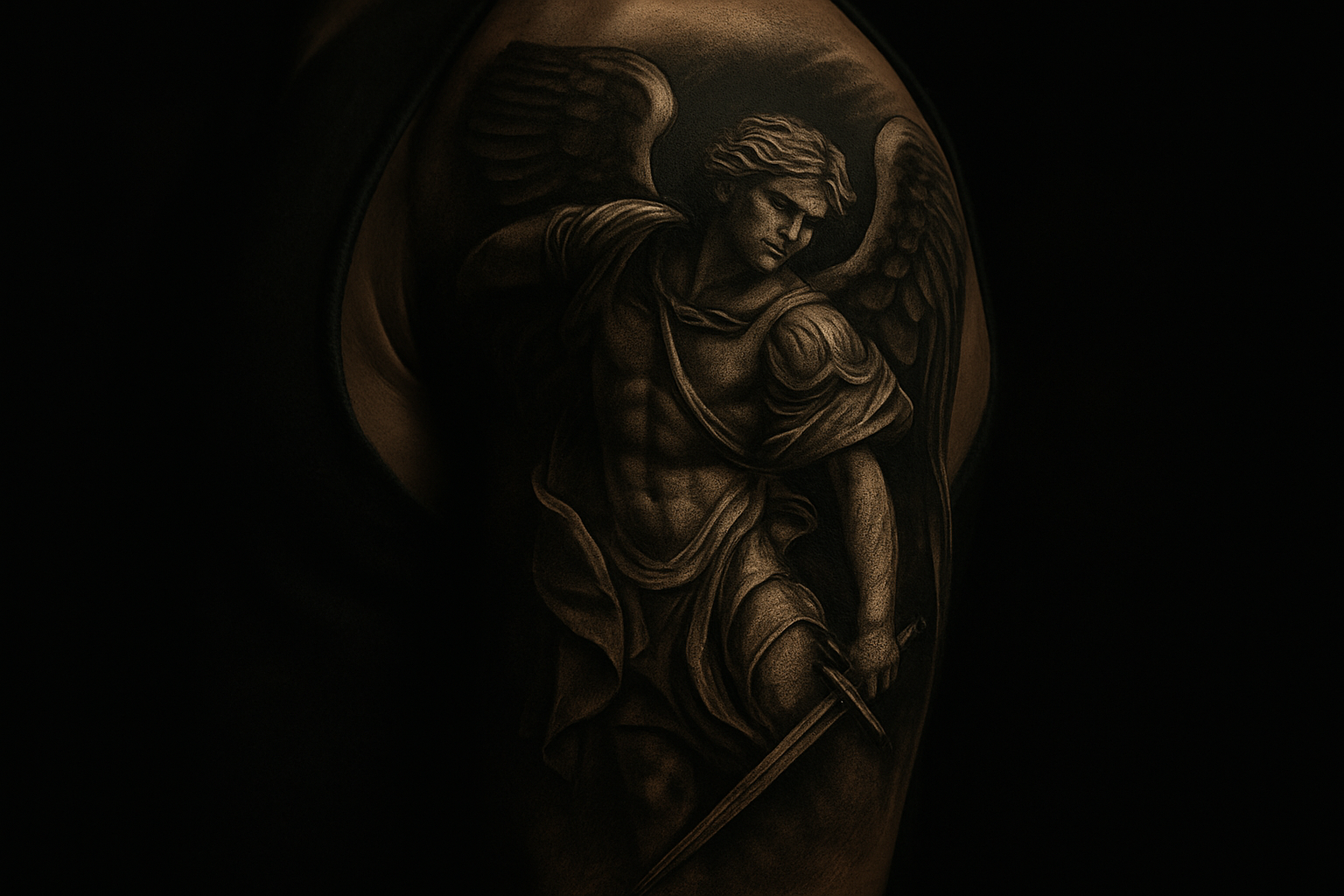
The first session put St. Michael on my right shoulder. Battle armor, sword, shield, the whole thing. David Watson did his usual work, which means it was already better than it had any right to be. I walked out of The Tattoo Shop in Forsyth that day feeling like it was done, and it was, technically. A complete piece. Finished by any reasonable definition.
Except it wasn’t.
I knew it the first time I really looked at it in good light. Not that anything was wrong, nothing was wrong. But it was like a song that ends before the bridge. The structure is there, the melody is there, and something is still missing that you can’t quite name until you hear the finished version.
The second session added the wings. Clouds. And a pile of skulls he’s standing on, walking through like they’re gravel on a dirt road. That’s when the thing became what it was always supposed to be. Not better in the way an upgrade is better. Finished in the way that something finally closes.
Here’s what that taught me, and I don’t mean it as a cute metaphor: the first pass is never the whole story, and you don’t always know what’s missing until you sit with the thing for a while.
I’ve seen this exact pattern repeat itself in everything I’ve ever built or learned. The first version of anything I code with Claude is functional. It does the job. I can ship it. And if I go back in two weeks, I can almost always see three things that should’ve been different, things I couldn’t see when I was still in the middle of building it. Not because I was lazy the first time. Because I didn’t have the perspective yet.
There’s no shortcut to that perspective. You have to let the first version exist for a while. You have to live with it, look at it in different light, and let the gaps show themselves on their own schedule. The skulls at St. Michael’s feet weren’t something I planned in session one. They came from staring at what was already there and finally understanding what the piece was actually saying.
My brain doesn’t naturally sit with things. ADHD means if something isn’t done, it’s haunting me, and if it is done, I’m already thinking about the next thing. The second session on that tattoo required me to do something genuinely uncomfortable, which was decide the first version was good enough to live with for a while before I tried to finish it. That’s harder than it sounds when your baseline setting is “if this isn’t perfect why does it even exist.”
But the piece on my arm is better for it. Not because David is better than he was the first session, he’s been great the whole time. Because I knew more about what I actually wanted after I’d had time to figure it out.
Most things worth doing have a second session. The first one proves it’s real. The second one makes it matter.