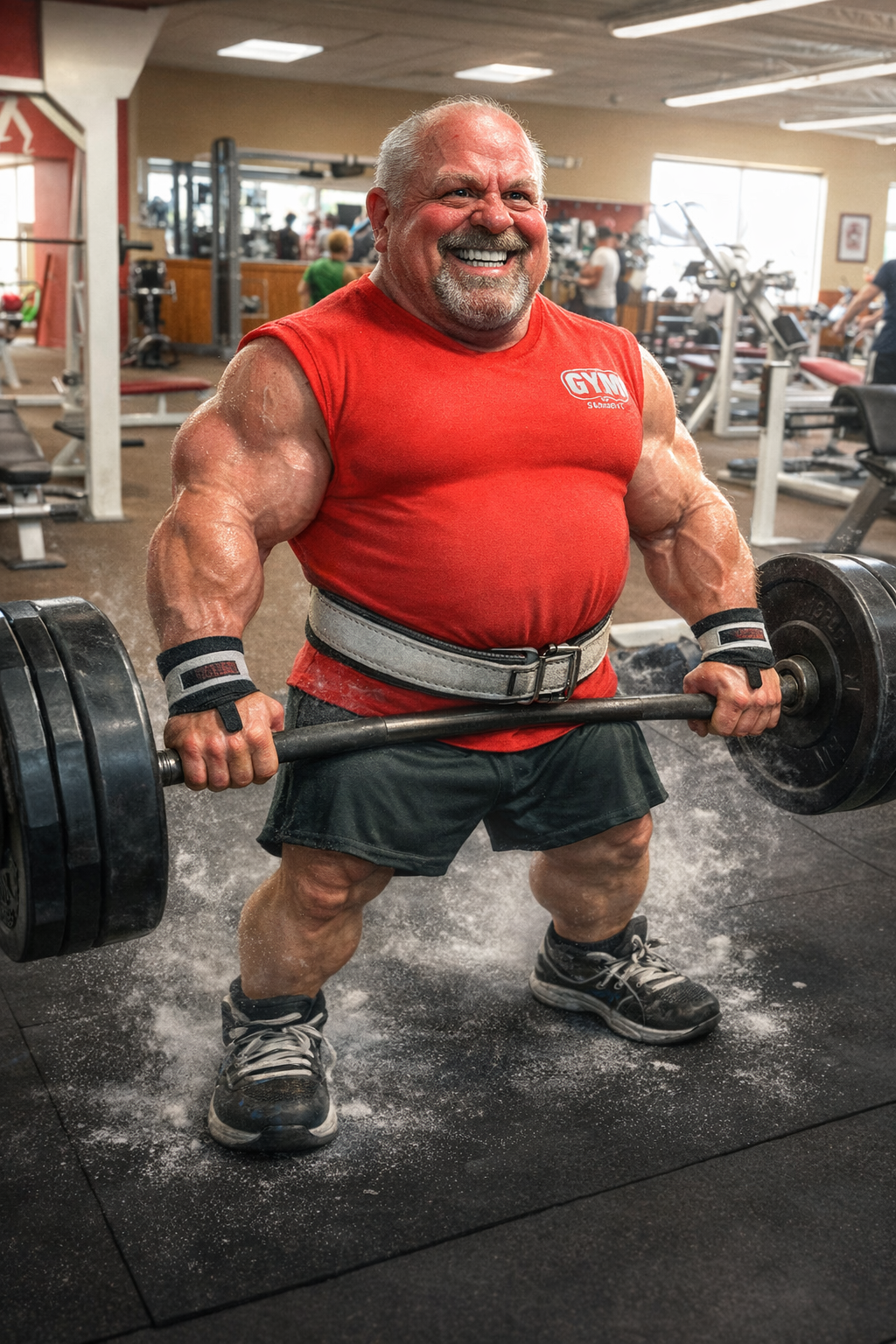
Frank
Frank
There’s a particular kind of humility that only comes from loading a bar with weight you used to move easily and discovering that your body has filed that capability under “historical record.”
That’s where I am right now. Fifty-five years old, working my way back after a longer-than-intended break from the gym, and being reminded daily that the barbell is the most honest piece of equipment ever invented. It doesn’t track your old PRs. It doesn’t give you credit for the years you put in. It just sits there, loaded to whatever you loaded it to, and it either moves or it doesn’t.
No partial credit. No “but I used to be really good at this.” Just physics.
Two Versions of Fitness, and What Each One Teaches You
Here’s the comparison that’s been living in my head since I started this comeback: there are basically two philosophies of training, and which one you subscribe to determines how you handle getting back under the bar after time off.
The first is what I’d call performance-based training. Powerlifting sits squarely in this camp. You pick three lifts, you learn them cold, and you chase measurable numbers. Squat, bench, deadlift. Your progress is a spreadsheet, not a feeling. On any given day, the weight either went up or it didn’t, and you know exactly which it was.
The second is what I’d call activity-based fitness. Cardio classes, fitness apps with streaks, group workouts where the goal is general movement and you feel good about showing up. Nothing wrong with it. But the feedback loop is different. You can show up, sweat, and leave feeling accomplished without any objective measure of whether you actually got stronger.
I’ve done both. And coming back at 55, I can tell you the difference matters more than it ever did when I was younger.
Activity-based training is forgiving. You can ease back in, dial the intensity down, feel the momentum of just being in the gym again. That’s not nothing. The consistency habit is real and it matters.
Performance-based training, specifically powerlifting, is the opposite of forgiving. The weights are absolute. You can’t talk a barbell into moving. There’s no narrative you can spin about how you’re “listening to your body” when you’re pinned under a squat you couldn’t finish. The bar tells you exactly where you are, right now, today, regardless of where you were two years ago.
That brutality is also the thing I missed most about it.
What “Honest” Actually Means Under Load
People use the word honest a lot in ways that mean “uncomfortable but ultimately fine.” That’s not quite what I mean here.
The barbell is honest the way your bloodwork is honest. It’s not trying to hurt your feelings; it simply has no mechanism for managing them. When I was in my late thirties and forties and training consistently, I moved serious weight. I knew my numbers. I had a feel for the whole thing that took years to build.
That feel is partially gone. Not all of it, but enough that I had to make a decision when I came back: do I reload based on memory, or do I reload based on reality?
I tried memory first. That was a short experiment.
The thing about strength is that it’s not stored anywhere you can access on demand after a significant layoff. Some of it comes back fast, especially the neural side of things, your body remembering how to recruit muscle efficiently. But the actual tissue capacity, the tendon tolerance, the work capacity built from months of progressive overload, that part doesn’t wait for you. It goes when you go.
So I’m rebuilding. Lighter than my ego wants. Slower than my history suggests I could go. And the barbell is tracking every bit of it with zero editorializing.
There’s something clarifying about that at 55 that I don’t think I would have appreciated at 35.
The Age Part Nobody Wants to Say Out Loud
I’m not going to pretend the age piece is irrelevant, because it isn’t. Recovery is different now. I can feel the difference between a training session that pushed me productively and one that pushed me into a hole I’ll be climbing out of for three days. That line is narrower than it used to be.
But here’s the thing about being a Gen-X guy who grew up watching his dad’s generation treat their bodies like disposable equipment for most of their fifties: I have a data point they didn’t. I know what consistent training does to longevity markers, to bone density, to basic functional capacity as you age. The research is not ambiguous.
The question at 55 isn’t whether to train. It’s how to train intelligently, which is a different problem than training hard. Those two things overlap less than most people think.
I’m not chasing my old numbers right now. That’s not a philosophy, it’s just tactics. The goal right now is to rebuild the foundation without wrecking the joints that have to last another thirty-plus years. Lower intensity, higher frequency, more attention to form than I probably gave it when I was young enough to muscle through bad mechanics.
And the barbell is still keeping score. Every rep, every session, every week the numbers go up a little. The progress is slower than it was at 38. It’s also more deliberate than it was at 38, which means I understand what I’m building better now than I did when I was just loading plates and grinding.
What Gets You Back Under the Bar
I’ve been thinking about what actually made me restart, because it wasn’t some moment of inspiration. It wasn’t a milestone birthday or a health scare or a bet with somebody. It was more that I kept noticing the absence of something. A certain kind of tiredness that only comes from actual physical work. The structural feeling of having done something that required genuine effort and paid off in a measurable way.
I spend a lot of my day in front of screens, at work and at home. Systems engineering, homelab projects, HookHouse-Pro, Suno sessions. All of it is real work but none of it leaves you physically tired. There’s no version of writing PowerShell that makes you need to sit down afterward.
The gym fills that gap in a way nothing else does. Not cardio, not yard work, not anything recreational. It’s specific to the weight room, and specifically to the barbell.
That’s not mysticism. It’s just a 55-year-old man noticing what his baseline feels like with and without it.
The bar doesn’t care about any of that backstory. It doesn’t know I’m coming back, doesn’t know what I used to lift, doesn’t register that I’ve been thinking about returning for months.
It just sits there on the rack, loaded and waiting, telling the truth.
That’s enough to get me back in the gym every time.