Frank
Frank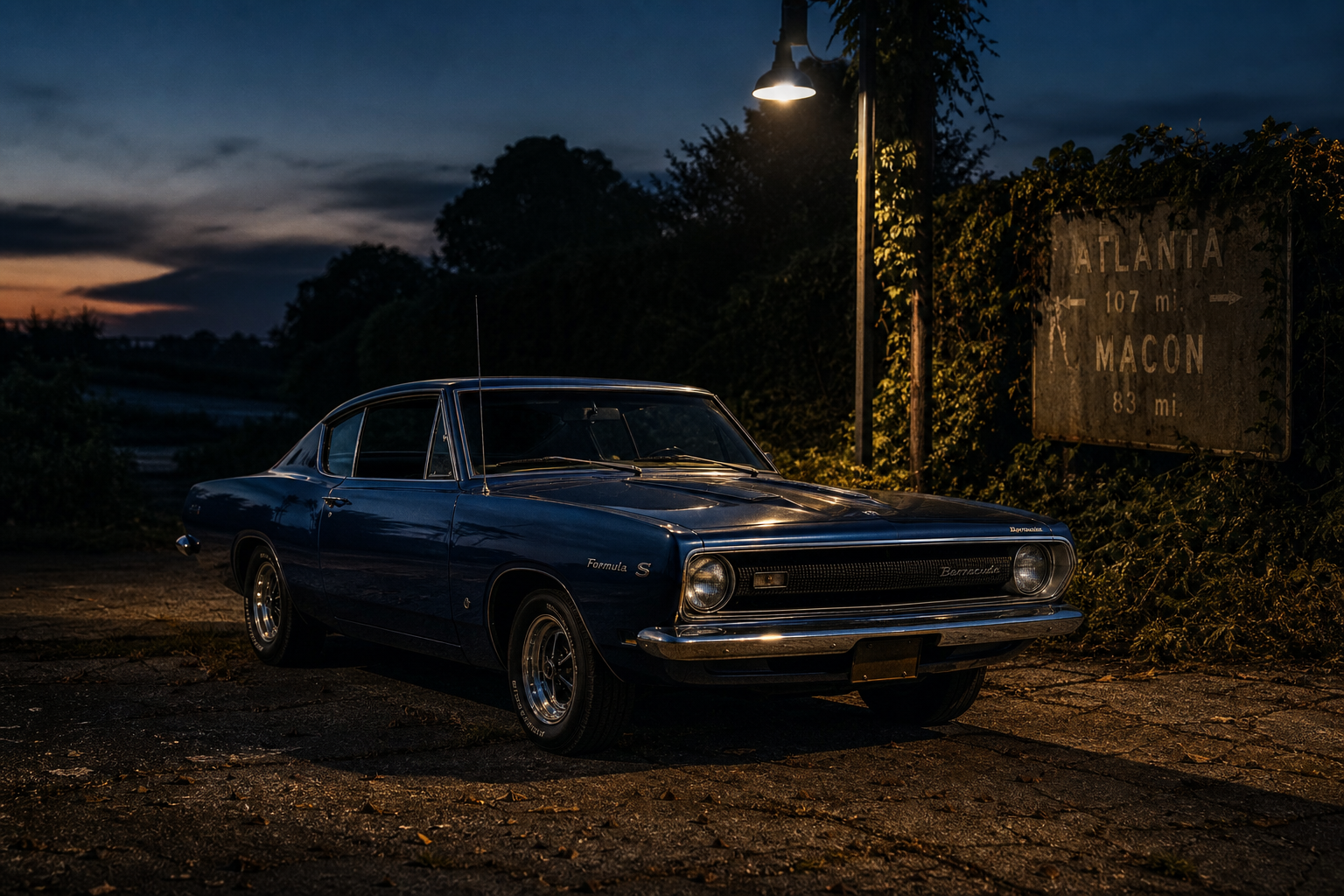
There’s a version of muscle car history that gets told so many times people just accept it as the whole story. The Mustang. The Camaro. The GTO. Maybe a first-gen Charger if y’all are feeling generous. That version isn’t wrong exactly, it’s just incomplete in ways that cost certain cars their rightful place in the conversation.
The 1967 Plymouth Barracuda Formula S 383 is one of those cars.
It was genuinely rare, genuinely fast, and built on an engineering gamble that by any reasonable measure should not have worked as well as it did. History buried it anyway. The reasons are worth understanding, because they say something true about how reputations get built and lost that goes way beyond horsepower numbers.
Plymouth’s Rarest Muscle Car Was Too Powerful For Its Own Body
The core tension with the ’67 Formula S 383 starts with the platform. The Barracuda at this point in its life was an A-body car. A compact. The same basic architecture underpinned the Plymouth Valiant, which was about as far from a muscle car as you could get while still having four wheels and a V8 option. The A-body platform was engineered around small-block power, specifically Chrysler’s excellent 273 and eventually the legendary 340. It was not designed to carry a 383 cubic inch B-block.
Plymouth’s engineers jammed one in there anyway.
That decision is either insane or impressive depending on how you look at it. I’d argue it’s both. The engineering compromises required were not minor, and we’ll get into those in a minute. But before we talk about how they pulled it off, let’s establish what the production reality looks like from a collector standpoint.
Depending on body style and how you read the production records, somewhere between 2,800 and 4,200 Formula S 383 units were built for 1967. That number is not a typo. For context, that’s a fraction of what a Z/28 Camaro commands in collector circles, and the Z/28 was not exactly mass-produced either. There are people who spend entire careers chasing muscle cars who have never stood next to a real ’67 Formula S 383, because there simply aren’t many left. The ones that survived were often driven until they couldn’t be driven anymore.
This is one of the rarest factory muscle cars of the entire era. It barely registers in mainstream muscle car conversation. That disconnect is the whole point of this post.
The Engineering Gamble That Made The Formula S 383 Possible
Getting the 383 B-block into the Barracuda’s engine bay was not a bolt-in affair. Chrysler’s engineers had to solve real problems. Some of the solutions they landed on were legitimately clever. Some were just necessary compromises you accept when the decision has already been made above your pay grade.
The most commonly cited fix is the battery relocation. In a standard configuration, there was simply no good way to fit the 383 and keep the battery where it belonged. It got moved to the trunk. That sounds like a footnote, but it says something meaningful about how tight the packaging was. The engine also sat differently in the bay than it would have on a B-body or C-body platform where the 383 was at home, and header and exhaust routing required specific solutions that weren’t shared with other applications.
The front suspension geometry took a real hit from the weight of that big-block sitting over the nose. A 273 or a 340 small-block in the same car was a manageable load. The 383 was substantially heavier, and the front end knew it. Chrysler addressed this with what they called the Formula S suspension package: heavy-duty torsion bars up front, a front sway bar, and firmer rear springs. The result was a car that, by 1967 standards, actually handled with some composure. It was not a one-trick straight-line machine. Period road tests noted the suspension tuning gave it respectable cornering behavior for a car of its era and power level.
Here’s the thing, this was not a car where they just threw an engine at it and called it done. There was actual engineering attention paid to making the complete package work. It wasn’t perfect, and anyone who tells you the front-heavy A-body with a 383 was balanced would be lying to your face. But it was better than it had any right to be.
What The Formula S Package Actually Gave You
The Formula S wasn’t just an engine option with a badge. It was a complete performance package, a distinction that often gets lost when people are scanning spec sheets looking for the horsepower number.
Here’s what you actually got when you ordered a ’67 Barracuda Formula S 383:
- The 383 B-block with a Carter AFB 4-barrel carburetor, rated at 280 horsepower
- The suspension package described above, not optional, included with the package
- Wide-oval tires that were genuinely wider than what the base car ran
- Specific badging and instrumentation
- Your choice of TorqueFlite 3-speed automatic or a 4-speed manual transmission
That 280 horsepower number deserves a footnote. Chrysler, like most manufacturers of the era, had a well-documented habit of underrating their engines for insurance and homologation reasons. The 383 in the Barracuda was the same basic engine that appeared in other Mopar applications where it made more power on paper, configured with a different intake and slightly different tune. Whether the actual output was closer to 300 or 310 is a debate enthusiasts have been having for decades. What is not up for debate is the quarter-mile times.
Period testing put the ’67 Formula S 383 in the mid-to-high 14-second range in the quarter mile. That placed it in direct competition with the Camaro SS 396 and the Mustang GT fastback of the same year. Not in the neighborhood, not politely participating in the conversation, actually competitive. This car was fast by any honest standard of 1967.
The 4-speed manual car was the one to have. The TorqueFlite was an outstanding transmission and nobody should apologize for it. But if you wanted to feel what the Formula S 383 was actually capable of, you put a stick in it and learned the torsion bar front end real quick on a launch.
Why The ’67 Formula S 383 Lost The History Wars To The Camaro And Mustang
Performance numbers didn’t save it. And the reasons are worth being honest about.
Ford had been building the Mustang’s cultural identity since April 1964. By 1967, three model years deep, the Mustang was not just a car, it was a phenomenon. It had been in movies. It had been on magazine covers. It had been in the driveways of people who didn’t even think of themselves as car people but bought one anyway because the thing was everywhere and it looked like freedom. Ford spent money on that image continuously and aggressively, and it worked.
Chevrolet came to the pony car fight in 1967 with the first-generation Camaro and immediately threw serious marketing weight behind it. GM had the dealer network, the advertising budget, and the cultural credibility that came with the Corvette sitting somewhere in the same family tree. The Camaro SS got the magazine covers, the track tests, the celebrity association.
Plymouth was fighting both of those machines simultaneously with a car that was genuinely competitive on the performance side and completely outgunned on the marketing side.
The deeper problem was the Valiant connection. The Barracuda shared its body with the Valiant, and that economy-car DNA followed it in the press like a bad reputation follows a man out of a small town. Journalists writing for mainstream car magazines in 1967 knew exactly what the Valiant was. They knew what it stood for: sensible transportation, modest expectations, practical ownership. Separating that image from the Formula S 383 in a reader’s mind required more editorial work than most publications were willing to do.
So what got printed was often something like: a surprisingly fast car that you wouldn’t expect from its economy-car roots. Which sounds like a compliment until you realize it’s also putting a ceiling on the car’s reputation before it even gets a chance to earn one. “Surprisingly fast” is not how you describe a car that’s going to be remembered as a legend. That’s how you damn something with faint praise.
The Shadow of 1970: How The E-Body Erased The A-Body From Memory
Then 1970 happened. And any chance the A-body Barracuda had of claiming its piece of history was gone.
The 1970 Plymouth Barracuda and ‘Cuda were purpose-built E-body cars, new platform from the ground up, designed specifically to handle the big-block power that the A-body had been managing through compromise and clever engineering. The design was stunning in a way that stopped people cold. The ‘Cuda with a 440 or a Hemi was a different animal entirely, proportioned right for what it was carrying, visually aggressive in a way the A-body cars simply weren’t.
The E-body ‘Cuda became one of the most iconic American muscle cars ever built. It got the posters. It got the die-cast models. It gets the Barrett-Jackson spotlights. It earns all of that, I’m not disputing it. The ’70 and ’71 ‘Cuda are genuinely great cars and they deserve every bit of the attention they get.
But here’s what that legacy did to the ’67 Formula S 383: it made it look like a rough draft.
When people think about a Barracuda with a 383 or bigger, they think about the E-body. The A-body cars get filed away as the awkward predecessor, the thing Plymouth had to build before they figured out how to do it right. That framing is understandable. It’s also not entirely fair.
Because what Plymouth was doing in 1967 was actually more audacious in its own way. They were making big-block power work in a car that was never supposed to carry it, three years before they built the platform to do it properly. That’s not a rough draft. That’s engineers solving a problem they weren’t supposed to have to solve, and solving it well enough that the car could run with the Camaro and the Mustang in period testing.
The ’70 ‘Cuda gets the poster on your wall. The ’67 Formula S 383 is the car that proved Plymouth was serious before anyone was ready to believe it.
Finding One Today, And What It Actually Means To Own One
If you’re looking for a documented, numbers-matching ’67 Formula S 383, you’re looking for a car that is genuinely scarce. These were performance cars that got driven like performance cars. The attrition rate over nearly sixty years has been significant. Many were wrecked, many were parted out, many had their engines swapped somewhere along the way when a 318 was cheap and the 383 was worth pulling.
The current collector market for a legitimate, documented example is not cheap. But it’s also not priced at the stratospheric premiums a real first-gen Z/28 or an authenticated Shelby commands at auction. There is still value to be found here for a buyer who knows what they’re actually looking at and can tell a numbers-matching car from a tribute build. That buyer exists. And if that buyer is y’all, the window to find something real at a price that doesn’t require a second mortgage is not going to stay open indefinitely.
What you need to understand about owning one is the social contract that comes with it.
If you pull up to a cruise night in a ’67 Formula S 383, maybe one in fifty people will know what they’re looking at without being told. The other forty-nine will see an old Barracuda and move on. You will not get the crowd gathering around the hood. You will not get the instant recognition that a ’69 Camaro or a ’67 Fastback Mustang gets just by existing in the same parking lot.
For some people that’s a deal breaker. They want the car that draws the crowd. There’s nothing wrong with that.
For a certain kind of person, though, that obscurity is exactly the point. Owning a ’67 Formula S 383 means you know something most of the room doesn’t know. It means you bought the history, not the reputation. Those are different purchases.
Plymouth built something real in 1967. They built it under constraints, with compromises, against competition that had better marketing and bigger cultural momentum. And they built something that was legitimately fast, legitimately rare, and got legitimately forgotten.
That’s not a sad story. That’s just an honest one.