Frank
Frank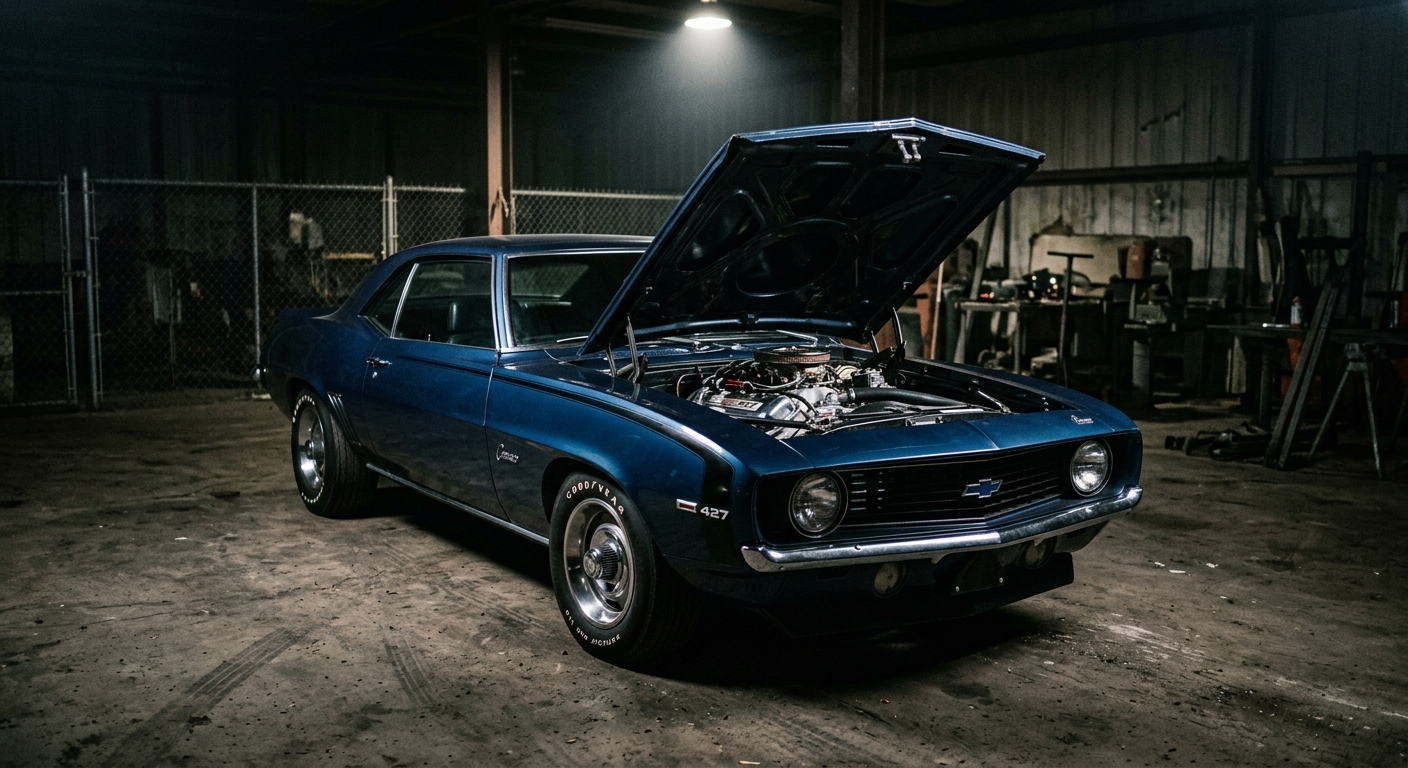
There are rare moments in automotive history when someone figures out how to break the rules so completely that the rule-makers have no idea what hit them. The 1969 Chevrolet Camaro ZL1 is exactly that kind of moment. It didn’t happen through official channels. It didn’t come from a product meeting or a marketing campaign. It came from a loophole, a determined drag racer, a sympathetic Chevrolet engineer, and about 69 cars built quietly enough that the corporate suits barely noticed until it was too late.
This is the story of the most outrageous factory Camaro ever made. And I use the word “factory” loosely, because the COPO 9560 ZL1 exists in a gray zone between backroom deal and production vehicle that makes it one of the most fascinating machines to come out of the entire muscle car era.
The Corporate Order That Made It Necessary
To understand why the ZL1 Camaro exists, you need to understand the bureaucratic wall Chevrolet had built around itself. By 1969, General Motors had a firm internal policy: no car under 400 cubic inches displacement in a vehicle weighing less than 3,500 pounds. The Camaro, as a pony car, was locked out of the big-block game at the corporate level.
The SS package offered the 396 cubic inch big-block, which was already a serious engine. But serious wasn’t the same as unlimited. The 396 was capped, managed, and engineered to fit within the acceptable risk profile of a street car that teenagers might actually buy. It was quick. It wasn’t terrifying.
What drag racers wanted, specifically a Chicago-area Chevrolet dealer named Fred Gibb, was something in an entirely different category. Gibb had been watching Chrysler’s Hemi tear through NHRA Super Stock competition, and he understood that if you wanted to beat the Mopar crowd at their own game, you needed an engine that matched their commitment to absurdity. The 396, no matter how well tuned, wasn’t going to get that done.
The COPO system, which stood for Central Office Production Order, was designed to allow fleet and special-purpose buyers to configure vehicles outside the standard option structure. Police departments used it. Taxi companies used it. It was never intended to be a performance loophole. But Vince Piggins, a Chevrolet product promotion engineer who deeply understood what racers needed and how the company’s bureaucracy worked, saw a path. The COPO system didn’t require product committee approval. It was an ordering mechanism, not a policy decision. If someone ordered it and someone at Chevrolet approved it, the car got built.
Piggins worked with Gibb to structure COPO 9560 as an order for fleet vehicles. The engine they specified was the ZL1, an all-aluminum 427 cubic inch big-block that had been developed for the Corvette and for Can-Am racing applications. It displaced more than the 400 cubic inch limit. It went into a car well under the 3,500 pound threshold. And it did so through paperwork rather than a product approval meeting.
What the ZL1 Engine Actually Was
Most people have never been close to a ZL1 engine. Even among muscle car enthusiasts who can rattle off horsepower figures like baseball statistics, the ZL1 represents something different, something that was never really meant to be a production engine in the conventional sense.
The block was aluminum. Not aluminum heads on an iron block, like the L88 Corvette engine I’ll be covering in Part 13. The entire engine, block and heads both, was cast aluminum. This was exotic, expensive engineering in 1969. Aluminum engine construction was the domain of race cars and aircraft, not production vehicles that dealers were supposed to sell to the public.
The official horsepower rating was 430. If you believe that, I have some oceanfront property in Nevada you might be interested in. Every credible source, every dyno result from the era, every engineer who has spoken on record about the ZL1 suggests the actual output was somewhere between 500 and 560 horsepower. The 430 figure was a deliberate understatement, the kind of corporate fiction that GM used throughout this period to avoid drawing attention from insurance companies and safety regulators. They rated the LS6 454 at 450 horsepower too, which we talked about in Part 5, and that number was equally optimistic in its conservatism.
The ZL1 breathed through a single four-barrel Holley carburetor sitting on an aluminum intake manifold. The heads featured large rectangular ports and 2.19-inch intake valves. The solid lifter camshaft had enough duration and lift to make the engine essentially undriveable at low RPM, lumpy and ornery and completely disinterested in civilized traffic behavior. This was not a commuter engine. This was an engine that existed to make a race car fast in a straight line.
What the aluminum construction gave you, beyond the power, was weight savings. The ZL1 engine weighed approximately 100 pounds less than the comparable iron-block big-block engines. In a car that already carried weight at the front end, this mattered. A Camaro ZL1 with the front weight distribution more closely balanced actually handled better than you might expect from a car this powerful. Not well, exactly. But better.
69 Cars and What They Cost
Fred Gibb initially ordered 50 cars. When Chevrolet came back to him with a price, he had a problem. The ZL1 engine alone cost approximately $4,160 as an option. Add that to the base price of a Camaro, and you were looking at a sticker price somewhere around $7,200 to $7,400. In 1969, the median American household income was roughly $8,500 a year. These were cars that cost nearly as much as most families made in a year.
Gibb managed to sell a handful of his allocation but couldn’t move them all. Chevrolet eventually produced 69 total ZL1 Camaros across multiple dealers. Some went to legitimate racing operations. Some went to private buyers with money to spend and a serious commitment to drag racing. Some sat on lots for years because the price was simply too high for the market.
The number 69 is, in the context of muscle cars, almost impossibly small. Compare it to the production numbers we’ve been discussing throughout this series. The Hemi ‘Cuda from Part 3 was rare, but hundreds were made. The GTO Judge from Part 6 sold in the thousands. Even the W-30 442 from Part 7 had a meaningful production run. Sixty-nine cars made for the public buying market pushes the ZL1 Camaro closer to prototype territory than genuine production car, which is part of why it occupies such a strange and celebrated place in muscle car mythology.
The racing results justified the investment for those who bought them for competition. In NHRA Super Stock class racing, the ZL1 Camaro was genuinely competitive against the Hemi-powered Mopars that had been dominating the category. This was exactly what Vince Piggins and Fred Gibb had intended. The car worked. It just cost more to make it work than most buyers were willing to pay.
Driving One: What the Experience Actually Tells You
I want to be honest with you here. I have not driven a ZL1 Camaro. There are perhaps 50 examples still known to exist in verifiable form, many of them in museum collections or private holdings where they’re treated more like sacred artifacts than automobiles. The barrier to actually getting behind the wheel of one is enormous, and I’m not going to pretend otherwise.
What I can tell you is what every credible account from people who have driven them describes. The idle is rough and mechanical and loud in the way that only a solid-lifter big-block can be, an aggressive, uneven lope that vibrates through the steering wheel and the seat. Below 2,500 RPM the engine is lazy, almost reluctant, like talking to someone who clearly has important things to say but won’t engage until the conditions are right.
Above 3,000 RPM the character changes completely. The aluminum engine revs more freely than iron-block equivalents, responds more quickly to throttle inputs, and builds speed with an urgency that drivers consistently describe as startling even when they’re expecting it. The car was built for the quarter mile, and in that context it delivers on every promise the engineering implies.
The transmission choices were a Muncie four-speed manual or a Turbo-Hydramatic 400 automatic. Most racers preferred the automatic for its consistency and quicker reaction to throttle application from a standing start, but the manual cars have a different kind of appeal to drivers who want to be physically connected to what’s happening.
What you’re experiencing in a ZL1 Camaro is a machine that wasn’t designed around comfort or refinement or the kind of drivability that makes a car useful for grocery runs. It was designed around one specific measurement: elapsed time at the end of a quarter mile. Everything else was secondary.
The Loophole Closes
GM’s management eventually figured out what Piggins and Gibb had done, and the corporate reaction was predictable. The COPO performance ordering path was essentially shut down for this kind of application. The 1970 model year brought new restrictions that made repeating the ZL1 exercise impossible through the same mechanism.
But here’s the thing about closing the barn door after the horses are gone: it doesn’t change the horses that got out. The 69 ZL1 Camaros existed. They raced. They won. And they established a precedent that certain Chevrolet people understood clearly even if the product committee preferred not to acknowledge it.
The COPO system didn’t disappear entirely. It morphed into something slightly different, slightly more controlled. COPO 9561, which I’ll be covering in Part 15, used the iron-block 427 rather than the aluminum ZL1 unit, making it more accessible and more producible at higher volume. That car represented a compromise between what Fred Gibb had originally wanted and what General Motors was willing to officially sanction. It’s a fascinating contrast to the ZL1, and I think understanding both cars together gives you a much more complete picture of what Chevrolet was actually doing in the performance arena during this period.
The ZL1 also points forward in another direction. The lesson that aluminum construction could save meaningful weight without sacrificing power would eventually become conventional wisdom in performance engineering. Today, aluminum engine blocks are standard across most of the industry. In 1969, putting one in a production car, even a quasi-production car built in numbers you could count without removing your shoes, was genuinely radical.
What It Means to Build Something This Extreme
Every car in this series represents a particular kind of commitment from the people who made it. The Charger Daytona from Part 4 was an aerodynamics experiment taken to street-legal extremes. The Buick GSX Stage 1 from Part 8 was a sleeper that attacked the muscle car hierarchy from an unexpected direction. Each one tells you something about what its creators valued and what they were willing to risk to pursue it.
The ZL1 Camaro tells you something specific and unambiguous. It says that certain people inside Chevrolet believed the right answer to competitive drag racing was an engine technology that the company’s own policy structure wouldn’t permit through official channels, and they found a way to build it anyway. They found a mechanism, a willing dealer, and a customer base that understood exactly what they were buying.
That combination of institutional creativity and technical ambition is what separates the truly legendary cars from the merely excellent ones. Plenty of manufacturers built fast cars in 1969. Very few built something this focused, this extreme, and this deliberately engineered around a single purpose while technically remaining street legal.
The 69 examples that exist today are, in a very real sense, evidence of a conspiracy to build something great. A friendly conspiracy between engineers who understood racing and dealers who wanted to win, operating just outside the boundaries of what corporate policy would have permitted if anyone had asked in the right room at the right time.
I love that about it. The ZL1 Camaro didn’t happen because General Motors decided it should exist. It happened because a few people believed it should exist and figured out how to make that belief into aluminum and iron and rubber.
Coming up next in the series, we’re shifting to Dodge and taking a serious look at the 1968 Charger R/T, a car that gets somewhat overshadowed by its famous 1969 and 1970 siblings but deserves its own careful examination. The fastback body, the engine options, and the way it established the template that the Daytona and the Charger 500 would later build from, it’s a car that rewards attention. Don’t skip it.