Frank
Frank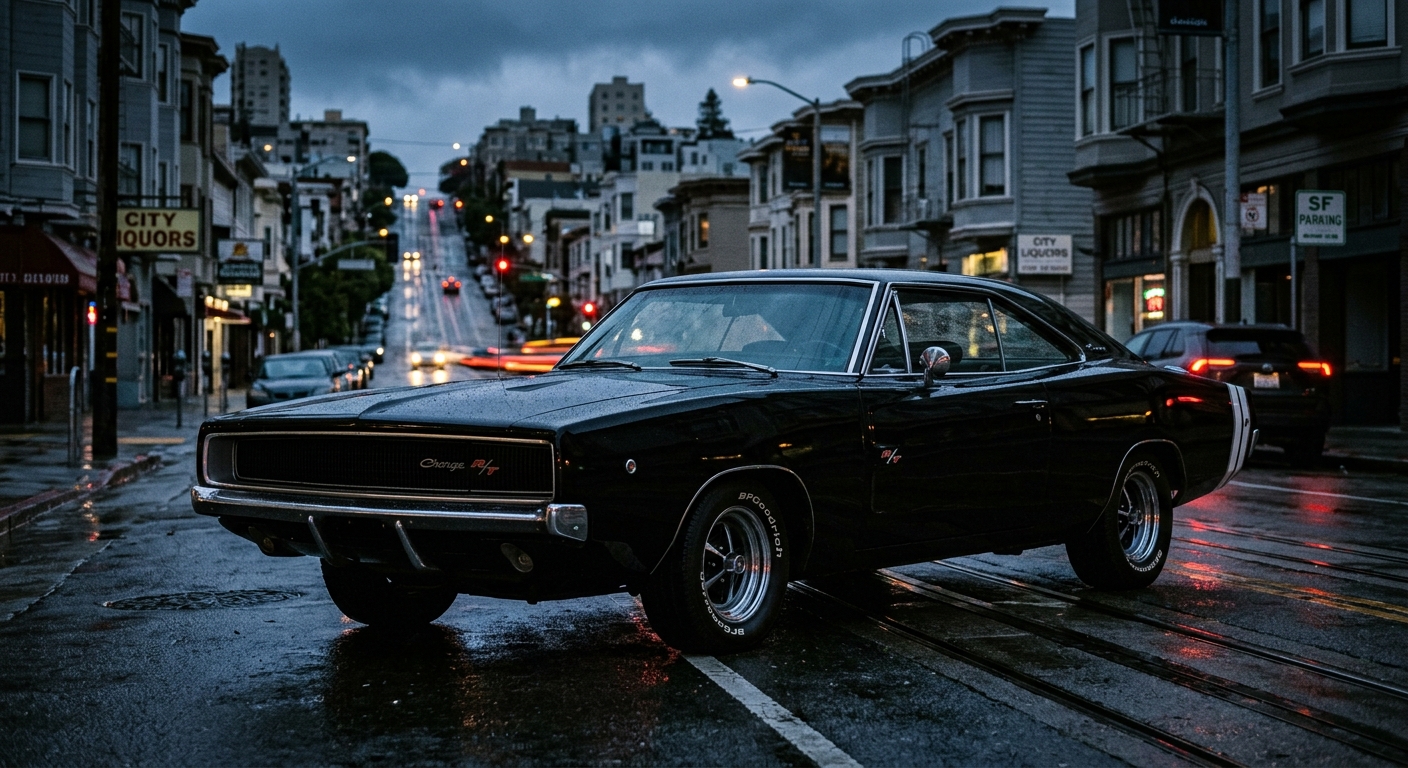
There are cars that perform. There are cars that look good. And then, very rarely, there are cars that do both so completely, so effortlessly, that they become something beyond transportation or even performance machinery. They become cultural objects. Icons. The kind of thing that gets burned into the collective memory of a generation and never quite fades out.
The 1968 Dodge Charger R/T is exactly that kind of car.
I’ve written in this series about raw power (the ZL1 Camaro), about outrageous factory audacity (the Buick GSX Stage 1), about the kind of engineering that makes your palms sweat just reading the spec sheet. But the ’68 Charger occupies a different category. It’s a car that combined genuine muscle car credentials with a design so far ahead of its time that it still looks modern today. More than fifty years on, you can park a 1968 Charger R/T on any street in any city in the world and people will stop walking to stare at it. That doesn’t happen with many cars. It happens every single time with this one.
This is the car that made Dodge dangerous. Not just fast. Dangerous.
The Redesign That Changed Everything
To understand why the ’68 Charger matters so much, you have to go back one year to the 1967 Charger, which is a car that is largely forgotten and largely deserves to be. The first-generation Charger (1966-1967) was essentially a fastback body bolted onto a Coronet platform, with a full-width grille and a few styling flourishes that never quite gelled into a coherent identity. It sold decently but didn’t set the world on fire. Dodge knew they had something potentially special in the Charger name, but the first attempt hadn’t unlocked it.
For 1968, they started over in the most meaningful sense. Designer Chet Fillmore and his team at Chrysler’s styling department attacked a clean sheet with a specific vision: a car that looked fast even standing still, with a body that flowed rather than was assembled. What they came up with was a second-generation Charger that was, and I don’t think this is an overstatement, one of the most beautiful American cars ever drawn.
The key design element was the recessed grille, set back into a tunneled opening that gave the car’s front end a depth and dimension that nothing else on the road had. Flying buttress C-pillars swept down from the roofline to the rear deck in a way that looked almost European but felt distinctly American. The body sides were clean and sculpted with a subtle body-side crease that caught light differently depending on the angle. The hidden headlights, which had appeared on the first-generation car, were refined into something genuinely elegant here.
The rear was equally resolved: a full-width tail panel with four round taillights set into a clean horizontal band. Simple. Purposeful. Perfect.
The result was a car that looked like it was doing about ninety miles an hour while parked. Dodge had figured out something crucial: that in the muscle car wars, image was half the battle, and they’d just brought a bazooka to a knife fight.
What R/T Actually Meant
The R/T designation, which stood for Road and Track, wasn’t just a badge on the Charger. It was a specific package that represented Dodge’s commitment to the idea that a performance car needed to actually perform across multiple dimensions, not just in a straight line on a drag strip.
To get the R/T badge on your 1968 Charger, you started with the 375-horsepower 440 Magnum V8 as the base engine. Let that settle in for a moment. The entry-level R/T engine was a 440 cubic inch motor making 375 horsepower and, critically, 480 pound-feet of torque. This was not a car for the faint of heart or the light of wallet.
Beyond the engine, the R/T package included:
- Stiffer heavy-duty suspension tuned for actual handling
- Wider F70x14 Polyglas tires on body-colored road wheels
- Heavy-duty drum brakes (front discs were optional, and seriously recommended)
- A specific R/T stripe treatment and badging
- TorqueFlite automatic or four-speed manual transmission options
The suspension tuning on the R/T deserves more credit than it usually gets in conversations about this car. Dodge was genuinely trying to build something that could handle, not just accelerate. The ’68 Charger R/T was noticeably more composed in corners than many of its contemporaries, which is part of why it reads as a complete performance car rather than just a straight-line monster.
But of course, if 375 horsepower wasn’t enough for you, Dodge had an answer. The optional engine was the 426 Hemi. And the 426 Hemi was, as I covered in some detail back in Part 3 when we talked about the Hemi ‘Cuda, an engine that existed in a different dimension from everything else available to the American car buyer in 1968. Street-rated at 425 horsepower (almost certainly underrated, and everyone knew it), with dual four-barrel carburetors and hemispherical combustion chambers that had been winning races since the early 1960s, the Hemi-equipped Charger R/T was one of the fastest production cars in the world. Full stop. No asterisk needed.
Steve McQueen Didn’t Choose It By Accident
Here’s the thing about cultural moments: they don’t just happen. The 1968 Dodge Charger didn’t become an icon purely because of its spec sheet, as impressive as that spec sheet is. It became an icon because of Bullitt.
The 1968 film starring Steve McQueen contains what is almost universally considered the greatest car chase in cinema history. McQueen, driving a Highland Green 1968 Ford Mustang 390 GT, pursues (and is pursued by) two hitmen in a black 1968 Dodge Charger R/T 440 through the streets of San Francisco. The chase runs for about ten minutes of screen time and required weeks of filming across multiple locations. It was violent, physical, and utterly real in a way that modern CGI-assisted car chases simply cannot replicate.
But here’s what’s interesting about Bullitt from the Charger’s perspective: the Charger was the villain’s car. It was supposed to lose. And yet, in the cultural memory of that film, the Charger is just as iconic as the Mustang, arguably more so. The reason is simple: it looked more menacing, more predatory, more dangerous than anything else in the frame. The black exterior, the hidden headlights, the fastback roofline. In motion, it was terrifying and beautiful simultaneously.
The filmmakers didn’t choose the Charger because they needed a generic bad-guy car. They chose it because it looked like something that should be feared. That’s a testament to how completely Dodge’s design team had captured something primal in the Charger’s shape.
After Bullitt, the ’68 Charger was no longer just a muscle car. It was a piece of American mythology. Film has a way of doing that to certain objects, and the Charger absorbed all of it and wore it like it was always supposed to be there.
The Numbers That Back Up the Legend
Let’s get specific about what these cars actually did, because the performance credentials are every bit as serious as the visual ones.
A 1968 Charger R/T with the 440 Magnum and TorqueFlite automatic, in contemporary period testing, was running the quarter mile in the high 13-second range at around 104 miles per hour. That was legitimately quick by any standard of the era, capable of embarrassing most sports cars that cost significantly more money.
Opt for the 426 Hemi and those numbers improved substantially. Car and Driver tested a Hemi Charger in period and recorded a quarter mile of 13.5 seconds at 105 miles per hour, with a 0-60 time of 6.0 seconds flat. In 1968. With air conditioning potentially on option. To give you context, a contemporary Ferrari 275 GTB/4 ran 0-60 in about 6.7 seconds and cost roughly three times as much money.
Production numbers for the ’68 Charger R/T were relatively modest by muscle car standards: approximately 17,665 R/T models were built for the 1968 model year. Of those, only about 475 were equipped with the 426 Hemi. The Hemi cars are, predictably, among the most valuable American muscle cars in existence today, with well-documented examples regularly bringing well over a million dollars at auction. Even the 440 Magnum cars, which are the “common” version of the R/T, command serious money from serious collectors.
These aren’t just nostalgia numbers. The market is telling you something true about what these cars actually represent.
Why It Belongs in Any Serious Conversation
There’s a category error that sometimes gets made when people discuss the ’68 Charger R/T in the context of the greater muscle car era. Because it’s so visually iconic, because it has the movie connection, because it photographs so well, some people mentally file it under “style over substance,” as if the design somehow comes at the expense of the performance credentials.
That’s wrong, and I want to be direct about it.
The 1968 Charger R/T was a genuine, certified, no-asterisk muscle car. The 440 Magnum was one of the best street performance engines of the era: torquey, durable, and savage in the mid-range in a way that made it deeply satisfying to drive on actual roads as opposed to drag strips. The 426 Hemi option represented the absolute pinnacle of American production V8 performance in 1968. The chassis tuning was serious. The braking options were serious. Dodge was not putting a pretty body on a grocery getter and calling it a performance car. They were building a genuine performance car and clothing it in one of the most stunning designs in American automotive history.
The ’68 Charger R/T belongs in this series alongside the Chevelle SS 454 LS6 and the GTO Judge and the Hemi ‘Cuda not because of what it looks like, but because it earned its place on merit and happened to also look like nothing else on the road. That combination, performance and design at that level, executed simultaneously, is genuinely rare. It’s why we’re still talking about it in 2024.
What Dodge accomplished with the second-generation Charger was essentially this: they made the case that you didn’t have to choose. You could have a car that was properly, seriously, frighteningly fast and also be something that made people catch their breath when it pulled up next to them at a stoplight. You could have the whole thing.
More Than the Sum of Its Parts
I want to close with something that goes beyond specifications and production numbers, because the ’68 Charger R/T demands it.
There’s a moment that I think defines what a truly great muscle car is, and it’s not a drag strip moment or a track lap time. It’s simpler than that. It’s the moment when someone who has nothing to do with cars, who doesn’t care about horsepower numbers or compression ratios or quarter-mile times, walks past a 1968 Dodge Charger R/T and stops. Just stops. Turns around. Stares. Maybe walks back to look at it again.
I’ve seen that happen. I suspect many of you have too. It happens with very few cars, and it happens with the ’68 Charger reliably, predictably, every time.
That’s not just design. That’s not just performance. That’s the result of a team of people who were trying to make something genuinely extraordinary, succeeding so completely that the object they created has outlasted the company culture that produced it, the economic conditions that surrounded it, and the era that defined it. The 1968 Dodge Charger R/T was right for 1968. It was right for 1978. It was right for 1998. It’s right now. Cars that achieve that kind of timelessness don’t do it by accident.
This is a legend in the most complete sense of the word. Not just fast. Not just beautiful. Not just historically significant. All of it, simultaneously, without compromise.
Up next in Part 11, we’re shifting to something that represents a completely different philosophy of muscle car: the 1969 Plymouth Road Runner 383. Where the Charger R/T was about delivering maximum impact on every dimension, the Road Runner was built around a single audacious idea, which is that you could give the working man the performance without the premium. It’s one of the most interesting stories in this entire series. Don’t miss it.