Frank
Frank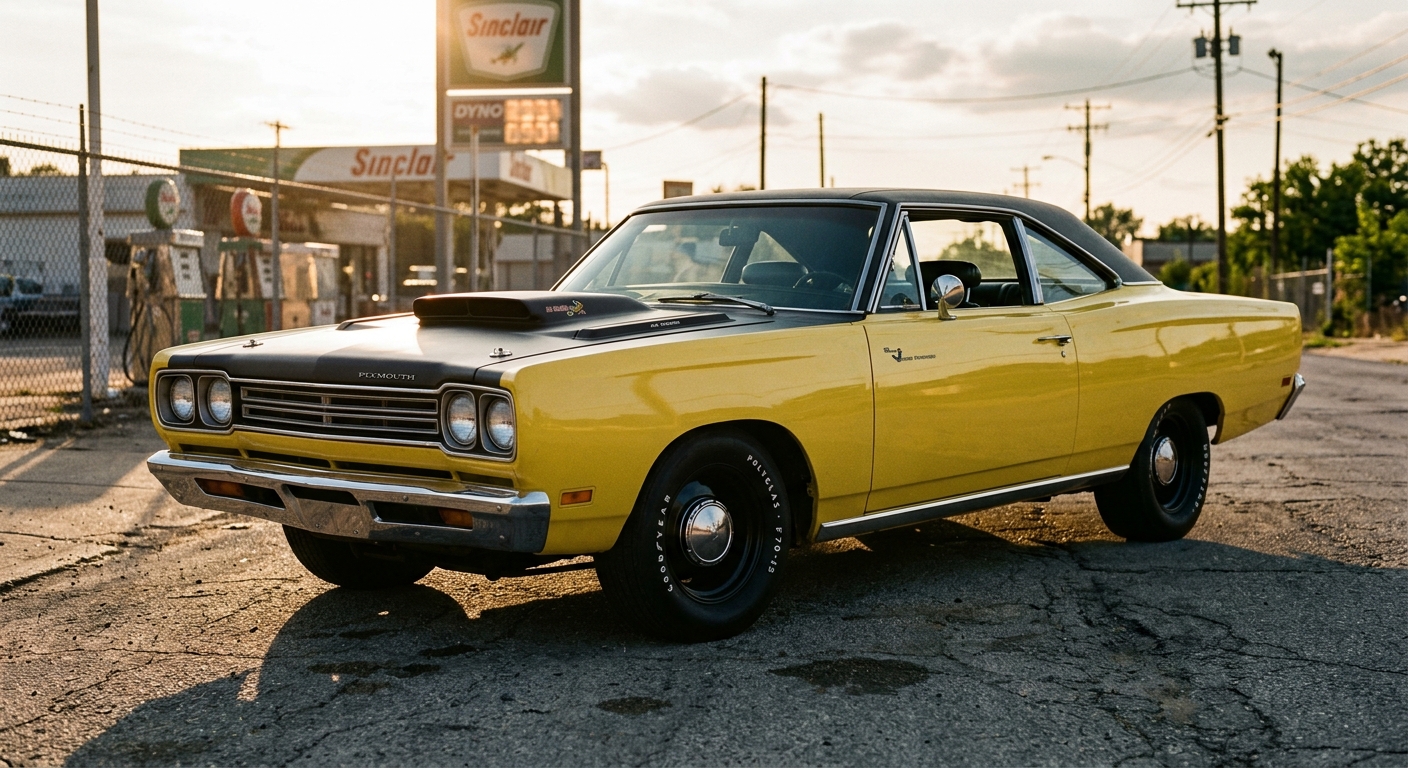
There’s a certain kind of genius that doesn’t announce itself. It doesn’t show up wearing a tuxedo or carrying a briefcase full of horsepower ratings. It shows up in work boots, hands in its pockets, and gets the job done better than anything twice its price. That’s the 1969 Plymouth Road Runner 383. Not the most powerful car on this list. Not the most exotic. Not the one that collectors fight over at Barrett-Jackson with trembling paddles and sweating foreheads. But in terms of what it meant, what it proved, and what it quietly accomplished in a world full of overpriced muscle, the Road Runner might be the most important car Plymouth ever built.
I want to make a case for the underdog here. Because muscle car history has a tendency to crown kings based on the biggest numbers, the rarest options, the most brutal engines. And those cars deserve their glory, no question. But every now and then, a car comes along that wins by changing the rules entirely. The Road Runner didn’t beat the competition by out-muscling it. It beat the competition by making everyone else look like they were charging too much for too little. That’s a different kind of victory, and in some ways, a more lasting one.
The Problem the Road Runner Was Built to Solve
By 1968, the muscle car market had drifted somewhere Plymouth’s product planners hadn’t intended. The GTO had gotten expensive. The Charger R/T was stacking up options like a Las Vegas buffet. Even Plymouth’s own Belvedere GTX, which we touched on briefly in the series, had climbed into premium territory. A loaded GTX could run you close to $3,500. Add the 440 Six Barrel or the Hemi and you were pushing $4,000 or more. That’s real money in 1968. Real enough that a lot of the kids who actually wanted muscle cars, the 22-year-olds working the line at the assembly plant, the guys pumping gas on Route 66, the weekend racers scraping together entry fees, were getting priced out of the segment they’d helped create.
Plymouth saw the gap. What the market needed was a no-nonsense muscle car that stripped out the luxury pretense, kept the serious powertrain, and hit a price point that felt almost criminal for what you got. The target was somewhere around $2,900 base. That’s aggressive. That required discipline, and it required saying no to a lot of things the marketing department probably wanted to say yes to.
What they built instead was pure. Almost defiantly so. The Road Runner arrived in 1968 named after the Warner Bros. cartoon character, complete with a licensed “beep beep” horn that honked in the spirit of the bird outrunning Wile E. Coyote. It was cheeky, it was unpretentious, and it was exactly right. By 1969, Plymouth had refined the formula, expanded the body styles, and the Road Runner had become one of the best-selling muscle cars in America.
The 383 and Why It Was Enough
Let me spend some time here, because this is where the Road Runner’s reputation sometimes gets unfairly shortchanged.
The 383 cubic inch big-block Chrysler B-series engine was not a new engine in 1969. It had been kicking around since the late 1950s. In its standard passenger car tune, it was a truck-pulling, family-hauling workhorse. Chrysler dropped it into everything from station wagons to New Yorkers. Which is exactly why some people turned their noses up at it when Plymouth bolted it into the Road Runner’s engine bay.
But Plymouth didn’t use the standard 383. Not even close.
The Road Runner 383 was a specifically modified version of the engine. Plymouth pulled the intake manifold, the camshaft, the exhaust manifolds, and the cylinder heads directly from the 440 Super Commando. That’s not a small thing. The 440’s free-breathing heads flowed significantly better than the standard 383 setup. The hotter cam changed the engine’s entire personality. What you ended up with was a 383 that breathed like a 440, revved with more enthusiasm than its displacement suggested, and produced a factory-rated 335 horsepower. Real-world numbers from contemporary tests put the quarter mile in the low-to-mid 14-second range depending on rear gearing and conditions.
Is that Hemi territory? No. Is it 450 horsepower? No. But here’s the thing: it was fast enough for street use in a car that cost dramatically less than anything else in the segment with similar performance. And the 383 was also lighter than the 426 Hemi or the 440, which helped the Road Runner’s handling characteristics more than people give it credit for.
For buyers who wanted more, Plymouth offered the 440 and the 426 Hemi as options. But the base 383 was the car that made the concept work. It was the engine that kept the price honest.
What You Gave Up and What You Got
Part of the Road Runner’s story is understanding what it chose not to be.
The standard Road Runner came with a minimum of interior luxury. Bench seat, rubber floor mats rather than carpet, no sound deadening to speak of, no standard radio, no power anything. The door panels were flat and plain. The dashboard was functional and nothing more. There was no hiding what this car was: a machine built around going fast, sold to people who understood that was the point.
And here’s where Plymouth pulled off something genuinely clever. By stripping it down, they made it cooler. The absence of luxury wasn’t a compromise in the eyes of the people buying these cars. It was a statement. The Road Runner said, loudly and without apology: I don’t need to impress you with carpets. Let’s go.
What you got instead of chrome trim and power windows was a properly reinforced B-body unibody, a heavy-duty four-speed manual gearbox option, upgraded suspension, a beefy Sure-Grip limited-slip differential, and that modified 383 under the hood. The front disc brake option was available for buyers who understood physics. The car handled its power with a kind of honest directness that more luxurious muscle cars sometimes masked under layers of NVH (noise, vibration, and harshness) suppression.
In 1969, Plymouth expanded the Road Runner lineup to include a hardtop, a post sedan, and a convertible. Total production hit around 84,000 units, which made the Road Runner one of the most successful muscle cars of the entire era by volume. That number matters. It tells you the formula worked. It tells you Plymouth had read the room correctly.
The Competition Didn’t See It Coming
It’s worth stepping back and looking at the competitive landscape in 1969 to appreciate what the Road Runner was doing to the market.
The GTO Judge, which we covered in Part 6, was Pontiac’s answer to the Road Runner. And the fact that the Judge existed at all is the best possible evidence of the Road Runner’s impact. Pontiac, the originator of the muscle car concept, the brand that had defined performance in American culture for half a decade, had to react to a Plymouth. That should tell you everything.
Dodge’s version of the same concept, the Super Bee, arrived at roughly the same time. It also used a modified 383 as its standard engine. Dodge and Plymouth were essentially running parallel experiments with the same formula, which sounds redundant until you realize that both cars sold in enormous numbers and served slightly different buyer demographics based on brand loyalty alone.
Ford and Chevrolet were watching too. The idea of a performance car sold on stripped-down value rather than luxury pretense was becoming a market force that nobody could ignore. The Road Runner had cracked something open.
The genius of Plymouth’s timing was that they launched this concept at the absolute peak of the muscle car era. Insurance companies were already starting to make noise about high-performance vehicles. The fuel crisis was still a few years off but the cultural headwinds were shifting. By building a car that was fast, cheap, and accessible, Plymouth gave one last generation of working-class buyers a legitimate ticket to the muscle car world before the door started closing.
Racing Heritage and the Road Runner’s Real-World Legacy
The Road Runner wasn’t born in a boardroom. It had drag racing in its DNA from the start, and Plymouth knew how to work that angle.
The combination of the modified 383, the lightweight interior, and the structural integrity of the B-body platform made the Road Runner a legitimate strip weapon right out of the crate. With the optional four-speed manual and the right rear gearing, a well-driven Road Runner 383 could embarrass cars that cost twice as much. And when buyers stepped up to the 440 or, for the truly committed, the 426 Hemi, the Road Runner transformed into something genuinely terrifying.
Super Stock and Stock class drag racing took notice. The Road Runner’s combination of weight, power, and configuration meant it competed favorably against everything in its class. Plymouth actively promoted the race results, feeding the street credibility that drove showroom traffic.
But the Road Runner’s legacy isn’t really about the race wins. It’s about what it meant for people who couldn’t afford the Hemi cars and the fully optioned GTXs. The Road Runner was the muscle car that regular people actually drove. Hard. On actual streets. Not coddled in a garage, not reserved for show days. Driven to work on Monday and raced on Saturday. Beaten on, maintained by their owners rather than professional technicians, kept alive through shade-tree mechanical ingenuity that stretched further when the parts were common and the platform was well-understood.
That’s the Road Runner that exists in actual memory rather than collector mythology.
The Quiet Revolution
There’s a philosophical point underneath all of this that I keep coming back to, and it’s why the Road Runner earns its place in this series alongside the Hemi ‘Cuda, the ZL1 Camaro, and the Charger Daytona.
Those other cars are legends because they represented the absolute ceiling of what Detroit could do. They were engineering statements, horsepower arguments, proof-of-concept exercises in organized violence. And they matter enormously. They’re the peaks.
But the Road Runner was the base camp. It was where the mountain actually met the ground. It was the car that democratized the muscle car era, that said the experience of driving something genuinely fast and genuinely American didn’t require you to take out a second mortgage or skip rent. The Road Runner made performance accessible without making it cheap. There’s a difference, and Plymouth walked that line with remarkable precision.
It also changed how manufacturers thought about the market. Before the Road Runner, the assumption was that muscle car buyers wanted luxury features bundled with their performance. After the Road Runner sold 84,000 units in 1969, that assumption was dead. Buyers wanted performance. The carpet and the chrome were secondary. That shift in thinking echoes through performance car philosophy all the way to the present day.
The 1969 Plymouth Road Runner 383 isn’t the loudest chapter in the muscle car story. But it might be the most honest one. It understood what people actually needed, built exactly that, and refused to apologize for the simplicity. Sometimes the best engineering decision is knowing what not to add. Plymouth knew.
Next up in the series, we head to Dearborn, where Ford built something entirely different. The 1970 Mustang Boss 429 was an exercise in what happens when you take an engine designed for NASCAR superspeedways and force it into a pony car that wasn’t really designed to hold it. The result was complicated, magnificent, and thoroughly Ford. Part 12 digs into all of it.