Frank
Frank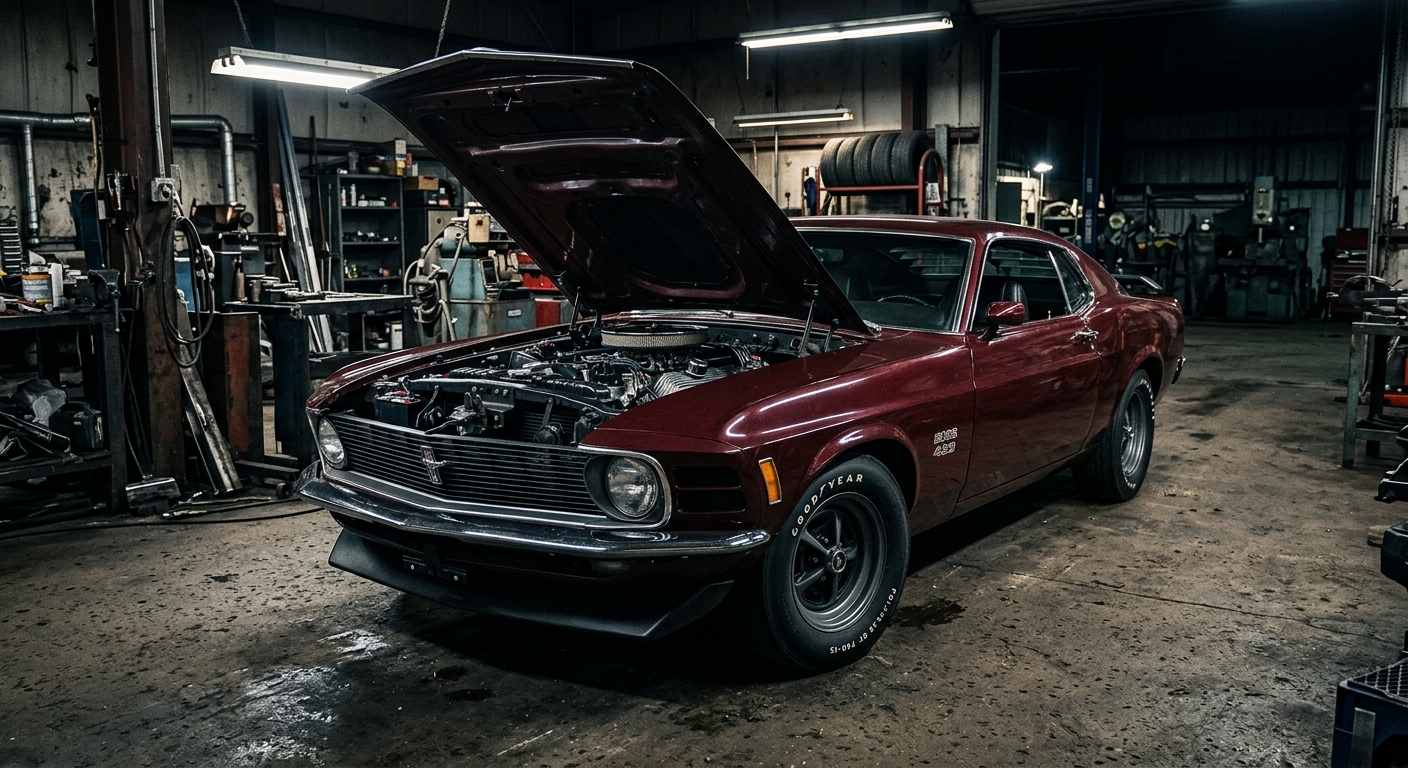
There are cars that win races. There are cars that win hearts. And then, on rare occasions, there are cars that do something more uncomfortable and more lasting than either of those things. They win arguments. The 1970 Ford Mustang Boss 429 is that kind of car. It didn’t dominate the drag strip the way the Hemi ‘Cuda did. It wasn’t the cheapest ticket to big-block thunder like the Road Runner we talked about last time. It was something stranger and more interesting than either of those things. It was Ford trying to do something technically ambitious inside a package that was never really designed for it, and somehow pulling off one of the most iconic muscle cars ever bolted together in Dearborn.
I want to be honest with you upfront: the Boss 429 is a car that rewards patience. On paper, at first glance, the numbers don’t quite tell the story you’d expect. You have to dig. And when you do, what you find is a machine built not for the quarter mile, not for the showroom floor, but for NASCAR superspeedways, modified for the street, and carrying within it a level of engineering ambition that puts it in a completely different category from its contemporaries. This is the car that reminds you that “muscle car” was never just one thing.
Why a Racing Engine Ended Up Under a Street Car Hood
To understand the Boss 429, you have to understand what Ford was chasing in 1969. NASCAR had a displacement limit of 430 cubic inches for superspeedway racing. Ford’s existing 427 FE-series engine was a proven performer, but it was getting long in the tooth. The cylinder heads on that engine, while durable, were a breathing limitation at high RPM. Ford needed something new. Something with massive, open, free-flowing combustion chambers. Something that could run at 200 miles per hour for three hours at Talladega and not detonate itself.
So Ford’s engineers developed the 385-series 429 cubic inch engine with a new cylinder head design. We’re talking semi-hemispherical combustion chambers, a design sometimes called “crescent” heads, that allowed for huge intake and exhaust ports, dramatically improved airflow, and better thermal efficiency at high engine speeds. The ports were so large that the valves actually required a specific geometry to function properly, with the intake and exhaust valves canted at different angles rather than sitting parallel to each other. This wasn’t a conventional engine. It was a race engine with exceptional breathing capability, designed to make power at the high end of the rev range where superspeedway racing lives.
Here’s the catch: NASCAR required that to homologate an engine for racing, you had to put it in at least 500 street cars. Ford wasn’t going to build a special model nobody had heard of just to satisfy a production requirement. They were going to do this right. They were going to put the 429 in the Mustang, and they were going to sell it to anyone who walked into a dealership with the right amount of money and the nerve to drive it home.
The only problem was that the Mustang’s engine bay wasn’t even close to wide enough to fit the 429. Not with that cylinder head design. Not with those massive ports. Not with a decent cooling system around it.
Ford’s solution was to contract Kar Kraft, a Michigan-based specialty manufacturer, to perform a modification that today seems almost violent in its simplicity. They cut the front shock towers. Moved them outward. Reinforced the frame rails. And then fitted the 429 into the expanded cavity with barely enough clearance to thread a dollar bill between the exhaust headers and the steering components. The whole operation added manufacturing complexity, added cost, and added about a month to the production timeline for each car. Ford did it anyway, because winning on Sunday mattered that much.
What the Engine Actually Was, and What It Wasn’t
Here’s where the Boss 429 story gets philosophically interesting, and where I want to spend some real time, because this engine is constantly misunderstood.
Ford rated the Boss 429 at 375 horsepower. That number, on paper, looks underwhelming compared to what Chevrolet was claiming for the LS6 454 we covered back in Part 5, or what Chrysler was advertising for the Hemi. But those ratings need context. Ford was tuning this engine for broad power delivery at street-legal compression levels and with conservative street-oriented carburetion. The engine wore a single Holley 735 CFM four-barrel carburetor, a relatively modest setup for a motor of this displacement and breathing capacity. The compression ratio was 10.5:1, manageable on premium pump gas but not the race-oriented compression you’d find in the hotter street versions of competing engines.
What the factory numbers don’t capture is the potential locked inside those cylinder heads. The port flow numbers on the 429’s heads were extraordinary for the era. Enthusiasts and racers who understood what they were looking at immediately recognized that this engine was massively underutilized in street trim. The carburetion was a bottleneck. The ignition timing was conservative. The camshaft was a mild hydraulic unit designed for streetability rather than performance.
When racers and knowledgeable tuners got their hands on Boss 429s, the results were dramatic. More aggressive camshaft profiles, improved carburetion, and optimized ignition timing could bring real-world output far closer to 500 horsepower than the factory’s 375 suggested. The engine wasn’t slow, not by any measure, but it was deliberately held back for emissions, for reliability, and frankly for the nervous insurance actuaries who were already making ownership of performance cars expensive for young buyers.
What you got from the factory was a refined, sophisticated, slightly mysterious engine that felt different from a big-block Chevrolet or a Chrysler Hemi. It was smoother at high RPM. It had a different powerband character, one that rewarded revving rather than low-end grunt. Standing next to one, idling in a parking lot, it didn’t shake the ground and announce itself the way a lumpy-cammed 454 did. The Boss 429 was almost polite by comparison, and that understatedness fooled a lot of people into underestimating what it was capable of.
The Car Around the Engine
Ford knew that if you were going to sell a NASCAR homologation special to regular buyers, the package had to look the part even if the performance numbers weren’t screaming at you from the spec sheet. The Boss 429 delivered on this requirement in a way that still holds up fifty years later.
The exterior treatment was restrained by muscle car standards of the era, and I mean that as a compliment. There were no wild graphics packages, no cartoon character decals like a certain Pontiac we discussed in Part 6. The Boss 429 wore a functional front spoiler, a matte black hood treatment that ran from the hood scoop back, NASA-style hood pins that were both functional and visually aggressive, and body-colored styling that let the shape of the Mustang do the talking. The result was a car that looked serious rather than theatrical. Like someone who doesn’t need to talk loud because they know exactly what they’re about.
Inside, you got a functional cockpit rather than a luxury suite. High-back bucket seats, a sport steering wheel, a Hurst-shifted close-ratio four-speed manual transmission as the sporting choice (a Select-Shift automatic was also available for those who wanted it, though it felt like ordering a steak well-done). The instruments were legible. The driving position was right. This was a car that communicated its purpose clearly without shouting it.
The suspension was upgraded relative to the standard Mustang, with stiffer springs, larger front anti-roll bars, and staggered rear shocks to combat wheel hop under hard acceleration. The stopping power came from front disc brakes standard, which was still not universal in this segment at the time. Ford wanted the Boss 429 to be a complete driver’s car, not just a straight-line machine, and the chassis tuning reflected that intent.
Weighing in at around 3,500 pounds with a full tank of fuel, the Boss 429 wasn’t the lightest Mustang you could buy. Moving those shock towers and fitting the cooling infrastructure for a proper race-derived engine added weight in places that mattered. But the car handled that weight with more composure than many of its competitors managed with less.
The Numbers Game, and Why It’s the Wrong Game
Quarter mile times for the Boss 429 in stock form typically landed in the mid-to-high 13-second range at around 103 to 106 miles per hour. That’s genuinely quick by any normal standard, but it placed the car behind the LS6 Chevelle, behind the Hemi ‘Cuda, and in some comparisons behind the considerably cheaper Road Runner we looked at in Part 11. Contemporary automotive press tests were polite but noted the performance gap with some puzzlement. Here was this exotic, complex, expensive Mustang that Ford was marketing as a serious performance machine, and it wasn’t winning every stoplight contest.
What those tests couldn’t fully capture was the experience of driving the car hard and the feel of that engine in its element. At higher speeds, at higher RPM, when the big ports could breathe properly, the Boss 429 came alive in a way that the raw quarter-mile numbers didn’t predict. It was genuinely rapid on road courses. It felt composed and connected in a way that a Chevelle SS or a Road Runner, brilliant as both those cars are, didn’t attempt to offer. The Boss 429 was a performance car in a broader sense than most of its competitors even tried to be.
There’s also the matter of what this engine represented for Ford’s long-term ambitions. The 429 in street Boss trim was essentially a detuned, homologated version of a proper racing engine. The knowledge embedded in those cylinder heads, the engineering decisions that went into the port geometry and combustion chamber design, those were real contributions to performance engineering that extended far beyond any single production year. When you’re evaluating the Boss 429, you’re not just evaluating one car. You’re evaluating a philosophy.
Rarity, Survival, and What Collectors Know
Ford produced 859 Boss 429 Mustangs in the 1969 model year, the car’s first season of production. In 1970, production expanded but remained limited, with approximately 7,013 units built. These were not mass-market cars. The price premium over a standard Mustang fastback was substantial, the mechanical complexity of the Kar Kraft modifications made production slow and expensive, and the buyer who understood what they were looking at was a specific kind of person.
Today, well-documented Boss 429s in excellent condition regularly command prices above $200,000, with exceptional examples and particularly desirable color combinations pushing considerably higher. The survival rate, as with many performance cars of this era, has been hurt by hard use, deferred maintenance, and the decades of parts-swapping that happened before anyone fully appreciated what these cars would become. Finding a genuine, numbers-matching Boss 429 with its original engine, its original Kar Kraft modifications intact, and documented history is genuinely difficult.
What collectors understand, and what the market reflects, is that the Boss 429 occupies a unique position. It is simultaneously a street car, a racing homologation vehicle, a piece of engineering history, and an aesthetic object of genuine merit. Those intersecting qualities are rare in any era. In the muscle car era, where many cars were essentially simple formulas executed with varying degrees of aggression, the Boss 429 was something more deliberate and more complex.
An Engine in Search of Its True Context
I keep coming back to a thought whenever I spend time with the Boss 429’s story. This engine was built for a track, for a specific set of conditions, at a specific temperature and altitude, turning a specific kind of power curve over a sustained period of time. Ford then took it, modified it to fit a car it was never designed for, tuned it down for street manners and emissions compliance, and sold it to dentists and college students and weekend racers who mostly drove it on roads it was wildly overqualified for.
And somehow, that collision of purposes produced something genuinely beautiful.
The Boss 429 is a car that exists at a crossroads. It’s too refined to be a pure blunt-force muscle car. It’s too compromised by street requirements to be a proper race car. It’s too exotic for most buyers to fully exploit, and too restrained in stock form to fully reveal what it contains. And yet, sitting in that uncomfortable middle space, it achieved something that pure examples of either extreme couldn’t manage. It became interesting. Deeply, enduringly interesting.
That’s what I find worth honoring here. Not just that Ford built a fast car, because plenty of companies did that. But that Ford tried to build a sophisticated car within a segment that didn’t particularly reward sophistication, and they got close enough to something genuinely great that five decades later, people are still arguing about it.
That’s the Boss 429. A car that wins arguments.
Next up in the series, we’re leaving the Mustang behind and moving into territory that some of you might argue doesn’t quite belong in a muscle car conversation at all. Part 13 covers the 1967 Chevrolet Corvette L88, an engine so extreme that Chevrolet actively discouraged buyers from ordering it for street use, and so powerful that its factory rating was a brazen fiction designed to keep insurance companies from panicking. If the Boss 429 is a car that rewards patience and careful attention, the L88 is a car that rewards courage.