Frank
Frank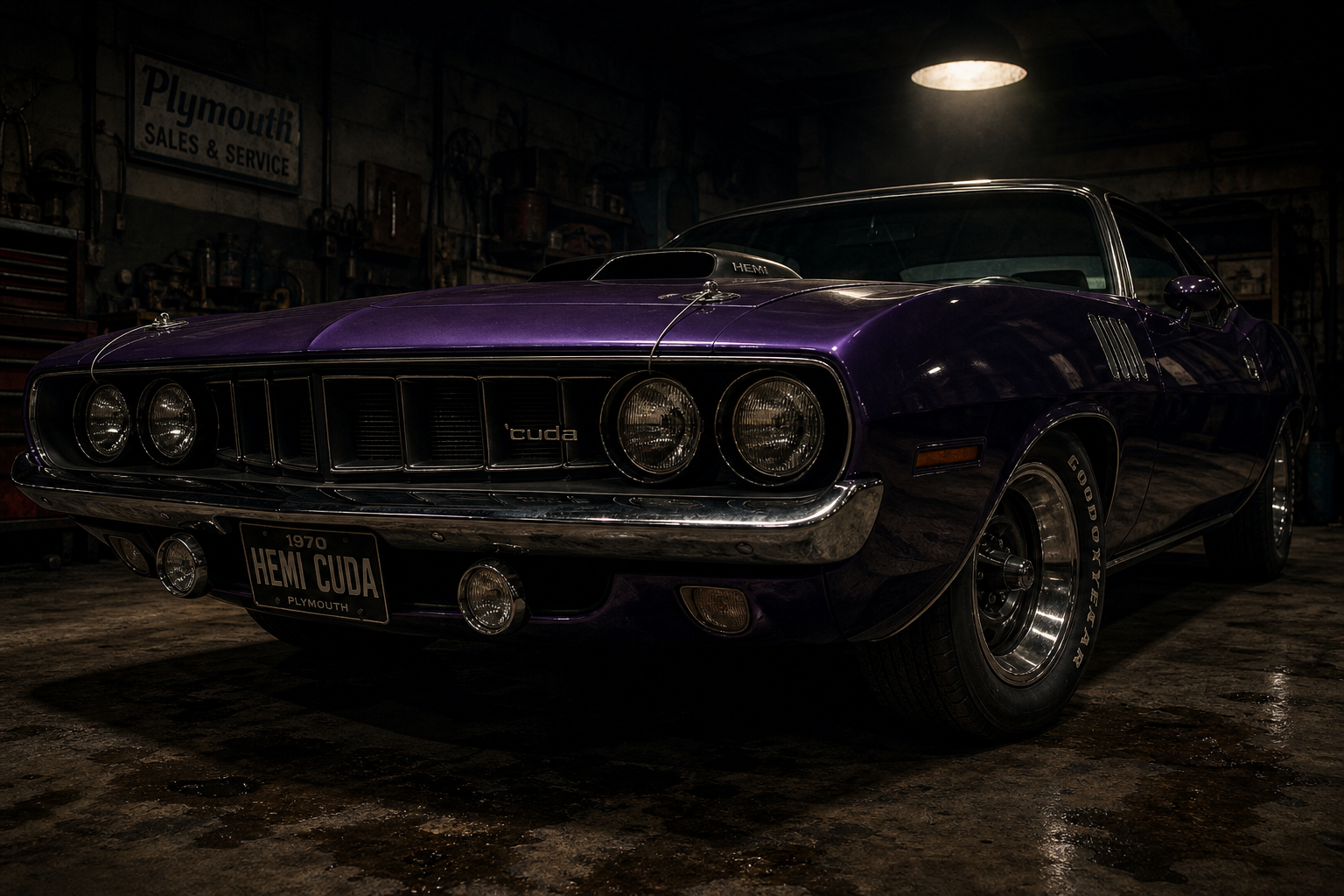
The moment you fired up a 1970 Hemi ‘Cuda, the conversation was already over.
Not because you said anything. Not because you argued a point. The 426 cubic inches of Chrysler’s elephant motor said it for you, and it said it so loud that the guy three stalls down at the cruise-in quietly reconsidered his entire position on what constituted a fast car.
I’ve been thinking about why that mattered. Not the horsepower numbers, not the quarter-mile times, not the collector value that makes grown men weep at Barrett-Jackson. I mean the specific deliberate choice Plymouth made to build something that couldn’t be ignored, and what it actually cost them to make that choice.
Because here’s the thing people forget: the Hemi ‘Cuda was a commercial disaster. Plymouth sold 652 of them in 1970. Six hundred and fifty-two. A Dodge dealer in Macon could sneeze and move more K-cars than that in a slow quarter. The car was expensive, brutal on insurance, nearly undriveable in any kind of traffic, and got fuel economy that would make an Abrams tank feel smug. By every rational business metric, it failed.
And none of that is the interesting part.
The interesting part is that Chrysler knew all of that going in. The 426 Hemi had been around since 1964. They knew what it cost to build. They knew what it cost to insure. They knew the buyers who could actually afford one and were willing to tolerate its personality were a razor-thin slice of the market. They built it anyway, and they built it specifically because the alternative, which was a ‘Cuda that was merely fast instead of apocalyptically fast, would have been a lie about what the car was supposed to be.
There’s a version of the ‘Cuda with the 383 that makes sense. The 340 version makes great sense. Lighter, cheaper, still quick, honest transportation with some personality. Those cars sold. Those cars made money. Those cars are fine.
The Hemi version wasn’t fine. Fine wasn’t the point.
What Plymouth understood in 1970 is something the entire auto industry has spent the last twenty-five years slowly forgetting: there is a category of product whose entire value proposition depends on it being exactly as extreme as advertised. The second you start engineering out the rough edges to reach a broader market, you haven’t improved the product. You’ve replaced it with something else that happens to share a name.
I grew up around these cars. Not the Hemi specifically, nobody I knew had a Hemi ‘Cuda, those things were unicorns even then. But I grew up around the culture that produced them. Milledgeville, Georgia in the late seventies and early eighties, you didn’t have to look hard to find big-block American iron sitting in somebody’s driveway with the hood up and oil on the concrete. My older brother William knew every car on our street by sound. He could tell you who was pulling into the neighborhood before they turned the corner just by listening. That’s not a skill you develop around sensible transportation.
The Hemi ‘Cuda was the extreme end of a philosophy that ran all the way down through the product line. It was the proof of concept. It was Plymouth saying: we are not hedging. We believe in this so completely that we are going to build the most uncompromising version of it that the laws of physics and the available technology will allow, sell it to whoever is serious enough to handle it, and let the existence of that car define what everything below it means.
That’s actually hard to do. It’s hard because the people who make production decisions are almost never the people who understand what the thing is supposed to mean. Accounting can tell you the Hemi option costs more to produce than it returns in margin. Engineering can tell you the driveline stress is a long-term reliability problem. Marketing can tell you the insurance surcharge alone is going to kill conquest sales. All of that is true. None of that is why the car exists.
The car exists because in 1970, if you wanted to know what a Barracuda was capable of, there needed to be an answer that didn’t come with qualifications. Not “well, it depends on the configuration” or “the sweet spot is really the 340.” When someone asked what a ‘Cuda could do, Plymouth wanted the answer to be the Hemi. Full stop. Everything else in the lineup borrowed its identity from that answer.
652 cars. That’s the whole run. There are small Georgia counties with more residents than there were 1970 Hemi ‘Cudas produced. But the existence of those 652 cars changed what the other thirty thousand Barracudas meant. It changed what Plymouth meant. It changed the negotiating position of every other muscle car on the lot.
That’s leverage that doesn’t show up in a production report. You can’t put it in a spreadsheet. But any car guy standing in a showroom in 1970 knew it was there, and it affected every decision they made, whether they were buying a Hemi or not.
The ones that survived are worth a million dollars plus now. Not because they were practical. Not because 652 is a prestigious number on its own. Because Plymouth refused to build a tamer version of the truth, and fifty years later, that refusal is the whole story.
Some things are only worth what they cost to make them real.