The Idea
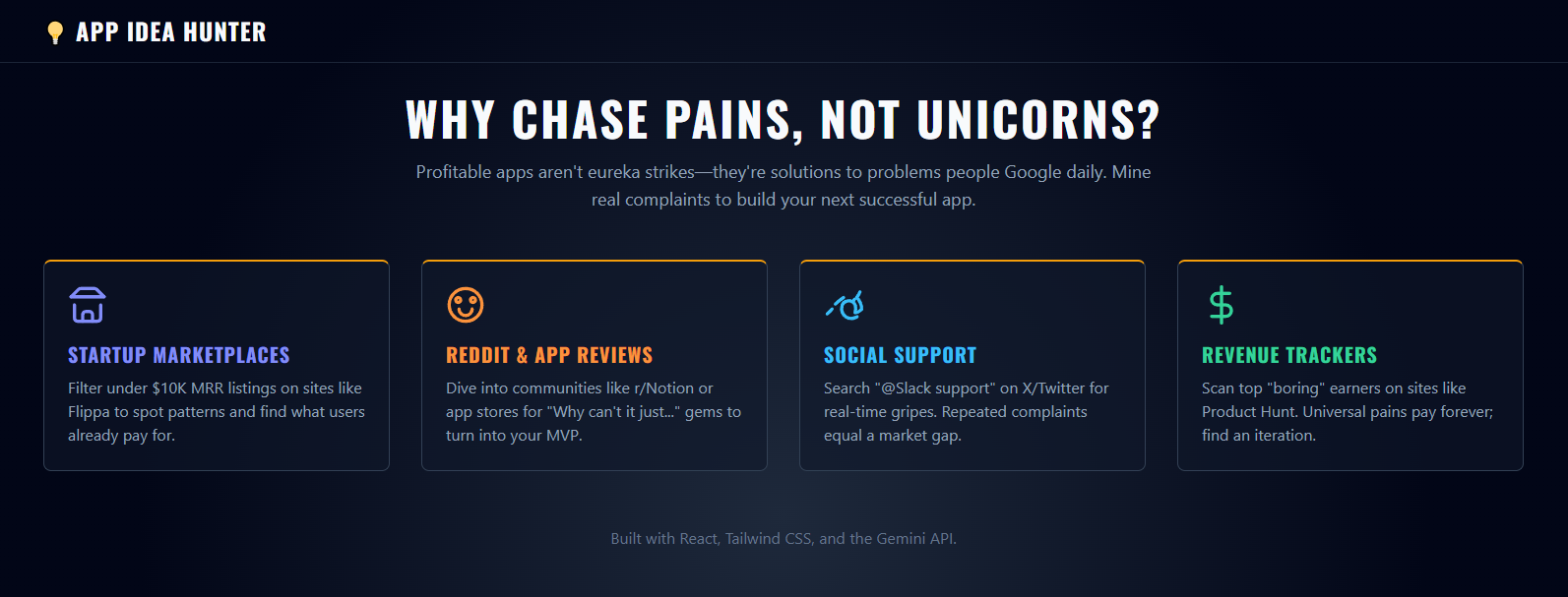
Most app ideas don’t come from flashes of inspiration, they come from frustration. Someone Googles “why can’t I just…” or posts a rant on Reddit, and buried in that complaint is a real problem people would pay to have solved. App Idea Hunter is a tool I built to systematically mine that signal instead of waiting for a eureka moment that may never come.
The premise is simple: profitable apps are solutions to problems people are already searching for. So rather than brainstorming in a vacuum, why not go find the complaints first?
What It Does
App Idea Hunter uses the Gemini API to analyze real user pain points and surface them as structured app opportunities. Feed it a topic or niche, and it digs into the kinds of problems people are actively venting about, then reframes those complaints as potential app concepts, complete with a rough sense of whom the audience is and why they’d care.
It’s less of a brainstorming tool and more of a validation shortcut. The difference matters: you’re not generating random ideas; you’re grounding new ones in demonstrated demand.
Why I Built It
I kept seeing advice like “scratch your own itch” or “just build something people want” without much guidance on how to find those itches reliably. This project is my attempt to make that discovery process repeatable. It’s also a useful excuse to keep experimenting with Gemini’s capabilities, the model is surprisingly good at synthesizing complaints into coherent problem statements when you prompt it the right way.
Under the Hood
The project is built with HTML and TypeScript, keeping the stack intentionally lean. There’s no heavy framework here, just a clean interface that stays out of the way and lets the AI output do the talking. It was originally prototyped in Google AI Studio, which made it easy to iterate on prompts quickly before locking anything in.
A few things I found interesting while building it:
- Prompt framing matters enormously, asking for problems versus ideas produces very different (and differently useful) outputs
- Keeping the UI minimal actually improved how I evaluated the results, since there was nothing else competing for attention
- TypeScript’s strictness caught a handful of edge cases in the API response handling that would have been silent bugs otherwise
Status
This project is actively maintained. I use it myself when I’m poking around for new things to build, and I’ve been refining the prompts and output structure as I learn more about what makes an idea summary actually useful versus just interesting-sounding.
You can browse the source on my self-hosted Forgejo instance.
