Frank
Frank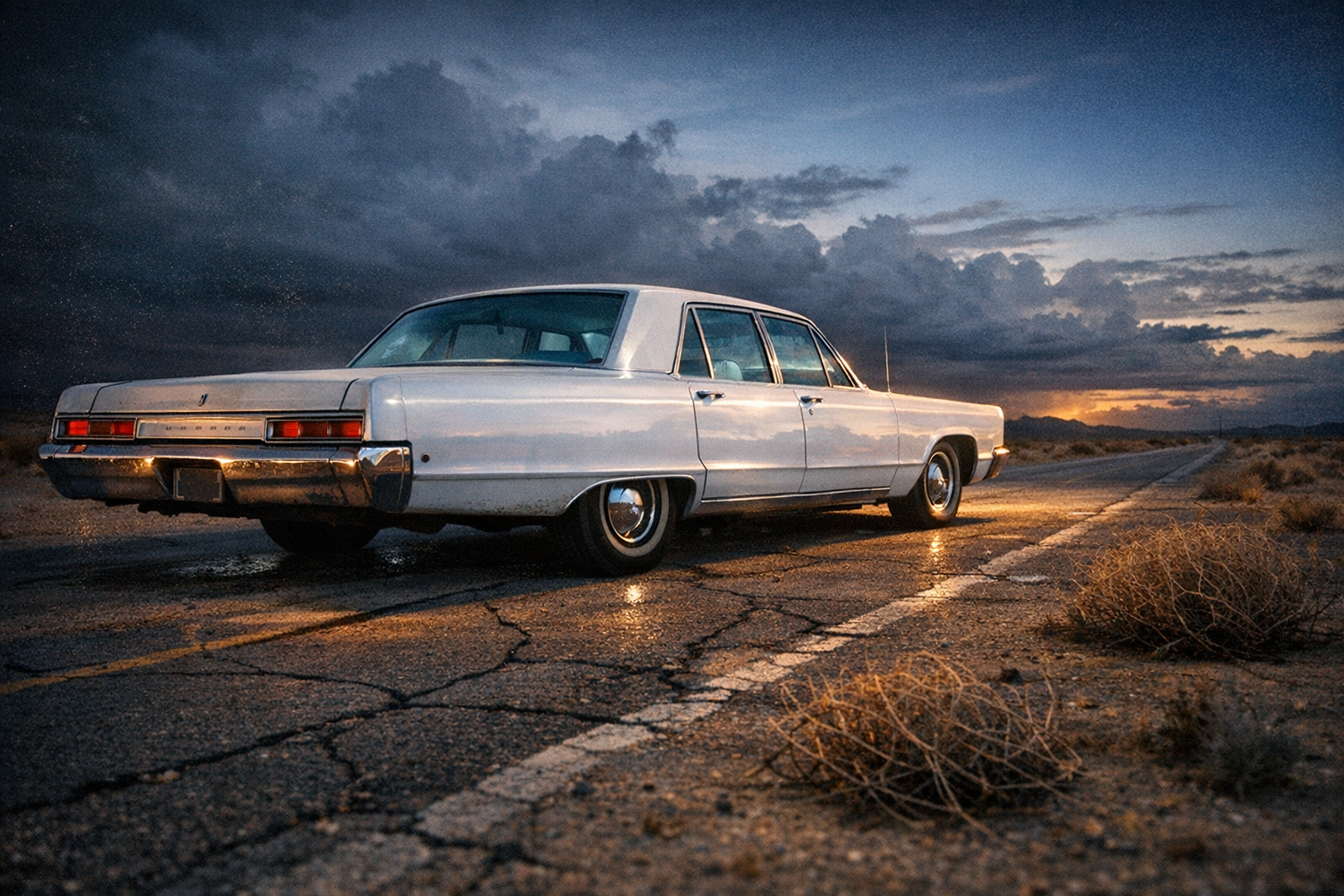
It’s a 1968 Chrysler Newport, four-door, white with blue interior. AM-only radio, no A/C, but she had Heat and MAX Heat, which tells you everything you need to know about the priorities of the era. My Grandaddy Ed’s sister gave her to me, which meant we had no business selling her, and yet here we are.
Thirteen miles long. Enough room for you and twelve of your closest friends, with storage in the trunk for two or three dead bodies, not that I’d know anything about that, but it WAS that big. Our friends christened her the SS Lusitania. The Luse, for short. She had a 383 Magnum under the hood, two-barrel carb, glass packs, and she was faster than the word of God on a revival Sunday, especially for a 52,000lb lead sled.
Nothing special on paper, maybe. But driving her felt like something I understood without having to think about it. And I’ve spent a good chunk of time since wondering why I ever let that go.
What Old Cars Actually Taught You
A 383 Magnum with glass packs doesn’t sneak up on anybody. You hear it coming, you feel it thinking, and when you put your foot down, it commits to the decision with you. The feedback loop is short and brutally honest. You feel the carb stumble. You hear the exhaust note shift under load. The steering tells you exactly what the front end is doing because there aren’t seventeen software layers between your hands and the road.
Modern cars route all of that through dampening systems and driver-assistance logic designed to make sure you never feel anything inconvenient. Which is fine, genuinely, if what you want is a machine that handles everything quietly while you zone out. But somewhere in that transaction you stop being a driver and start being a passenger who’s technically holding the wheel.
I’ve worked in IT for 28 years. I know exactly what it looks like when a system abstracts away complexity to make something easier to use. That’s not always wrong. But there is always something lost in the abstraction. Always. The Luse didn’t abstract a thing. She ran, or she didn’t, and figuring out which situation you were in was entirely your problem.
The Identity Piece Nobody Admits Out Loud
I grew up in Middle Georgia. Cars weren’t a hobby, they were infrastructure. Your car was how you got to work, how you got to the lake, how you got anywhere that wasn’t walking distance, which in rural Jones County was almost everything worth going to.
The car you drove said something about you whether you meant it to or not. Not in the pretentious city way, where it’s all status signaling and lease payments. More elemental than that. It was about whether you were the kind of person who could take care of something mechanical, who understood that things break and you fix them, who didn’t need a dealership to solve a basic problem.
The Luse taught me to set points, adjust timing, replace spark plugs, and diagnose a vacuum leak by sound. Every one of those skills made me more confident in ways that had absolutely nothing to do with cars. You learn you can figure out a problem you’ve never seen before, and that knowledge travels. It traveled all the way into a 28-year IT career, if I’m being honest about it.
I’ll open a browser tab to look up a part number and resurface twenty minutes later reading about Chrysler’s B-body platform history. That’s been true my whole life, and it started with that car.
The Ones That Got Away Always Teach You Something
I’ve owned better cars since the Luse. Faster ones, technically. More practical ones, definitely. I’m not here to tell you a 1968 Newport four-door is some lost American masterpiece that belongs in a museum. It isn’t. It’s a big, loud, white land barge that got about twelve miles to the gallon on a good day with a tailwind.
But every so often, usually when I’m driving something modern and smooth and competent and completely forgettable, I think about what it felt like to pilot something that had no illusions about what it was. It was a big, honest, American machine. It did what it was supposed to do and let you feel every bit of it, the good and the inconvenient both.
The cars I remember most aren’t the impressive ones. They’re the ones that had a personality I recognized. Something in the way they sat, or the sound they made, or the way they asked something of you before they gave you anything back.
The Luse asked you to pay attention. To stay engaged. To actually drive it instead of just being present while it drove itself.
There’s a lesson in there that goes way past cars. The tools that teach you something, the ones that demand your participation instead of just your presence, those are the ones worth keeping. I’ve tried to remember that every time I’m tempted to let the abstraction do all the work for me.
Sometimes I even succeed.