Monkeywrench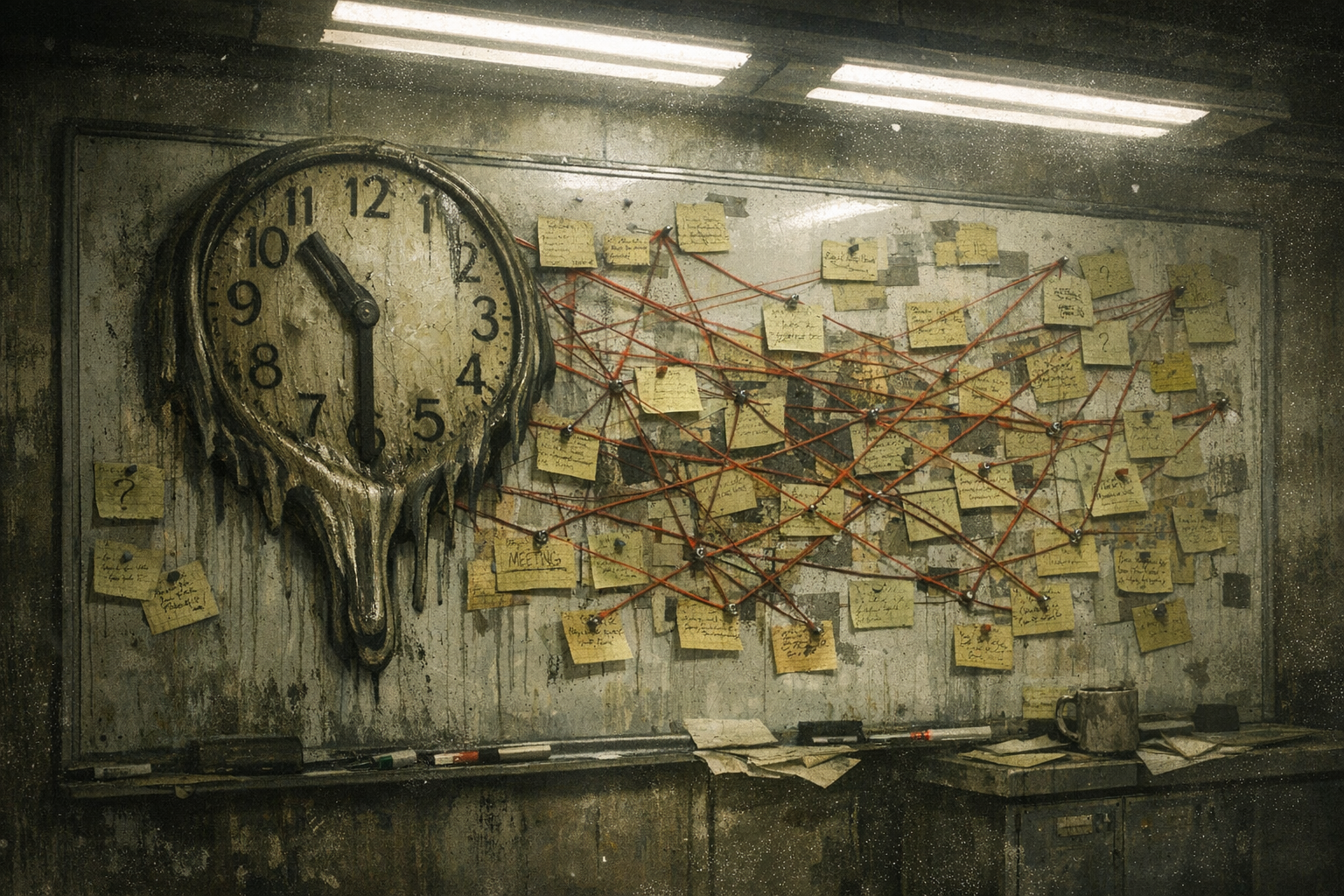
The stand-up meeting was invented as a kill switch for meetings. Fifteen minutes. Everyone standing. Discomfort enforces brevity. You say what you did, what you’re doing, what’s blocking you. Then everyone goes back to work.
That was the idea. A circuit breaker.
Now there’s a recurring calendar invite, a shared doc with a template, three Teams reminders before it starts, a rotating facilitator, and a parking lot agenda for items that “deserve more time.” The parking lot has its own follow-up meeting. That meeting has prep work.
We built a faster way to communicate and then staffed it.
The Original Sin Wasn’t Laziness. It Was Status.
Here’s the thing nobody says out loud: the stand-up didn’t get corrupted by accident. It got corrupted on purpose, by people whose job security depends on meetings existing.
If the meeting is short and information-dense and then done, certain people have nothing to show for their morning. No output. No artifact. No proof they were present and contributing. So the meeting grows, because growth is how some people justify their existence in a room.
I’m not talking about developers. Developers hate this. I’m talking about the layer of coordination that accumulates around any team that’s actually shipping things. The people who track the tracking. Who schedule the scheduling. Who send the recap of the recap.
They don’t mean harm. Most of them are probably exhausted and underpaid and trying to look useful in a system that’s made usefulness abstract. But the net effect is that your fifteen-minute sync now has an owner, a format, a set of norms, and three people whose performance reviews implicitly depend on its continued existence.
That’s not a meeting. That’s a small bureaucracy with a timer that nobody checks.
I judge companies by their error messages and their coffee. Both tell you the same thing: how much this organization respects the people actually doing the work. A stand-up that runs forty-five minutes tells you the same thing as a 500-error page that just says “Oops.” Someone wasn’t thinking about the person on the other end.
What It Actually Costs and Why Nobody Adds It Up
Let’s be specific, because vagueness is how this stuff survives.
A ten-person team. Daily stand-up. Forty-five minutes instead of fifteen. That’s thirty extra minutes per person, per day. Two hundred fifty minutes a week. Per person. Ten people means forty-one hours a week. That’s basically one full-time employee just evaporating into meeting overhead every single week.
Nobody writes that on a budget line. Nobody puts it in a sprint retrospective. It just disappears into the calendar, and the calendar is the most trusted document in most organizations. If it’s on the calendar, it must be necessary. Nobody questions the calendar.
The hidden cost isn’t even the time, though. It’s the mental residue. A meeting that runs long doesn’t just take time. It takes the twenty minutes after it that your brain needs to get back into deep work. Long stand-ups tend to cluster in the morning, which is when most engineers do their best thinking. You’ve effectively strip-mined the most productive part of the day to produce a shared understanding that could have been a three-paragraph Slack message.
And nobody volunteers that information because the people who benefit from the meeting are also the people who run the retrospectives.
The Subtasks Are the Tell
You want a diagnostic? One question. Does your stand-up generate work?
Not work that already existed. New work. Action items. Follow-up threads. “Hey, let’s sync on that later” moments that become calendar invites. If your stand-up consistently produces new tasks, you don’t have a stand-up. You have a planning meeting wearing a stand-up’s clothing.
The subtask is the tell. The second someone says “I’ll create a ticket for that,” the meeting has metastasized. It’s no longer reporting status. It’s now generating requirements. That is a categorically different activity, and it deserves a different time slot, a different attendee list, and someone who actually has the authority to make decisions.
What happens instead: the person who “creates a ticket for that” assigns it to themselves, puts it in the backlog, mentions it at the next stand-up, and the loop begins again. You now have a process that sustains itself by producing inputs for itself.
That’s not agile. That’s a perpetual motion machine made of calendar invites.
The deeper dysfunction is that nobody in the meeting has enough power to stop it. The developer who’s watching twenty minutes evaporate knows something is wrong but has no structural mechanism to fix it. The facilitator is incentivized to keep things moving, not to end the meeting. The manager is getting information they might actually need. Everyone has a private cost and a diffuse benefit and the math never gets done publicly.
So it continues. And someone adds a new field to the stand-up template. Just one field. Just to help with “visibility.”
Nothing About This Is Inevitable
The stand-up doesn’t have to become a meeting. Some teams hold the line. The ones that do share a few things in common.
The people running them understand what a stand-up is for. Not “alignment.” Not “visibility.” Not “keeping everyone on the same page.” Those are descriptions of what a meeting produces for the people who like meetings. A stand-up is for surfacing blockers and ending as fast as possible. That’s it. Two functions. Everything else is scope creep.
The other thing those teams share: someone with standing is willing to be rude about time. Not mean. Just rude enough to say “that’s a sidebar, let’s take it offline” and then actually end the meeting. Politeness is why stand-ups bloat. Someone asks a question that deserves a real answer, and the polite thing is to try to answer it. The correct thing is to table it and protect everyone else’s morning. Those are different things.
There’s also the question of async. Some stand-ups shouldn’t exist at all. A team that writes clearly, updates their tickets honestly, and flags blockers in a shared channel doesn’t need a daily verbal ritual to prove it’s functioning. The stand-up was a workaround for teams that couldn’t communicate any other way. Plenty of teams don’t need the workaround anymore.
But the calendar invite persists, because deleting a recurring meeting requires someone to admit it wasn’t necessary, and that’s not a conversation most organizations are structurally capable of having.
The stand-up was supposed to kill meetings. Instead, it became the thing that needed killing, and everyone’s too busy in their stand-up to notice.