Frank
Frank
1. You Don’t Become a Fan. You’re Just Born One.
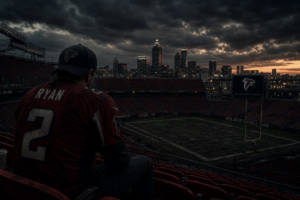
I didn’t choose the Atlanta Braves. That’s not how it works in Middle Georgia. You come out of the womb in this part of the state and somebody has already made that decision for you. The Braves were on TBS every night, Dale Murphy was the closest thing to a secular saint that Georgia had to offer, and rooting for any other team would have been a social and geographic crime. You don’t pick a team here. You inherit one.
That’s an important distinction. Inherited fandom doesn’t come with opt-out clauses. You don’t get to transfer your loyalty to a franchise that’s performing better or a city that has more playoff appearances. You’re locked in. And that lock is not a burden exactly, it’s just a fact, the same way Milledgeville is where I’m from and Gray is where I live and neither of those facts is particularly negotiable.
2. The Nineties Broke Something in My Expectations
I was in my early twenties for most of that run. Division titles every year, year after year, like it was just the natural order of things. Maddux, Glavine, Smoltz. The best pitching rotation in modern baseball history and it was ours, parked right there in Atlanta, doing something so good it almost seemed unfair.
The problem with that era is that it recalibrated what I thought a good baseball organization looked like. One World Series title out of all those years should have felt embarrassing. Instead, because of how dominant the regular season was, it felt like we got shorted. That is a genuinely insane position to hold about any sports franchise, but here we are.
I watched the 1995 World Series with my brother William. That’s one of the things that sticks. We were living together in Milledgeville at the time, and I remember exactly what that felt like, both of us going absolutely stupid when they closed it out. That was a real moment. That was the Braves at the top of what they could do, and we were there for it together.
3. The Middle Years Were Fine, Which Is Somehow Worse Than Bad
There’s a special kind of frustration that comes from watching a team be good but not great for a decade. Not bad enough to feel the cleansing fire of a full rebuild, not dominant enough to do anything in October. Just good. Functional. Present.
The years between that dynasty and the 2021 title felt like that to me. You’d watch them make the playoffs and then watch them do nothing once they got there. And that’s harder to process than a losing season, because a losing season has an obvious explanation. “Good but not enough” has no explanation. It just sits there.
4. 2021 Was Not What You Think It Was
The 2021 championship gets talked about like it was a surprise. It wasn’t. Not to anyone who was paying attention. The pieces had been building for a while, Freddie Freeman had become one of the best first basemen in the game quietly while people were busy talking about other franchises, and Brian Snitker had settled in as a manager who actually seemed to understand how to use what he had.
What was surprising was when it happened. They were below .500 in August. That World Series run was the kind of baseball where you just stop analyzing and start watching. There’s nothing to break down. It was chaos that turned into inevitability, and I have no rational framework for it. I just know I was in the living room losing my mind in a completely undignified way and Kimberly was somewhere between entertained and concerned.
5. Freddie Freeman Leaving Still Sits Wrong
I have made my peace with it. Mostly. The organization made their decision, Freeman made his, and the Dodgers have a World Series ring with his name on it now, so congratulations to everyone involved.
But there’s a version of the last few years where he stays in Atlanta and those middle-of-the-order questions answer themselves. Freddie Freeman in a Braves uniform for his entire career would have been the kind of continuity that means something beyond wins and losses. It would have been a statement that the organization understood what it had. Instead it became a negotiation that fell apart.
I’m not saying either side was wrong exactly. I’m saying it changed how I watch the team now. There’s a loyalty question that hangs over every big contract situation since then.
6. The Rotation Has Always Been the Identity
When the Braves are good, it’s the pitching. That’s the through-line from Maddux to Hudson to Smoltz coming back out of the bullpen to whatever they’re doing now. The lineup has varied. The managers have come and gone. The uniforms have gone through phases I try not to think about. But the organizational identity has always been built around starting pitching and defense.
When that foundation holds, they’re competitive. When it doesn’t, everything else gets exposed. I watch their rotation news the same way other people watch the injury report. It tells me more about what kind of year it’s going to be than the offense does.
7. Ronald Acuña Is What a Franchise Player Actually Looks Like
There’s a version of watching baseball where you’re just counting wins and losses and adjusting your expectations accordingly. And then there’s watching Ronald Acuña play baseball, which is something else entirely. The man makes plays that don’t fit neatly into any highlight category. He’s not just fast, he plays with a kind of controlled recklessness that makes the game look different when he’s on the field.
Watching him work his way back from the ACL has been its own story. The concern isn’t really about whether he can return to form. Players like him usually do. The concern is whether the window around him gets maximized or wasted. The Braves have had a history of letting those windows close.
8. What Patience Costs Over Decades
Here’s the thing nobody tells you about being a lifelong fan of any franchise: the longer you’re in it, the more you have personally invested in outcomes you have absolutely no control over. I am fifty-five years old. I have spent more calendar time caring about what happens to this baseball team than I’ve spent on most things I actually had a say in.
There’s no rational defense of that. Fandom is not rational. It’s not meant to be. But it does cost something. It costs time, attention, emotional energy, and in certain October series, a few years off your lifespan.
The Braves don’t owe me anything for that. They didn’t ask me to invest. I just did, the same way any kid growing up in Baldwin County in the seventies would have. And I’ll keep watching because that’s how inherited things work. You don’t put them down just because they’re heavy.
William understood that. He’d have something specific and pointed to say about this roster right now, and I’d probably argue with him about it. That part I don’t get to have anymore. But the games are still on, and I’m still watching, and that’s the part that doesn’t change.