Frank
The first time I drove “The Luse,” I was probably fifteen years old and absolutely should not have been behind the wheel of a 383 Magnum.
It was a 1968 Chrysler Newport, four-door, the color of something that hadn’t been washed since Nixon was in office. We called it The Luse, short for SS Lusitania, because that thing was genuinely the length of a small ocean liner. My dad’s aunt had it, gifted it to us and it was exactly the kind of car that makes no sense on paper and every kind of sense when you’re sitting in it. Heavy. Long. Built like a vault. The 727 TorqueFlite shifted like it had opinions about where it was going, and it mostly went where it wanted.
I didn’t “fully” appreciate any of that at the time. I was fifteen. I just knew it was big and loud and kind of terrifying to parallel park.
It took me about 20 minutes after Dad sold it to realize that car was actually something special. Something that was part of me that could not be replaced.
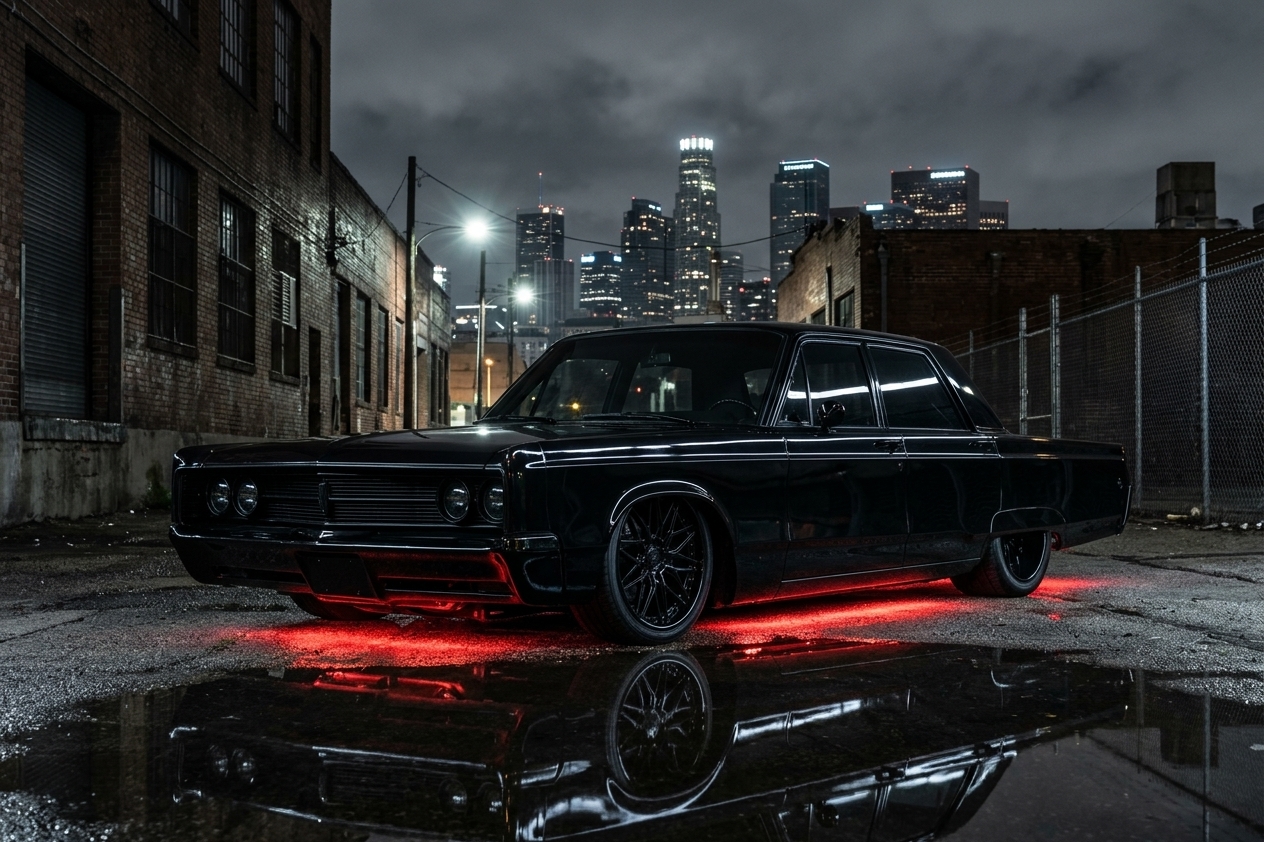
Now I’m fifty-six, and I find myself thinking about what I’d do if I could find a clean one tomorrow. Not restore it. Not preserve it. I’d murder that thing out completely.
Here’s the exact build I’ve been running in my head.
First, the motor gets pulled and built. The 383 Magnum is already a good block, plenty of cubic inches to work with, but “good” doesn’t mean done. Forged internals, a serious cam, a decent set of heads, and you’ve got something that can actually move all that steel. I’m not chasing race numbers here. I want torque. Low-end pull that pushes you into the seat when you get into it. “Pull Hell of the Hinges”, so to speak. This is a boulevard car, not a strip car.
Then I’d bag it, put it in the dirt. Next comes a narrow rear end and some fat ass tires. That’s non-negotiable. One of the things that ages big cars badly is the stock stance, those skinny factory tires sitting inside wheel wells that were engineered for road clearance and nothing else. You lower it, narrow the rear, fit a set of proper wide meats back there, and suddenly the whole car plants differently. It looks planted. It is planted. Wicked deep-dish black rims. Something aggressive without being cheap-looking. This car is going to be dark on dark on dark, so the wheels have to carry some of the visual weight.
Limo tint, all the way around. Full blackout. You shouldn’t be able to see inside this car at all.
Paint is black. Not metallic, not pearl. Gloss – high-solid two-stage urethane system (base coat + clear coat). After spraying, the clear coat will get a full color-sand and buff to eliminate any orange peel, achieving a glass-like finish that mirrors the concrete when aired out.. Let the shape do the work. The Newport’s body lines are actually pretty clean for a car that big, long hood, squared-off roofline, that formal four-door silhouette. You don’t need to add much. You just have to eliminate everything that isn’t the idea.
What a Build Like This Is Actually About
This isn’t a restoration project. I want to be clear about that.
Restoration is about putting something back the way it was. I understand the appeal, I do. My dad and I did a frame-off on a ’67 GTO with a 400 and a Turbo 400, and I never even got to drive the finished product because we sold it. That one still bothers me, if I’m being honest. All that work and someone else got to enjoy it.
But what I’m describing with the Newport is something different. It’s more like a conversation between what the car was and what it could be. You’re not erasing the history. The 383 block is still there. The basic architecture is still Chrysler B-body from 1968. You’re just re-dressing it in a way that makes it relevant to right now, to how you see it, not how a factory spec sheet saw it fifty-six years ago.
There’s also something specific to this car that makes the murdered-out treatment feel right. The Newport was always the overlooked one in the Mopar lineup. It wasn’t the 300. It wasn’t a Road Runner. It was the big, sensible, slightly boring family hauler that happened to share a platform and an engine family with cars people actually talked about. That anonymity is part of the appeal now. Nobody’s looking for it. Clean ones don’t get bid to the moon at auction because they’re not on the radar the way a Charger or a ‘Cuda would be.
You find a solid one, you build it the way I’m describing, and you’ve got something genuinely unique. Not a clone of something famous. Not a numbers-matching trailer queen. Something that shows up and makes people walk across a parking lot going, “what is that thing?”
That’s the whole point.
I like systems because motivation is unreliable. If I waited to feel inspired every time I wanted to build something, nothing would ever get finished. A good build plan works the same way. You write it down, you sequence it, you execute the steps. Motor first, then rear end, then suspension, then body and paint. You don’t start with the cosmetic stuff and then realize you should have done the mechanical work first. The plan is the thing.
The Luse deserves a plan like that.
Somewhere there’s a ’68 Newport sitting in a field or a garage, probably with a flat tire and a seized brake caliper, waiting for somebody to see it for what it actually is. If I ever find a clean body with a solid floor, I’m buying it before I finish negotiating. I’ve already got the build in my head. I’ve been carrying it around for 41 years.