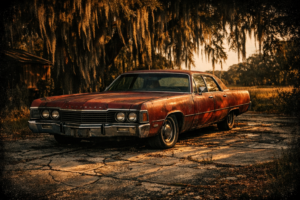
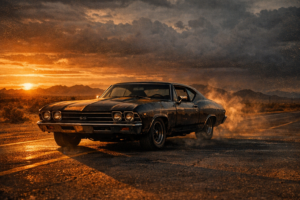
Monkeywrench
The formula wasn’t horsepower. It wasn’t the sheet metal. It wasn’t even the sound, though God knows the sound was part of it.
It was the fact that nobody was trying to build an icon. They were trying to win a fight.
Chevrolet wanted to beat Ford. Ford wanted to embarrass Chrysler. Chrysler wanted to prove everyone wrong. The whole era was a street fight between divisions that genuinely hated each other, and the cars were the weapons. You don’t manufacture that with a brand strategy session. You can’t roadmap it into existence. The aggression was real, so the machines felt real.
That’s the part nobody talks about when they try to explain why a 1969 Chevelle or a ’70 Cuda still stops people cold in a parking lot. It’s not nostalgia, exactly. It’s something closer to recognizing a thing that wasn’t built by committee.
What It Actually Cost
Here’s what the golden age mythology skips over.
Those cars were mechanically exhausting. The maintenance cycle on a big block from that era was a part-time job. Carburetors that needed tuning every other season. Points ignitions that drifted constantly. Brake systems that required faith as much as hydraulics. If you actually drove one as a daily in 1970, you weren’t experiencing romance. You were managing a relationship with something that wanted to kill you on a wet road.
The fuel economy was not a tradeoff. It was an insult. These things didn’t sip gas. They inhaled it. The 1973 oil embargo didn’t kill the muscle car era by accident. It killed it because those engines were built for a world where fuel was practically free and nobody was counting.
And the build quality, the actual fit and finish, was frequently terrible. Gaps in the body panels. Interior materials that cracked inside of two summers. Rust that started before you finished paying it off.
So you’re telling me people are obsessed with cars that were unreliable, expensive to run, and fell apart on schedule?
Yes. Exactly. That’s the whole point.
The tradeoffs were honest. A 1970 Chevelle SS 454 didn’t pretend to be a sensible purchase. It didn’t promise efficiency or longevity or all-weather composure. It promised one specific thing. You knew what you were getting, and it delivered that one thing with total commitment. There’s a strange integrity in that, even if the thing is objectively impractical.
Modern performance cars are better in every measurable way, and they feel like appliances. The Dodge Challenger tried to reach back for that feeling and came closest. It was also the most polarizing car in its segment for twenty years, which is itself evidence that the formula is uncomfortable for people who want performance without personality.
The reason nobody has replicated the late sixties formula is that replication requires the original conditions. You need scarcity. You need competition without safety nets. You need engineers who are also enthusiasts arguing with accountants and sometimes winning. You need an industry that hasn’t yet learned how to protect itself from its own instincts.
That window closed. Emissions standards, insurance rate spikes, the fuel crisis, corporate consolidation. All of it was probably necessary. Some of it definitely was. But the conditions that produced the GTO and the Boss 302 and the Hemi ‘Cuda were conditions the industry survived, not conditions it chose.
Things that just work don’t always need explaining. But things that made you feel something, even when they were breaking down, those are worth understanding. Not to recreate them, just to be honest about why nothing since has landed the same way.
The cars weren’t special because Detroit was brilliant. They were special because Detroit was desperate. And you can’t fake desperate.