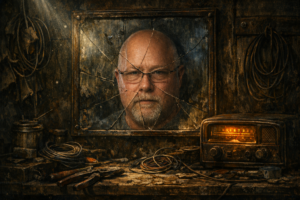
Frank
Frank
Nobody told me getting a diagnosis at 55 would feel like losing something.
That’s not how people talk about it. The cultural script says you finally have answers, you finally understand yourself, you move forward with clarity and self-compassion and all the other language that belongs on a wellness blog I will never read. The diagnosis is supposed to be the turn in the story where things start making sense.
Here’s the thing, “things making sense” is not always comfortable. Sometimes the sense it makes is the kind that makes you put the decoder ring down and sit quietly for a while.
That’s where I’ve been.
The Diagnosis Doesn’t Arrive as a Gift
ADHD. Severe anxiety. Autism. Diagnosed late. Meaning I spent 55 years grinding through a life with wiring nobody identified, navigating systems built for a different kind of nervous system, and assuming the gap between how hard things felt and how hard they looked to everyone else was a ME problem. A character problem. A discipline problem.
I finished a degree at GCSU. I’ve built a 28-year career in IT that started with me teaching myself how computers worked because nobody handed me a curriculum. I’ve been married for 28 years. I’ve raised two kids who both turned out to be real people that I actually like. I became a grandfather in October ’24 when Kade was born, and that hit me in a way I didn’t see coming.
None of that is small and none of it is accidental either. It happened because I ground through it. I just didn’t know until recently that I was doing it on hard mode without knowing the difficulty setting was different.
That’s what the diagnosis actually says, if you sit with it long enough. Not that you failed or that you are busted. It says everything you built, you built without the tools the instructions assumed you had. The foundation is real. The cost was just higher than it needed to be, and you paid it in currency you didn’t know you were spending.
The gift framing assumes the diagnosis arrives before the damage is done. At 55, that ship sailed a long time ago. What you get instead is language. And language, when applied backward across five decades, is heavy.
Re-Reading Your Own Life Is Not a Comfortable Process
This is where the mourning actually starts.
The diagnosis works like a decoder ring. You get it, and then you go back. You re-read the social anxiety that made small talk feel like defusing a bomb under fluorescent lights with people watching. You re-read the procrastination that everyone, including yourself, called laziness. The inability to relax. The hair-trigger in situations that most people apparently walk through without their nervous system going full alert. The relationships that were harder than they should have been, not because the people were wrong, but because I was running a parallel processing load nobody could see.
None of that looked like wiring from the inside. It looked like character defects. It looked like things I should have been able to fix if I just tried harder, cared more, paid better attention.
There’s a term, RSD, rejection sensitivity dysphoria, that describes something ADHD brains experience at a level most people don’t. It’s not fragility. It’s a documented neurological response where perceived rejection or criticism hits with a disproportionate intensity. It’s not a choice. It doesn’t respond to “just let it go.” Social situations carry a tax for me that other people don’t pay, and I spent 55 years assuming the tax was personal, that it meant something unflattering about who I was.
There’s also a word, masking – it’s what neurodivergent people do to appear functional in environments built for different wiring. You learn to perform the version of yourself that fits the context. Read that last sentence again….You do it so long it becomes semi-automatic. The problem is it’s exhausting in a way that doesn’t show on the outside, and the energy it costs is real energy you’re not spending on other things.
Solitude, for me, has never been antisocial behavior. It’s repair time. After a workday at Advocate Health that involves being “on” and functional and normal-presenting for hours, I need quiet the way other people need water. That’s not a preference. That’s what a masked nervous system requires just to get ready to do it again tomorrow.
Knowing that now is useful. It doesn’t undo the years of explaining it wrong.
You Didn’t Walk In Empty, You Walked In Pre-Loaded
Here’s the part that adds another layer.
ADHD and mood disorders are among the most heritable conditions in psychiatry. Which means some portion of what I was managing from day one wasn’t accumulated damage, wasn’t circumstance, wasn’t anything I did wrong. It was the starting position. I walked in pre-loaded.
There’s a form of depression called dysthymia, persistent depressive disorder, that runs at a lower grade than major depression but also runs longer. One of its features is anhedonia, which is the muting of the reward circuitry. The upswing that other people seem to access, the thing that makes a good outcome feel good, the signal that says “that worked, keep going,” that circuit runs quieter in a dysthymic brain. It’s biological. It’s not a moral failure. It also doesn’t respond to being told to cheer up.
I don’t get sad in the obvious ways. I get flat. Events that should register as wins sometimes just don’t register. That used to confuse me. Now I understand what’s happening mechanically, which is useful, though it doesn’t make the flatness disappear.
I grew up as a latchkey kid on Lakeside Drive in Milledgeville. The Lakeside Drive Mafia, we called ourselves, me and William and Tom and Derek and Corky, a collection of kids who had a lot of unsupervised time and figured out how to fill it. I’m not telling a hard-luck story here. But a childhood that requires a kid to be self-reliant early, to be alert, to read the environment and respond accordingly, that forms a nervous system in a particular way. High vigilance. Always scanning. The alarm that got calibrated early does not turn off just because the context changes.
I am 55 years old and I am still running the same alarm system I built at age ten. There isn’t a switch and it’s not hyperbole, it’s my neurology.
Thirty Years Is Not Long Enough for That Kind of Loss
This one gets its own section because it doesn’t belong folded in anywhere else.
My brother William was a Baldwin County Sheriff’s Deputy. He was 26. He was killed in the line of duty on December 17, 1995. I was 25. We were eighteen months apart and we had lived together since my freshman year of college. We shared a room before that, all through childhood, until he went off to college his freshman year, which was my senior year of high school. Then he came back and we moved in together and we were just there, two brothers, until he wasn’t.
That’s not a grief story that fits a template. Line-of-duty death of a 26-year-old sibling when you are 25 is developmentally formative trauma. You’re at the exact age when identity and trajectory are getting locked in, figuring out what kind of person you’re going to be, and then the floor gives out in a specific irreversible way.
The anger from that kind of loss is not a stage you pass through on the way to acceptance. It is a feature of the ongoing relationship you have with the person you lost. The question isn’t how to eliminate the anger. The question is how to carry it without it running your life. People who push toward “I’m at peace with it” with a loss like this tend to end up sicker. People who learn to carry it tend to do better. I am still, thirty years later, in the carrying-it phase. That is entirely appropriate.
For nearly twenty years after William died, our family went through trials, appeals, Supreme Court hearings, the whole grinding machine. December 10, 2014, I sat with my younger brother Tom and my father Edward and watched the execution. That’s not closure. That’s a different kind of scar. A different chapter of the same weight.
The diagnosis adds a layer to this that I am still working out. I processed all of that, all nineteen years of it, with an unidentified nervous system. No map. No language for what was happening to me internally. Whatever coping I built, I built it without knowing what I was actually working with. I don’t know yet whether that makes the grief heavier or just more visible. Probably both.
The Medication Trial Process Is Cruel in a Specific Way
Let me be plain and clear about this because it doesn’t get described honestly very often.
Trialing ADHD medications as an adult means you are chemically adjusting your brain to address a condition that, among its other features, makes it hard to be patient with processes that require patience. You try something, give it weeks, evaluate, adjust, try something else, stay regulated enough while doing all of this to still show up at work and be a functional human being, then do it again if the first thing doesn’t land the way it was supposed to.
The reward signal that would normally tell you “this is helping, stay the course,” that’s exactly the circuit that dysthymia mutes. So the feedback mechanism is compromised at the same time you’re trying to use it.
Absolutely senseless design. But here we are.
There is no clean version of this experience. There are only less-bad versions.
I’m carrying this process while also doing a full job at Advocate Health that involves real enterprise-level complexity, Exchange hybrid environments, Active Directory, the whole thing. While maintaining a home lab with active projects. While being a husband and a father and now a grandfather. The patience required is coming from somewhere. I’m just not always sure where.
What I’ve had to talk myself down from is treating every adjustment as confirmation that nothing will ever work. That’s a dysthymic brain looking for evidence to support the low ceiling it’s already set. I recognize it now, which doesn’t make it quieter, but at least I know what I’m arguing with.
The Question Isn’t Whether You’ve Earned the Rest
Here’s what I know at 55 that I didn’t know at 15 or at 25….or 35…..or 45.
The mourning is not the end of the process. It’s the beginning of it. Re-reading your life with a new lens, going back through the social failures and the procrastination and the anxiety and the flat affect and the alarm-system nervous system and re-labeling them as wiring rather than weakness, that’s how the self-blame starts to lose its structural support. It’s not comfortable. It is, however, necessary.
Carrying an unresolved loss without letting it run you is a slow project. At 55, with William still in my head every single day, I am still in the middle of that project. That is entirely appropriate. It doesn’t mean that I’m stuck, it means that it is genuinely heavy and I’m still strong enough to carry it.
The real inventory, the actual one, not the self-critical one that runs automatically, looks like this: 28-year career in IT built largely from scratch and self-taught. A marriage still standing after 28 years. Two adults I raised who are actually good people. Lauren’s son Kade, the first grandchild, who arrived and hit me somewhere I didn’t expect. Real technical work, Cookslate, FleetWright, HomeBase, tools that exist in the world and do actual things, built by someone who barely qualifies as a programmer but built them anyway.
That is not a failure story. That is a hard-mode success story. Written by someone who never knew the difficulty setting was different.
Let me be blunt: I am a 55-year-old man with documented neurodevelopmental differences, a nervous system formed in high vigilance, genetic psychiatric loading I walked in with before anything happened, an unresolved line-of-duty sibling death, and a daily workload that would be heavy even for someone without any of that.
Y’all, anyone with those inputs would be tired.
The question is not whether I’ve earned the rest. That part is obvious.
The question is whether I can let myself have it.
I’m working on it.