Frank
Frank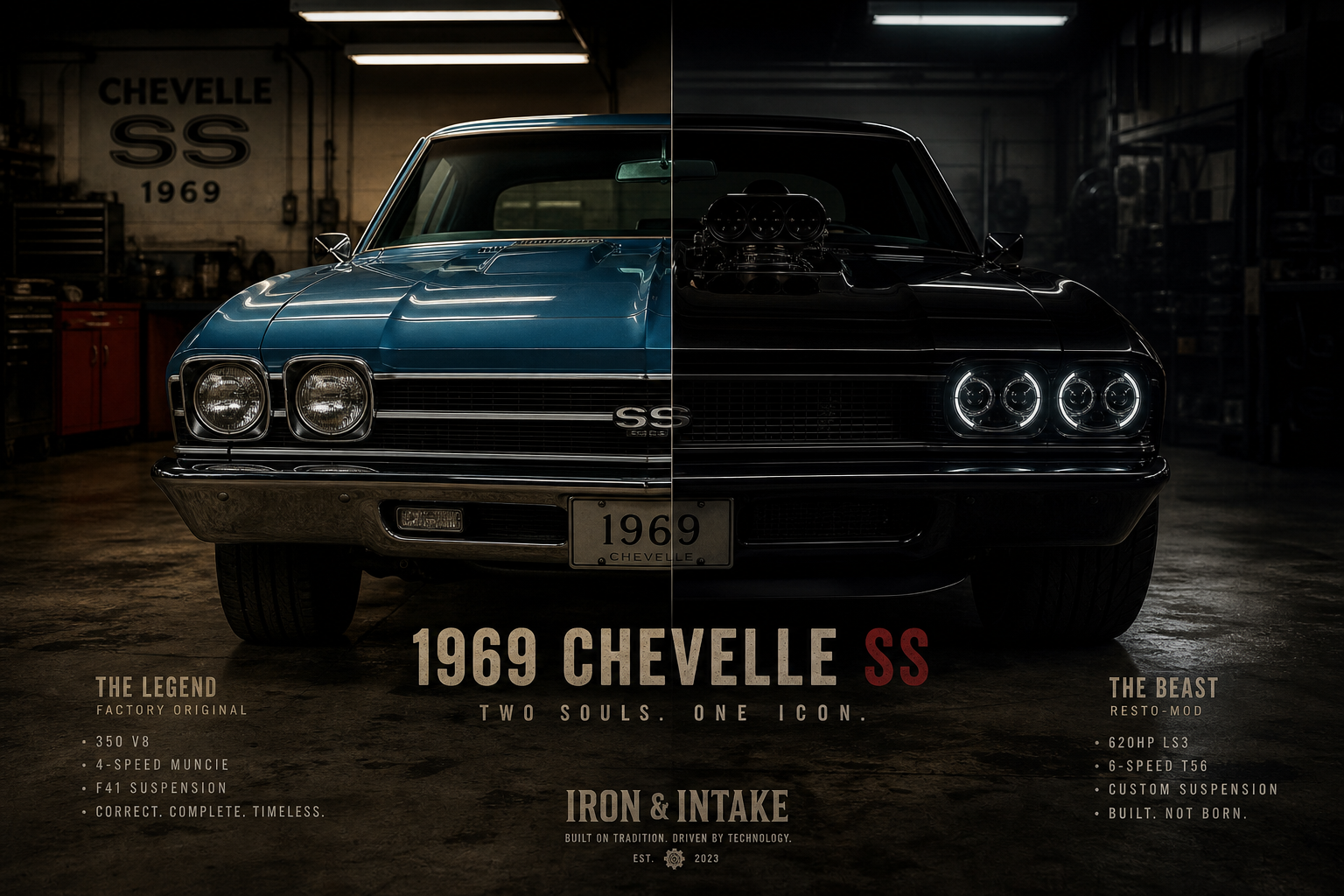
The second you say you’re building a classic car, someone’s going to ask you which camp you’re in. Keep it factory correct, or make it something you can actually drive in traffic without sweating through your shirt and wondering if the brakes are going to work.
I’ve thought about this more than I care to admit. And after years of being around old iron, here’s what I actually think.
What “Stock” Means in the Real World
- Original is irreplaceable, and that matters more than people admit. A numbers-matching car is a document. It’s a physical record of exactly how something was made, on a specific day, at a specific plant, with specific parts. Once you start modifying it, you can never fully un-modify it. That doesn’t mean you shouldn’t, but you need to understand what you’re giving up before you crack that first bolt.
- Factory correct cars tell the truth about what the era actually was. A bone-stock ’70 Chevelle SS 454 with the original engine, original trim, original interior, original four-speed, that’s not a fantasy. That’s exactly what GM shipped. And what GM shipped was both magnificent and flawed in equal measure. The drum brakes were marginal. The factory carburetor could be temperamental. The seat foam is 55 years old. Keeping it honest means keeping all of that.
- Numbers-matching cars have a ceiling. You can maintain one. You can restore one. You cannot meaningfully improve one without destroying the thing that makes it valuable in the first place. That’s a trade-off that makes sense for some people and none at all for others.
What Resto-Mod Actually Is (and Isn’t)
- A resto-mod is not a shortcut. It’s a different goal. People who look down on resto-mods are usually comparing the wrong things. Nobody builds a resto-mod because they couldn’t afford to keep it stock. They build one because they want to drive it on a Tuesday without it being an event. Air conditioning that works. Brakes that stop the car. Fuel injection that doesn’t need tuning every spring. That’s not disrespect for the car. That’s a different relationship with it.
- The best resto-mods are invisible until they’re not. That’s the craft. A well-executed build looks right from twenty feet, sounds right when it starts, and then absolutely destroys your expectations when you get it on the highway. The body is original, the stance is right, the chrome is real. But under the hood, there’s a modern LS or a stroked small block on EFI, and behind that firewall there’s a Tremec instead of a Muncie. It looks like the past. It drives like something that doesn’t hate you.
- Bad resto-mods are a real thing, and they’re everywhere. This is where the philosophy breaks down in practice. An LS swap done right is incredible. An LS swap done wrong, with a harness that looks like something from a server room after an outage, mismatched gauges, a suspension that’s been partially modernized so it corners like a compromise, that’s just a broken car wearing a classic’s body. The execution matters as much as the concept. Probably more.
Where Each One Falls Apart
- Stock cars fail when the owner treats them like investments first and cars second. The saddest thing I’ve seen in classic car culture is a beautiful numbers-matching car that never gets driven. Trailered to shows, wrapped in a cover the other 350 days a year, constantly worried about the humidity in the garage. I understand it. I don’t think it’s wrong exactly. But a car that never gets driven is a car that’s slowly dying anyway, just slower and cleaner than the alternative.
Stock cars also fail when someone restores them to a standard the original factory never actually achieved. Factory correct doesn’t mean perfect. It means assembled by hourly workers in a plant in Norwood, Ohio on a Wednesday. Some of those cars left with uneven panel gaps and overspray in places nobody was supposed to look. Concours-level perfection on a driver-quality car is its own kind of fiction.
- Resto-mods fail when the builder loses the thread of what the car was. The whole point is that it should still feel like that car, just more competent. When you’ve lowered it four inches, widened the body, swapped the interior for something from a totally different era, installed a completely different engine, and kept essentially nothing original except the shell, what you have isn’t a resto-mod anymore. It’s a kit car wearing a famous name. That’s fine if that’s what you want. Just don’t call it something it isn’t.
I’ve gone back and forth on this my whole life, and I still do. I try to think long term about these things, but the honest answer is that my opinion shifts depending on the specific car.
A ’69 Camaro Z/28 with its original DZ 302? That thing stays stock. Full stop. There aren’t many of them left, and the people who keep them right are doing the rest of us a favor by preserving something real.
A ’72 Nova with a tired 307 and a three-speed? Build the damn thing. Put in what you actually want, make it reliable, and drive it. Nobody’s protecting the historical integrity of a base-model Nova. That car wants to be enjoyed, not curated.
The car tells you what it is. Most of us just need to get quiet enough to listen.