
Six Thinking Hats AI
What is this?
Edward de Bono’s Six Thinking Hats is a 40-year-old method for structured parallel thinking.
Instead of one perspective dominating a decision, you examine it through six distinct lenses,
facts (White), emotions (Red), risks (Black), benefits (Yellow), alternatives (Green), and
process (Blue), each in turn.
This tool automates that structure. Pick a hat and describe your decision, or run Debate Mode
to stream five AI perspectives simultaneously, then synthesize them with Claude Sonnet into a
decisive recommendation. Sessions persist, share by link, and export to Markdown or PDF.
Live demo
Try the live demo: Should I quit my job to start a company?
This is a pre-seeded Debate Mode session, no sign-up required, no API key needed.
The app itself is rate-limited (30 requests/min per IP) but the demo link is read-only
and accessible without the token.
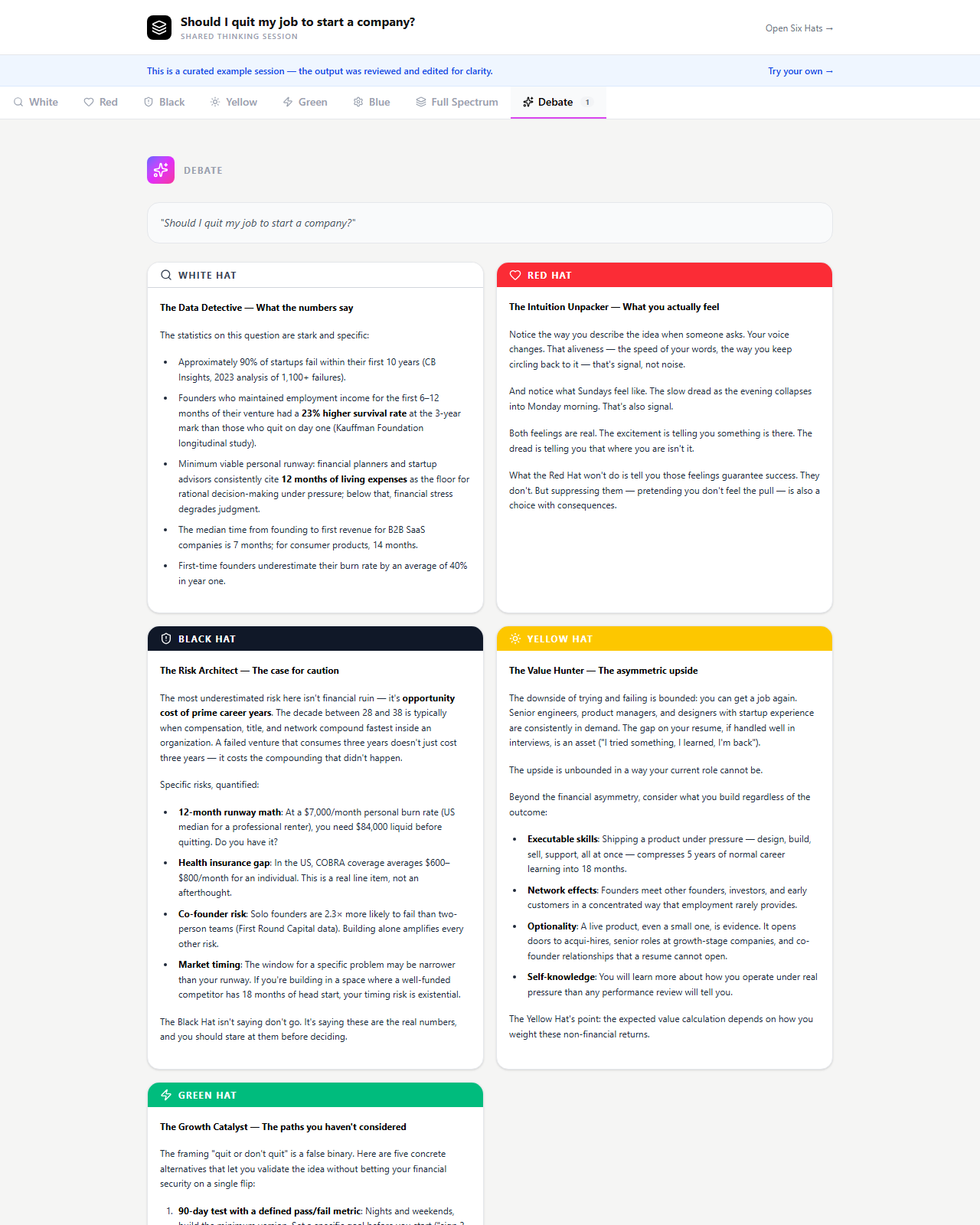
Debate Mode -five AI perspectives on a single decision, synthesized by Claude
Multi-agent Debate Mode
Debate Mode is the technical headliner. Five Claude Haiku instances stream in parallel, each
taking a distinct analytical stance on the same question. When all five finish, Claude Sonnet
reads their outputs and synthesizes a final recommendation.
This is not sequential AI prompting with a “now summarize” step. It is genuine parallel execution:
five concurrent SSE streams, one shared session, one synthesis call that reads all five before
responding. The result is a recommendation that has genuinely considered opposing perspectives,
not just the loudest one.
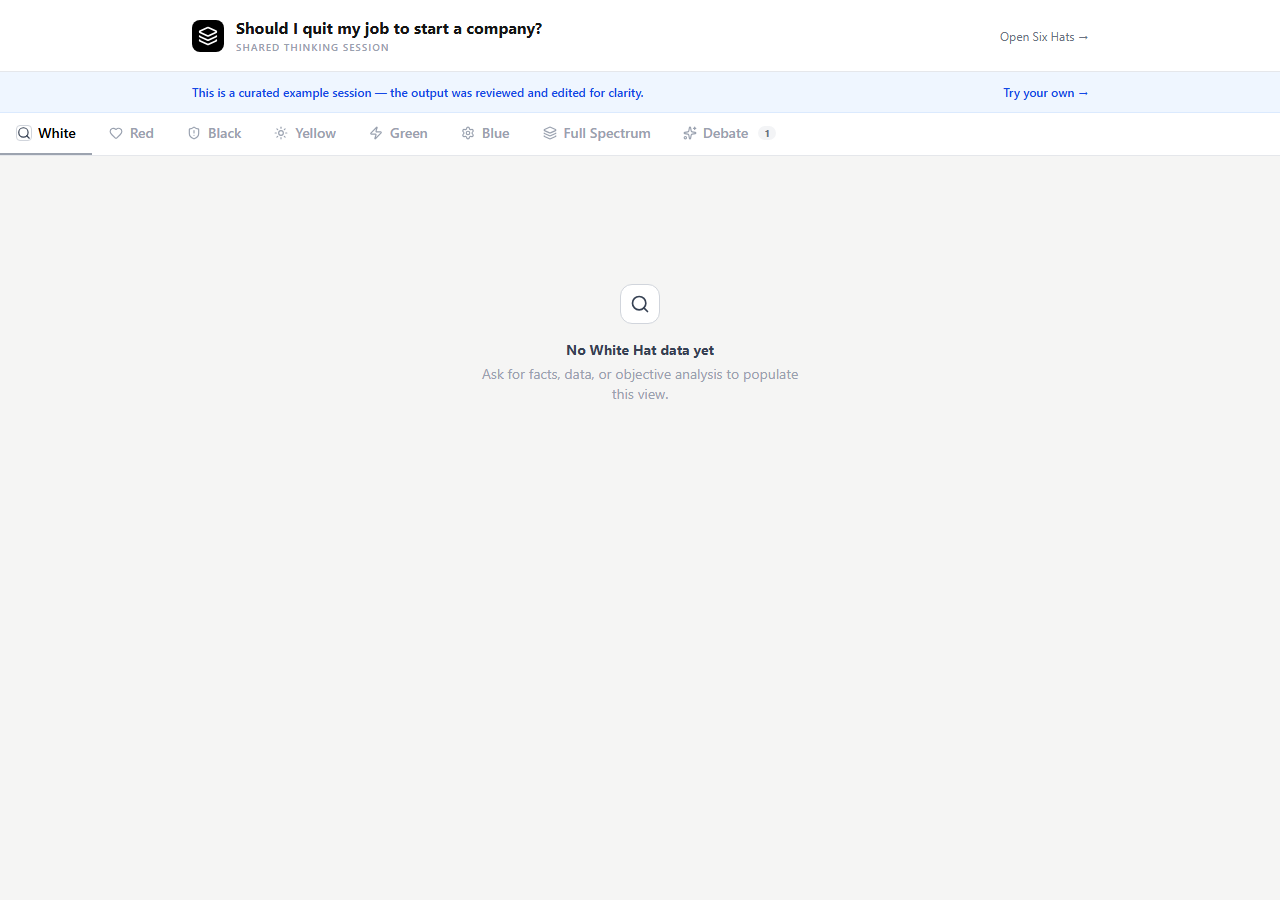
The per-hat tab UI
Each analytical lens lives in its own tab. Switch between White (facts), Red (emotion), Black (risk),
Yellow (benefit), and Green (alternatives) to navigate a session. A Debate tab appears automatically
when a session contains a multi-agent debate.
Per-hat tab view – each analytical lens has its own organized thread
Deploy anywhere
No cloud-specific platform required. One Node.js process serves both the API and the built Vite
client. Runs on any VPS, home server, or Docker host.
# Clone and configure
git clone https://forgejo.familytechlab.com/frank/sixhats.git
cp .env.example .env
# Set: CLAUDE_API_KEY, APP_TOKEN (also set as VITE_APP_TOKEN for the client build)

# Build and run with Docker
docker compose up -d --build

# The app is now at http://localhost:3001
# Proxy with Caddy (see Caddyfile.snippet in the repo)
Security model
The APPTOKEN is intentionally included in the client bundle as a shared secret for solo-user
access control. Any developer who opens DevTools can extract it in 30 seconds, this is
security-by-obscurity, not real auth.
The actual defense is rate limiting on /api/generate (30 req/min per IP) and /api/debate
(5 req/min per IP) plus a configurable daily spend cap via DAILYCOSTCAPCENTS. For a
personal single-user tool, this is the right tradeoff. The architecture preserves the auth
retrofit path: userid TEXT DEFAULT 'anonymous' is already in the schema, and getRateLimitKey(req)
is already factored for a one-line swap when real auth lands.
For a multi-user deployment, replace APPTOKEN with Authentik OIDC (already in the infrastructure)
and scope sessions and usage logs by user_id.
Architecture
client/       Vite 6 + React 19 + Tailwind 4 (SPA)
server/       Express 4 + better-sqlite3 (API + SSE streaming)
shared/       Hat types, prompts, model routing (isomorphic)
data/         SQLite DB (gitignored, volume-mounted in Docker)
dist/         Built client assets (served by Express in production)
Model routing (shared/hats.ts):
- Single-hat queries + Debate-mode perspectives →
claude-haiku-4-5 - Full Spectrum + Debate-mode synthesis →
claude-sonnet-4-6
Development
cp .env.example .env.local
# fill in CLAUDE_API_KEY, APP_TOKEN, VITE_APP_TOKEN (same value as APP_TOKEN)

npm install
npm run dev
# Express backend → :3001, Vite dev server → :3000 (proxies /api to backend)
npm run build   # Vite build → dist/
npm start       # NODE_ENV=production tsx server/index.ts
Health check: GET /health → { ok: true, uptime, version }
Issues and roadmap: Forgejo
