Frank
Frank
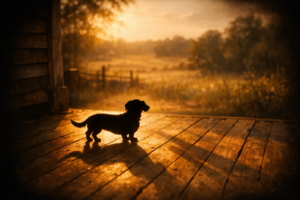
Flash was our sixteen-year-old Miniature Dachshund who got put down three days before Christmas last year, and I still reach for him sometimes. Not dramatically. Just that half-second when you walk past the spot where his bed used to be and your brain sends the wrong signal before reality corrects it.
Oakley is seven years old, ninety pounds, and could eat Flash’s entire bed as a snack. He’s a German Shepherd with a personality big enough to fill any room he walks into. He is also completely irrelevant to the grief, and that is not a slight against him.
This post is about why those two things are both true at the same time.
The Day We Put Him Down
December 22nd. Three days before Christmas.
Flash had been winding down for a while. Sixteen years is a genuinely long time for a Miniature Dachshund. He got there having lived a charmed life, no back problems that breed is famous for, just the slow drift of old age, with all the incremental losses that accumulate before the final one. You watch a dog age long enough and you spend the last couple of years half-braced for the conversation with the vet.
When the conversation finally came, we already knew. That’s a mercy and a cruelty at the same time.
What I was not prepared for was the specific texture of losing something that had been woven into daily life for that long. Flash was there when Lauren was nine. He was there when Logan was seven. He watched Kimberly and me argue about things that don’t matter anymore and celebrated the things that did. When Kade was born and we brought him around, Flash was already slowing down, but he was still there, still taking up his spot in Kimberly’s chair like he had a deed to it.
Sixteen years is not a pet. Sixteen years is a chapter of your life with four legs.
Why Oakley Can’t Fix This (And Why I Don’t Want Him To)
Here’s the question people ask without asking it directly, usually with a sympathetic tilt of the head: “Well, at least you still have Oakley.”
I know what they mean. They mean well. And yes, Oakley is here, and Oakley is a genuinely good dog who takes up considerable square footage and demands attention with the confidence of someone who has never once doubted his own worth.
But “at least you still have Oakley” is the same logic as “at least you still have your other hand.” It’s not wrong, exactly. It just doesn’t understand what loss is actually doing.
Flash and Oakley occupied entirely different categories in our house. Flash was a lapdog, a Velcro dog, a creature whose entire operating philosophy was proximity to a human being at all times. He had one speed: pressed against you. Oakley is patrol mode. He moves through a room like he’s checking a perimeter. He loves us, but on his own terms, in his own way, and that way does not involve sitting on your feet for six consecutive hours while you watch television.
Neither of those things is better. They’re just different animals, with different natures, doing different jobs in the household. Expecting Oakley to fill the Flash-shaped hole in the room is like expecting a Dodge Charger to scratch the itch that a ’69 Cadillac leaves. Both are cars. That is where the overlap ends.
What Grief Actually Does With Its Time
I’m almost fifty-six years old. I have had enough loss in my life to know that grief does not operate on anybody else’s schedule, and it does not consult you before it shows up.
I’ve spent thirty years carrying a version of grief that doesn’t have a clean edge to it, the kind that doesn’t resolve, that just becomes part of the architecture of who you are. Losing Flash is not in that category. It’s not the same weight. I want to be clear about that.
But grief is not a competition, and small losses are still losses. The sixteen-year loss of a dog is real, even if it doesn’t break you the way other things do.
What it does is leave a specific kind of quiet. Flash was a noisy presence. Not loud, exactly, but present. His nails on the floor. His spot on the couch. The way he’d position himself in whatever room you were in, not because he needed anything, just because that’s what he did. When that’s gone, the absence has a shape. You notice it in the same way you’d notice a piece of furniture that got moved. Nothing is wrong. Something is just different, and your muscle memory hasn’t caught up yet.
Oakley fills the house with different sounds. Unbridled energy. His is not a quiet presence. But he is not trying to fill Flash’s place and, honestly, I would not want him to. What Flash was to this house is finished. Oakley is something else entirely. That’s not sad. That’s just true.
The Part Nobody Says Out Loud
There is a specific guilt that comes with having two dogs and losing one. Like you are supposed to immediately redistribute all of your affection onto the surviving animal and call it even.
I did not do that. I still haven’t done that, and I don’t think I need to.
Oakley gets what Oakley gets. He gets the frisbee throws, the attention, the treats, the scratches behind the ears that he shoves his enormous head into so he can lick you. He is not being shorted. He is not grieving the way I am. He seems to have processed the new reality faster than I have, which is one of the things about dogs that is either admirable or quietly devastating depending on the day.
I’m still somewhere in the middle of it. Not stuck, just moving at my own pace.
Someday, we’ll get another Sausage, maybe two. Not soon though. Not as a replacement, because that is not a category I believe in. Just because small dogs and big dogs do different things in a house, and eventually the quiet left by Flash will just be a room we’re ready to put something new into.
But that’s not today. Today, Oakley gets the big dog life he’s always had, Flash gets remembered without being replaced, and I get to sit with both of those things at the same time without anybody trying to make it neater than it is.
That is not a problem. That’s just what grief actually looks like when you stop trying to fix it on a schedule.