Frank
Frank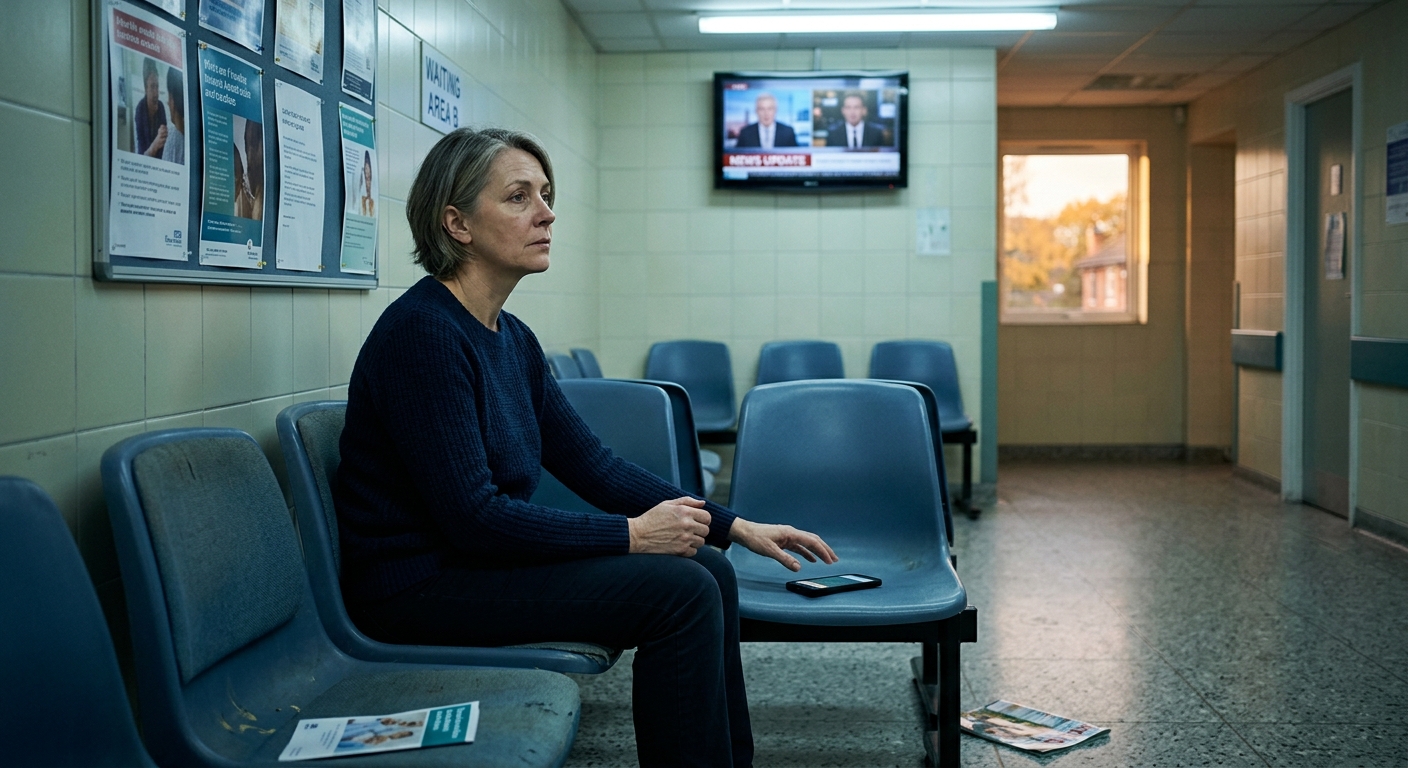
The widespread elimination of unstructured, idle time through smartphone use and algorithmic content feeds represents a largely unacknowledged loss of a cognitively essential human state. Boredom, once a natural feature of daily life, supported memory consolidation, creative insight, self-reflection, and the development of empathy through the brain’s default mode network.
Algorithmic feeds replace that idle cognitive space with a continuous stream of novelty-driven stimulation, training the brain away from sustained attention and deep thought. The author connects this shift to measurable declines in creative capacity and empathy, arguing that the mental processes most essential to human inner life now go chronically unused.
I was sitting in the waiting room of my doctor’s office a few months back. Plastic chairs, bad lighting, one of those cable news channels playing on a mounted TV with the sound turned down. The kind of room where time used to move slow and thick, like humidity in July. I reached for my phone before I even registered doing it. Didn’t think about it. Didn’t decide to do it. My hand just went there, same as it would go to scratch an itch. I caught myself mid-reach and stopped. Made myself sit there with nothing. Just the plastic chair and the bad lighting and the closed captions on the TV. It felt wrong. Genuinely uncomfortable. Like something was missing that should be there.
That moment stuck with me, because what I was feeling wasn’t just restlessness. It was withdrawal.
Here is what I think has changed the world for the worst, in a way most of us haven’t fully absorbed yet: we broke boredom. Not fixed it. Broke it. We treated one of the most important cognitive states the human brain ever evolved as a problem to be eliminated, and we eliminated it, and we have absolutely no idea what we lost in the process.
For most of human history, boredom wasn’t an enemy. It wasn’t a failure state. It was just, the texture of life between things. You waited for the bus. You stared out the window on a long drive. You sat on the back porch after dinner and watched the light go out of the sky. Your brain, left alone with nothing demanding its attention, shifted into a mode researchers now call the default mode network. It’s not idle. It is working, hard, on things that don’t look like work. Consolidating memories. Working through emotional problems without you consciously forcing it. Generating ideas that had no obvious entry point. Imagining other people’s lives in enough detail to build genuine empathy. Constructing and refining your own sense of self, your values, your story, the thread that makes you a coherent person over time.
Boredom, the real kind, the sitting-still-and-going-nowhere kind, was the engine of the inner life. Every generation before mine had it in enormous quantities. They mostly complained about it.
We solved it. And that is the catastrophe nobody is naming clearly enough.
I’m fifty-five years old. I grew up in Milledgeville, Georgia, in the 1970s and 80s. Latchkey kid, unsupervised summers, a small crew of neighborhood kids who spent entire afternoons doing genuinely nothing structured. No organized activities. No device in our pockets. We’d ride bikes until we got bored of riding bikes, then sit around in someone’s yard and talk, or argue, or just exist in parallel without talking at all. Hours would pass. I had no idea at the time that those hours were doing something irreplaceable. We just called it summer.
When I think back on where my actual personality came from, the values I formed, the music I fell into, the things I care deeply about and the things I can’t stand, almost all of it traces back to unstructured time. Lying on my bedroom floor with headphones on, staring at the ceiling, not doing anything but listening and thinking. Long car rides with my family where I’d watch the Georgia pine trees blur past the window for two hours and my brain would go wherever it wanted to go. That wasn’t wasted time. That was my brain building itself.
My generation was the last one to have that in abundance. And I didn’t appreciate it until it was gone.
The smartphone didn’t just give us a new tool. It colonized the gaps. Every moment of waiting, every moment of transition, every moment between things, those moments that used to be empty and quiet and cognitively productive in ways we never saw, got filled. Immediately and completely filled. And because the fill felt good, because the stimulation was real and the dopamine was real, we went back to it over and over until going back became automatic. Until my hand reached for the phone in a doctor’s waiting room before I even knew I was doing it.
I’m AuDHD. Diagnosed late, in my fifties, after a lifetime of wondering why my brain works the way it does. The ADHD piece means my baseline tolerance for boredom was already lower than average. My brain is wired to seek stimulation, to resist sitting still, to jump from thing to thing chasing novelty. In that sense, the smartphone was basically a weapon built specifically for my neurology. It is optimized, with genuine engineering precision, to keep a brain like mine locked in a loop. The algorithmic feed never ends. It is always producing something new, something slightly more outrageous or funny or infuriating than the last thing. For a brain that struggles with sustained attention on boring things, but hyperfocuses on interesting things, it is a perfect trap.
But here is the thing: this isn’t just an ADHD problem. The algorithmic feed was designed to work on every human brain, because every human brain has dopamine receptors and every human brain responds to novelty, social validation, and outrage. The engineers at these companies didn’t build something that works on broken brains. They built something that works on all brains, by targeting the mechanisms we all share. ADHD just means I’m more vulnerable. But nobody is immune.
What the feed does, specifically, is prevent depth. It creates the sensation of engagement while systematically training your brain away from the sustained, uncomfortable, unrewarded mental work that produces real thought. Reading a long essay is hard. It doesn’t give you the little dopamine ping every eight seconds. Sitting with a complex problem that won’t resolve quickly is uncomfortable. Your attention wants to slide away. Watching a forty-five second video that tells you something surprising, then another, then another, those give you the pings. Your brain learns very quickly which behavior gets rewarded. After a few years of this, your capacity for depth doesn’t just atrophy. It becomes something you actively avoid, because depth feels bad and the feed feels okay.
I build software as a hobby. Small apps, home lab projects, tools that scratch an itch I have. I’m not a programmer by trade, barely qualify as one by any real measure, but I spend a lot of hours in the problem space. And the thing I’ve noticed is that the best moments, the moments where something actually clicks and I understand why something works or how to fix something broken, those moments come after sustained uncomfortable focus. They don’t come while I’m actively staring at the screen trying to force them. They come in the shower. On a long drive. Lying in bed in that half-awake space before sleep. They come from my brain processing in the background, which only happens when I step away from all inputs and let it run.
Every programmer, every writer, every musician, every person who has ever solved a hard problem will recognize exactly what I’m describing. The insight doesn’t come from grinding directly at the thing. It comes from the unstructured space around the grinding. That space is what we’ve eliminated.
Think about what this means for creativity at a civilizational scale. The music I love most, and I mean genuinely love, the Allman Brothers, Lynyrd Skynyrd, Prince at his weird brilliant best, those albums came from musicians who had enormous quantities of boredom-adjacent time. Long drives between gigs with nothing to do. Hours in cheap motel rooms with no television worth watching. That time wasn’t just rest. It was where the music was actually being built, in the background, in the gaps. The sessions were where they captured it. The boredom was where it grew.
I’m not romanticizing poverty or limitation. I’m saying that the cognitive state created by the absence of stimulation has always been where human imagination lives. And we’ve paved over it with notifications.
Here’s another angle on this, one that pisses me off because it’s so quiet and insidious: what the algorithmic feed has done to empathy. The default mode network, the thing that activates in genuine boredom, is heavily involved in what researchers call theory of mind. The ability to model other people’s internal states. To imagine what it’s like to be someone else, not in an abstract moral sense, but in a concrete, detailed, felt sense. That’s not something you do consciously very well. It happens in the background. It happens when you have time and quiet and your brain is allowed to wander into territory it chooses rather than territory an algorithm chooses for you.
What the feed gives you instead is a simulation of social connection. Engagement metrics instead of understanding. It shows you other people constantly, but processed and packaged for maximum reaction. It doesn’t give you the quiet, unprompted space to actually imagine their lives. It gives you outrage or affirmation, whichever keeps you watching. After years of this, I don’t think people are losing the capacity for empathy because they’re getting meaner. I think they’re losing it because the cognitive machinery that builds it is going unused. You can’t exercise a mental muscle you never let activate.
The result is a culture that performs concern loudly and at high volume while being genuinely, measurably worse at understanding people who aren’t exactly like themselves. That’s not a coincidence. That’s what happens when you eliminate the cognitive state that builds the skill.
I think about my grandsons Kade and Grier. They are 21 months and three weeks old right now, not even old enough to start figuring out the world in that raw, wordless way babies do. And I can picture what their childhood might look like, in rough outline, because I can already see the trajectory. There might be screens available to them from an early age. The adults around him might use screens to manage their attention when things get hard. By the time they reach ten, they’ll have a device in their pocket. By the time they are in their teens, the algorithm will know them better than they know themselves, because it will have been studying their responses since before they had the language to articulate their own preferences. And it will use that knowledge to keep them engaged, because engagement is the product and they are the inventory.
I don’t know what to do about that in any large-scale way. I’m not a policy guy and I’m not naive enough to think the companies building this stuff are going to pump the brakes voluntarily. They’re not. The incentives don’t point that direction. What I can do is be aware of what’s being taken, name it clearly, and make deliberate choices about my own behavior, which is harder than it sounds when withdrawal is a real physiological thing.
The muscle car guys I grew up around had this concept for modified engines: you can tune something to make enormous power in a narrow band, but you sacrifice the broad usability that makes an engine good for the long haul. Race-tuned for peak output in specific conditions, terrible everywhere else. The algorithmic feed has done that to human attention. Tuned for maximum response to novelty and outrage, terrible for sustained thought, deep reading, empathy, and the long slow work of building an actual inner life. We traded a broad, capable, flexible mind for a narrow and reactive one, and we did it because the narrow one felt more stimulating in the moment.
Here’s what I know for certain: every significant thing I’ve built, every real thought I’ve had, every moment of genuine connection with another person, came from somewhere the algorithm can’t reach. It came from the spaces between. The long drives. The quiet mornings. The times my brain was allowed to drift without being immediately called back by a notification or a fresh piece of content calibrated to my specific reaction patterns.
Those spaces aren’t luxury. They aren’t laziness. They are the actual substrate of a human mind doing what human minds evolved to do.
We didn’t fix boredom. We amputated it. And most of us are still waiting to feel the pain, too busy scrolling to notice what’s gone.