Frank
Frank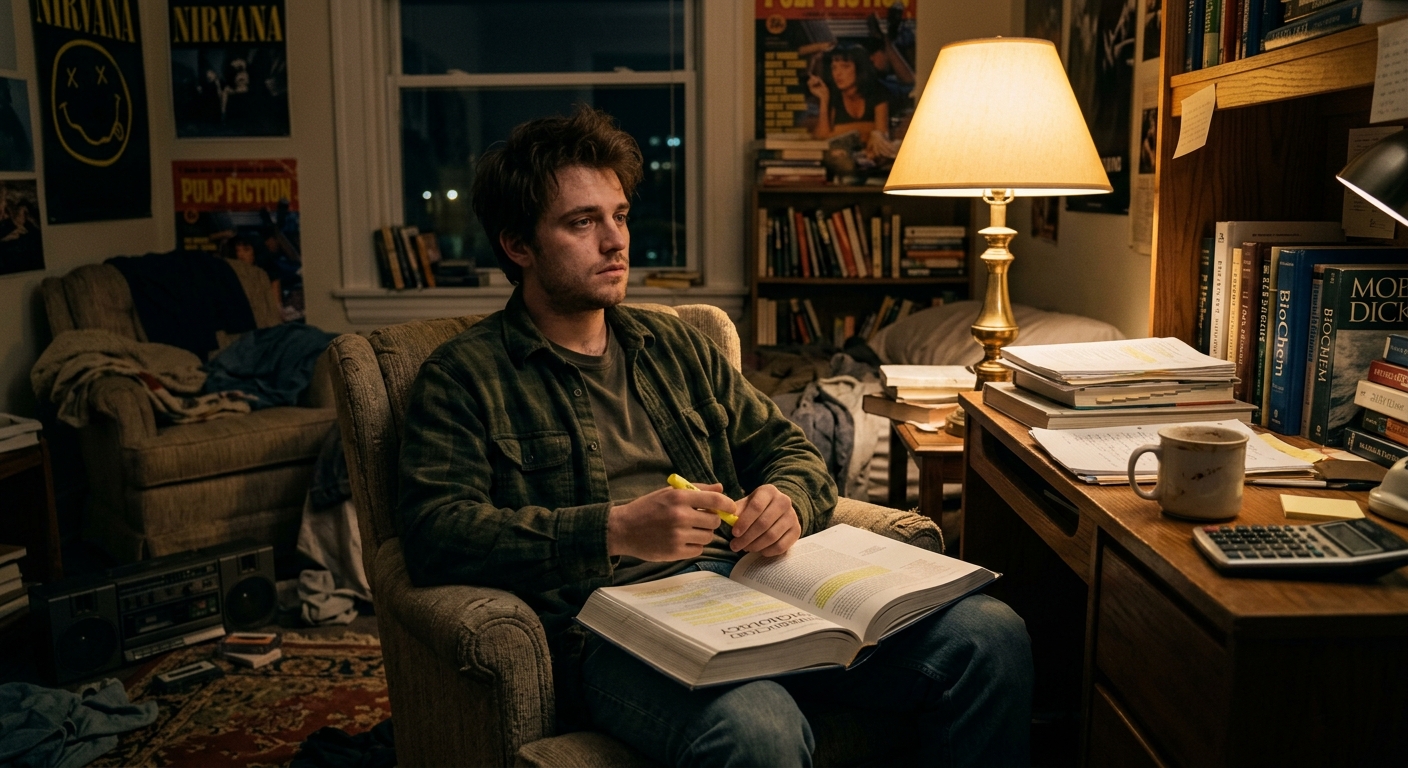
A late-in-life AuDHD diagnosis at 55 reframes decades of academic failure, social exhaustion, and sensory overwhelm that had long been attributed to laziness or poor character. Experiences ranging from paralysis while studying to the physical cost of routine small talk now carry clinical explanations.
The diagnosis followed years of worsening executive dysfunction during remote work and arrived alongside a confirmed PTSD diagnosis connected to his brother’s murder and nearly two decades of subsequent legal proceedings. Relief and grief coexist, as a lifetime of working significantly harder than peers to achieve less now has a name, even if that name changes nothing retroactively.
I know much of my writing feels like a rehash of other posts, and in some ways, it is. It’s part of my therapy and a coping mechanism. Anxiety, Executive Dysfunction, RSD, PTSD, AuDHD. I keep thinking that if I write about it and read enough, things will improve. So far, they haven’t, but I remain pessimistically hopeful. Let’s set the scene:
It’s a Tuesday night sometime in the early-nineties. I’m sitting in my chair in my apartment, a textbook open in front of me, highlighter in my hand. I have a test Thursday. I know I have a test Thursday. I have known about this test for two weeks. The highlighter has been in my hand for approximately forty minutes and I have highlighted one sentence, and I’m not even sure it was the right sentence.
What I am doing instead of studying is thinking about the way the guy in my morning class tapped his pen against his notebook. Tap, tap, tap, tap. I don’t know why I’m thinking about it. He did it three hours ago. I wasn’t even sitting near him. But here I am, in my chair, with my highlighter and my two-week-old test I haven’t studied for, and my brain has decided that pen tapping is the event of the evening.
I put the highlighter down. I’ll start in a few minutes.
I most certainly did not start in a few minutes.
I told myself what I always told myself: I just didn’t want it badly enough. I was lazy. I was fundamentally not built for this. Everybody else in that building managed to sit down and get it done. I had seen them and they looked fine. They looked like sitting still and reading words in sequence was just a normal human activity that normal humans could do without their brain throwing a full-blown revolt.
I was twenty years old and I already had my verdict. Discipline problem. Character problem. Me problem.
The maddening thing is, that story coexisted with a completely different one, and I never let the contradiction land.
I’ve been in IT for twenty-eight years, almost all of it self-taught. Nobody gave me a curriculum. Nobody held my hand through Exchange Server or Active Directory or PowerShell. I just picked it up because I had to, and then I kept going deeper because I couldn’t stop myself. I’ve built software that real people use. I’ve got a React and TypeScript music app running live right now that does things most working developers would look at and raise an eyebrow. I’ve finished more “fake” AI music than a lot of actual musicians produce in a career. By any external measure, I sustain things. I finish things. I go embarrassingly deep on things.
And I spent thirty years walking around convinced I lacked the drive that everyone else apparently had.
That’s the specific cruelty of it. The bursts were real. The output was real. So when the flatlined days came, when I couldn’t do the simple thing, when I sat in the chair with the highlighter and went nowhere for forty minutes, the productive days didn’t read as evidence that something else was going on. They read as proof. I was clearly capable. Which meant every day I couldn’t function was a choice I was making. A failure I was responsible for. A character verdict I kept handing down on myself, over and over, with a jury of one.
Here’s something that should have been a data point and wasn’t. Small talk damn near requires a warmup routine.
I can stand in a breakroom with a coworker, someone I have talked to a hundred times, and the simplest exchange about the weekend feels like defusing a bomb. I know roughly what I’m supposed to say. I’ve said it before. But my brain is running a simultaneous background process trying to figure out what my face is doing, whether my response was too slow, whether that pause was weird, whether I should have laughed at that, and by the time I’ve processed all of it, the conversation has moved on and I’m standing there nodding like I’m receiving information from a satellite.
The whole time, I look fine. That’s what nobody sees. From the outside I’m just a quiet guy who doesn’t say much. From the inside I just burned the same energy as a brisk walk to have a two-minute exchange about the Braves.
I have spent my entire adult life doing that, daily, and calling it being an introvert, which is technically true but is maybe twenty percent of the explanation.
The sensory piece. I don’t know how to explain this to someone who doesn’t have it, so I’m just going to describe it, and you can decide what to do with it.
Someone chewing near me, and I mean in the same room, not directly next to me, registers in my skull like a fire alarm. I am no longer doing what I was doing. I am now doing the sound. Every wet, soft, rhythmic piece of it. Whatever I was focused on is gone. My whole nervous system pivots toward it and locks on and will not let go. I’ve sat in meetings watching my ability to track the actual discussion just drain away because someone three chairs down was working on a granola bar.
Snoring does the same thing. Shirt tags used to wreck me until I started ripping them out of everything I owned, which I did for years before I understood that it wasn’t a quirk, it was my nervous system telling me something it had been trying to tell me my whole life. Now I specifically buy shirts that have the information printed on the fabric. That was a life upgrade I made in my forties that should have been obvious in my twenties.
Lotion. After a massage, as soon as I get home, I have to shower. The oil has to come off. I can feel it sitting on my skin, and it is not going to stop being the main event until it’s gone.
Crowded parking lots. If I pull in somewhere, and it looks too crowded, and that threshold is completely arbitrary and makes no sense and I cannot explain the calculus, I leave. I just leave. I nope right on out and find somewhere else to be, or I go home, or I wait in the car until some version of the crowd disperses that satisfies whatever internal measurement my brain is taking. Most people just walk in. They don’t think about it. They walk in.
I watched people do that my whole life and thought I was just difficult. Too sensitive. Needed to toughen up.
I genuinely do not know what the word relax means in practice.
I know what it means as a concept. I can explain it to you. But doing it, that’s a different conversation. After a day at work, after I’ve masked my way through eight hours of interactions and sounds and textures and the low-grade background hum of managing everything I’m feeling while also doing my actual job, I come home and I sit down, and I try to decompress. What actually happens is I sit there, and my brain starts auditing the day. Did that person look at me funny in the hall? Did I say the wrong thing in that email? What did my face do during that meeting? Why did I stumble over that sentence? What does my supervisor think about that ticket I closed? Is my job secure?
This is not a choice. I am not deciding to do this. It is just what happens when I stop actively doing something else. The anxiety doesn’t take a break because I sat down. It just changes targets.
Growing up Gen X, there was no language for any of this. The available diagnoses were weird, too sensitive, needs to apply himself, and the all-time classic, has so much potential if he’d just try. Nobody was out here in the 1980s running a sensory processing checklist on a kid from Milledgeville, Georgia. You either kept up or you didn’t. If you didn’t, that was your problem.
So I adopted the explanation that was on offer. I figured everyone else was fighting the same internal noise, and they were just tougher about it than I was. I took the only diagnosis available to a kid like me, which was: try harder.
For fifty years that is what I believed.
I’ve been working from home for six years now. Just me and the dogs, Oakley the German Shepherd generally asleep somewhere near my desk, and Flash, god rest his soul. The kind of silence that gives your brain nowhere to hide.
What happened, slowly, over those six years, is that everything got worse. The executive dysfunction, worse. The anxiety, worse. The depression, worse. The focus issues, catastrophically worse. Without the external structure of an office, without the forced regularity of being around people even when people were expensive for me, I was left alone with my brain for eight, ten, twelve hours a day. And my brain is not a quiet place.
By year five I was scared. Not in a vague, general way. In a this is going to cost me my job way. Nearly seventeen years at Advocate Health, and I was genuinely afraid I was unraveling in a way I couldn’t keep patching.
I went to my primary care doctor. She pointed me toward a psychiatrist. And my psychiatrist, after listening to me describe what I’d been living with, said he wanted to have me tested for AuDHD.
I didn’t know what that was, not really. I had a general pop-culture understanding of ADHD. I had basically no understanding of how autism actually presents in adults who have spent half a century learning to compensate for it.
I failed the test. Severely. ADHD, on the spectrum, Rejection Sensitive Dysphoria on top of it. And separately, my therapist confirmed what I think some part of me had known for a long time. The PTSD from losing my brother William. He was twenty-six, I was twenty-five. That broke me. We had grown up sharing a room, moved in together when I started college, lived together until the night he didn’t come home. What followed was almost twenty years of trials, appeals, Supreme Court hearings, waiting rooms, verdicts that got overturned, more waiting rooms. That was basically reliving December 17, 1995 for almost 20 years. His killer was executed on December 10, 2014. I was there. My dad was there. My brother Tom was there.
I don’t know how to explain what nineteen years of that does to a person’s nervous system without underselling it. The anxiety I didn’t know I had a name for. The anger and rage I couldn’t always account for. The hair-trigger that I’d written off as a personality flaw. All of it now had a reason, and the reason had been sitting in my body since I was twelve years old.
The diagnosis didn’t solve the last fifty years. I want to be clear about that. Nothing rearranged itself. The mornings are still hard. The sensory stuff is still real. I still have to rip tags out of shirts and leave crowded parking lots and lose whole hours to sounds that no one else in the room seems to register. The anxiety doesn’t care that it has a name now.
But here’s what’s different.
I am angry. I am genuinely, specifically, productively furious. Not at anyone in particular and at everyone who was ever in a position to see it and didn’t.
My grades were fine until seventh grade. All A’s. Then something shifted, and the grades went sideways, and nobody stopped to ask why. Nobody said, wait, this kid was getting all A’s, and now he’s getting C’s and D’s, what changed. What they said was that I wasn’t applying myself. So I got tutors. I nearly didn’t graduate high school. I applied to Georgia College and State University, which was literally across town, because it was the only school I believed had any chance of accepting me.
Then eight years to get a four-year degree. Quarters on academic probation. Six separate quarters of academic exclusion, where my advisor had to go to the Dean and personally petition for me to continue my studies. I retook classes trying to get my GPA above a 2.0 so I could be admitted to the School of Business. Two-point-zero. I was fighting to get to two-point-zero.
Everyone thought I wasn’t trying.
I was trying so hard I cannot describe it to you. I was sitting in those classes fighting to follow what was being said while my brain catalogued the texture of the shirt on the person in front of me and the fluorescent light that was one frequency off from the others and the guy two rows over shifting in his seat. I was going back to my apartment afterward and sitting in my chair trying to study and losing hours to nothing, to the pen tapping from three hours ago, to the audit of everything I had said wrong that day, to the paralysis that I called laziness because I didn’t have another word for it.
I graduated. Eight years, multiple academic exclusions, and I graduated. And I went into IT where hyperfocus is actually an asset and built a twenty-eight year career largely on the one cognitive feature of this brain that happens to be useful in that context.
That is not a character flaw that occasionally produced results despite itself. That is someone working three times as hard as everyone around him to accomplish what looked like half as much, who then went home and built things with the capacity he had left.
It wasn’t a discipline problem. It was a name I didn’t have yet. And I am fifty-five years old, and I got that name not quite one year ago, and some days the relief and the grief arrive at exactly the same time and I don’t know which one to feel first.
I feel both. Usually before noon.