Frank
Let me tell you something about the way old men talk about cars. Not the internet guys, not the auction house commentators, but actual old men who were there. My dad could describe the sound of a 426 Hemi at idle like he was describing a person. Not the stats, not the horsepower number, just the sound. That low, lopey, uneven rumble that sounds like the engine is barely tolerating the fact that it’s sitting still. He’d get this look on his face. You know the one. Like he was back somewhere.
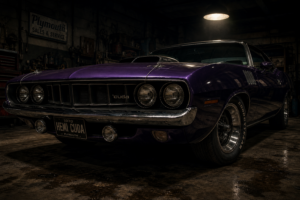
That’s what certain cars do. They don’t just exist as objects. They exist as moments. And if you want to talk about a car that exists almost entirely as a moment, a myth, a thing that barely happened before it was gone, you have to talk about the 1970 Plymouth Hemi ‘Cuda convertible.
There were forty-five of them. That’s not a typo. Forty-five. Built with the 426 Hemi, ordered as a convertible, delivered to actual paying customers in 1970. That’s the whole production run. Not forty-five hundred. Forty-five cars. For context, my high school graduating class was bigger than that.
To understand why this matters, you have to understand what was happening to the American muscle car at the end of the 1960s. The whole thing was accelerating toward a cliff and nobody fully knew it yet. The insurance companies were starting to strangle it. The federal government was circling with emissions requirements. The fuel crisis hadn’t hit yet, but it was coming. What you had in 1969 and 1970 was this strange, beautiful, completely unsustainable last gasp. The manufacturers knew on some level that the party was ending. So they went completely insane in the best possible way.
Plymouth’s answer to that moment was the ‘Cuda. Specifically the E-body ‘Cuda, which arrived for 1970 as a complete redesign. Shorter wheelbase, wider stance, meaner proportions. The car looked aggressive sitting still. It looked like it was irritated at you for not driving it fast enough. Plymouth put that body on the market with engine options that ran from a basic 318 all the way up to the 426 Hemi and the 440 Six-Pack. You could spec this car into absolute lunacy.
The 426 Hemi was not a normal engine. I want to be clear about that because people throw the word Hemi around now like it means something general. It doesn’t. The 426 Street Hemi was a hand-assembled, cross-ram inducted, dual four-barrel carburetor animal that made 425 horsepower on paper and considerably more than that in reality. Chrysler rated it conservatively because the insurance actuaries were already watching. The real number was closer to 500 horsepower, maybe more depending on who was building it that day.
Installing that engine in a hardtop ‘Cuda was already a commitment. Installing it in a convertible was something else entirely.
Here’s why the convertible mattered. The E-body was not an especially rigid platform to begin with. When you cut the roof off and add a folding soft top, you lose structural rigidity. The chassis wants to flex. Add 500 horsepower and a four-speed manual or a heavy-duty TorqueFlite, and you’ve got a car that’s working against itself every time you get on it hard. Plymouth essentially built a chassis brace into the car to compensate, but the whole thing required a specific kind of buyer. Someone who understood what they were getting into. Someone who wanted the experience more than they wanted practicality or comfort.
And only forty-five people in the entire country ordered one that way. Hemi. Convertible. 1970.
I grew up around muscle cars. My dad and I spent a lot of time on a 1967 GTO together, frame-off restoration, 400 cubic inch, Turbo 400 transmission. We worked on that thing for years. And I drove everything in that era that I could get my hands on. The ’68 Newport with the 383 Magnum that we called “The Luse” (short for S.S. Lusitania) because it was roughly the size of an aircraft carrier. A ’65 F-85 Cutlass. My brother William’s ’69 Chevelle SS 396. I know what these cars feel like. I know the way a big block makes the seat vibrate at idle. I know what happens when you put your foot down and the rear end squats and the front end comes up and you’re just hanging on. That was real. That was every Saturday afternoon.
But the Hemi ‘Cuda convertible was operating on a different level than most of what I drove. The 426 in a lighter body with no roof, with the whole car transmitting every input directly to you because there was nothing overhead to dampen it. That’s not a daily driver. That’s barely even a weekend car in any practical sense. That’s a piece of rolling mechanical theater.
The production numbers are what they are because of several factors stacking on top of each other. First, the Hemi option was expensive. In 1970 dollars it added over nine hundred dollars to the base price, which was serious money. Second, convertible sales had been declining across the industry for years. The pony car era was largely a hardtop and fastback era. Third, the Hemi in a convertible created specific engineering challenges that Plymouth addressed but never fully resolved. The combination made the car more expensive, more temperamental, and harder to insure than almost any other production vehicle you could buy that year.
So most buyers who wanted a Hemi got a hardtop. Most buyers who wanted a convertible got a smaller engine. The overlap, the people who specifically wanted both, was forty-five.
What happened to those forty-five cars is its own story. Some got raced. Some got crashed. Some sat in fields and rotted because the owner ran out of money or ran out of interest or both. The survival rate on cars like this from that era is brutal. These weren’t museum pieces when they were new. They were driven hard by people who bought them to drive hard. Gentle driving was not the point.
When you look at what survives today, you’re looking at maybe thirty cars that are confirmed to exist in any condition. Restored examples, documented and matching-numbers cars, have sold at auction for numbers that are genuinely hard to process. The Barrett-Jackson and Mecum auctions have moved these cars for figures well into the millions. That’s not hyperbole. That’s what happens when forty-five of something were made, when the ones that survive are the ones that someone cared enough to keep, and when the collector car market decided that the muscle car era was worth preserving at any price.
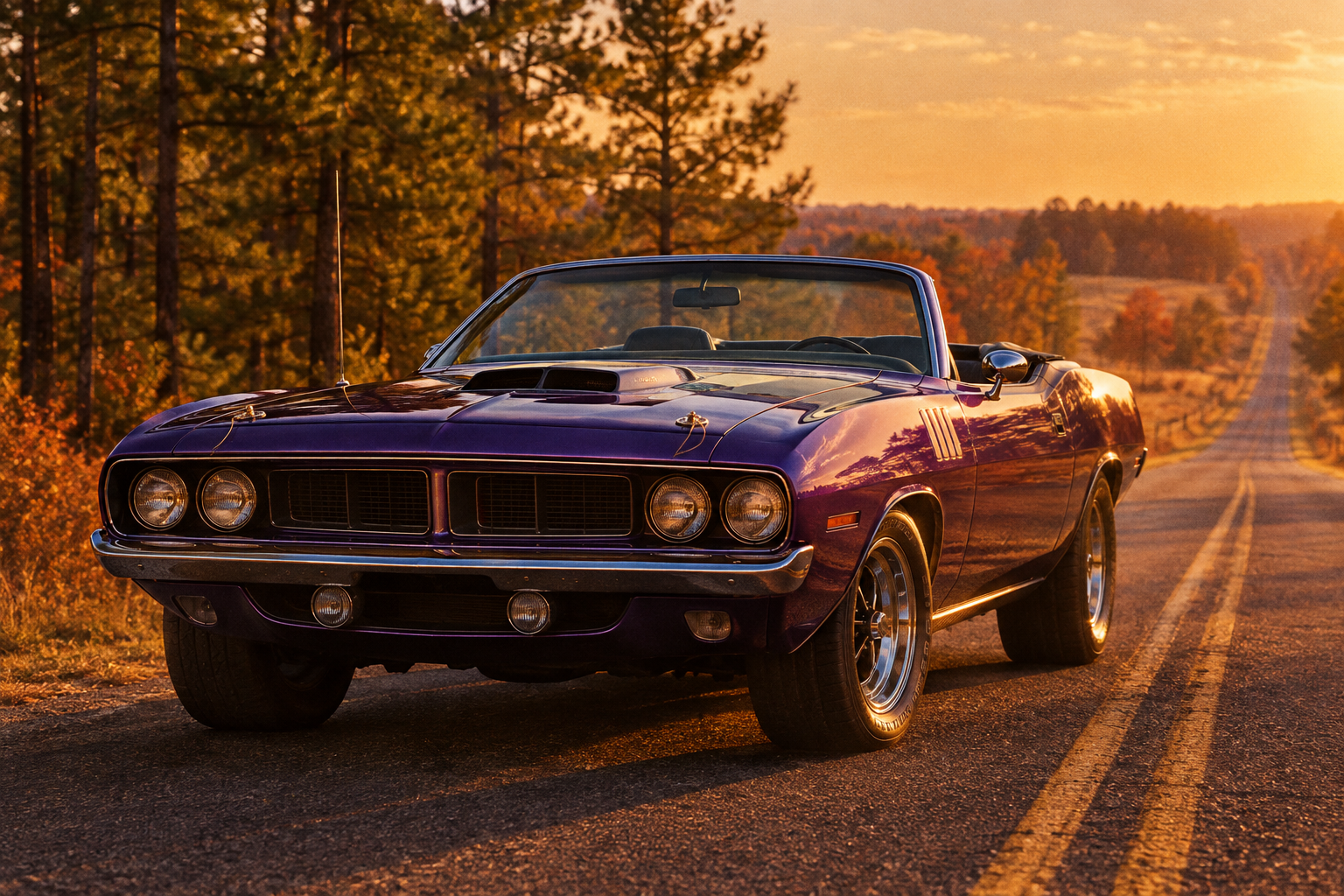
There was a white Hemi ‘Cuda convertible that sold for over three million dollars. There was an orange one that went even higher. The colors matter in this market because ‘Cudas came in the most aggressively named colors Detroit ever produced. Plum Crazy. Vitamin C. In-Violet. Tor-Red. These weren’t just paint codes. They were a statement that Plymouth was done being subtle. The whole car was a statement that Plymouth was done being subtle.
I think about what it says about that moment in American manufacturing that something this extreme, this impractical, this deliberately over-the-top actually got built and sold to regular people. Not racing teams. Not factory drivers. Regular people who walked into a Plymouth dealership, ordered exactly what they wanted, and drove it home. That’s remarkable. The idea that a private citizen could walk into a dealership in 1970 and order a hand-assembled racing engine stuffed into an open convertible body and just… have that. No special credentials. No track requirement. Just money and the willingness to deal with the insurance premium.
My brain works in a certain way. The AuDHD thing means I hyper-focus on specific details and I don’t let go of them. Numbers stick. Specs stick. I can tell you the compression ratio on the 426 Hemi (10.25:1 for the street version), the carburetor setup (two Carter AFBs on a cross-ram intake), the recommended premium fuel, the maintenance interval on the solid lifters. This is the kind of information that lodges itself in my head and stays there. The production number for the Hemi ‘Cuda convertible has been lodged in my head for decades. Forty-five. That’s not a number you forget.
What I keep coming back to is the randomness of survival. The 1970 model year was fifty-five years ago. The people who bought these cars new were, in most cases, young. They had no particular reason to believe they were buying something historically significant. They were buying a fast car they wanted to drive. Whether those cars survived depended entirely on what happened to those specific buyers over the next five and a half decades. Whether they kept the car, whether they sold it to someone who kept it, whether they stored it, whether they crashed it, whether they let a kid borrow it, whether they needed money one year and sold it for whatever someone would give them.
The ones that made it through all of that are the ones we have now. And the ones we have now are worth more than most houses in middle Georgia.
I have a weird relationship with rare things. Part of me appreciates the scarcity on an intellectual level. I understand auction dynamics, I understand collector markets, I understand why limited production numbers drive value. But there’s another part of me, the part that grew up in Milledgeville working on cars with my dad, that finds the whole auction scene a little distant from what these cars actually were. They were built to be driven. The 426 Hemi was built to accelerate a car as violently as possible. Putting one in a climate-controlled collection and covering it with a fitted cloth cover is technically preservation, but it’s also a little sad.
The best version of a Hemi ‘Cuda convertible is one with the top down on a two-lane road in Georgia in October, when the weather finally breaks and it’s actually tolerable to be outside. With the dual four-barrels wide open and the exhaust doing exactly what it was designed to do. That’s what Plymouth built it for.
There’s a reason the muscle car era ended when it did. The combination of insurance industry pressure, fuel costs, emissions regulations, and the simple economic reality that you cannot sell ten-second quarter mile times to a general market forever, all of that was going to win eventually. And it did. By 1972 the compression ratios were being dropped and the horsepower numbers were collapsing. By 1974 the fuel crisis had finished what the insurance actuaries had started. The Hemi option was gone after 1971. The convertible body style was dead at Plymouth by 1975.
What you’re left with is a very specific window. 1968 to 1971, roughly. The peak of American performance manufacturing before the regulatory and economic reality closed the door. The Hemi ‘Cuda convertible is the most extreme example of what that window produced, precisely because it required such a specific buyer at such a specific moment. Someone with enough money to order the Hemi, enough nerve to want a convertible with it, and enough disregard for practicality to actually pull the trigger.
Forty-five of them existed. Maybe thirty survive. Each one is a direct connection to a period of American manufacturing that will never happen again, when a major automaker looked at what it could do and decided to do all of it, no qualifications, no hedging, just the most powerful engine they made dropped into an open car and handed over to whoever showed up with a check.
My dad understood that completely. So do I.