Frank
Frank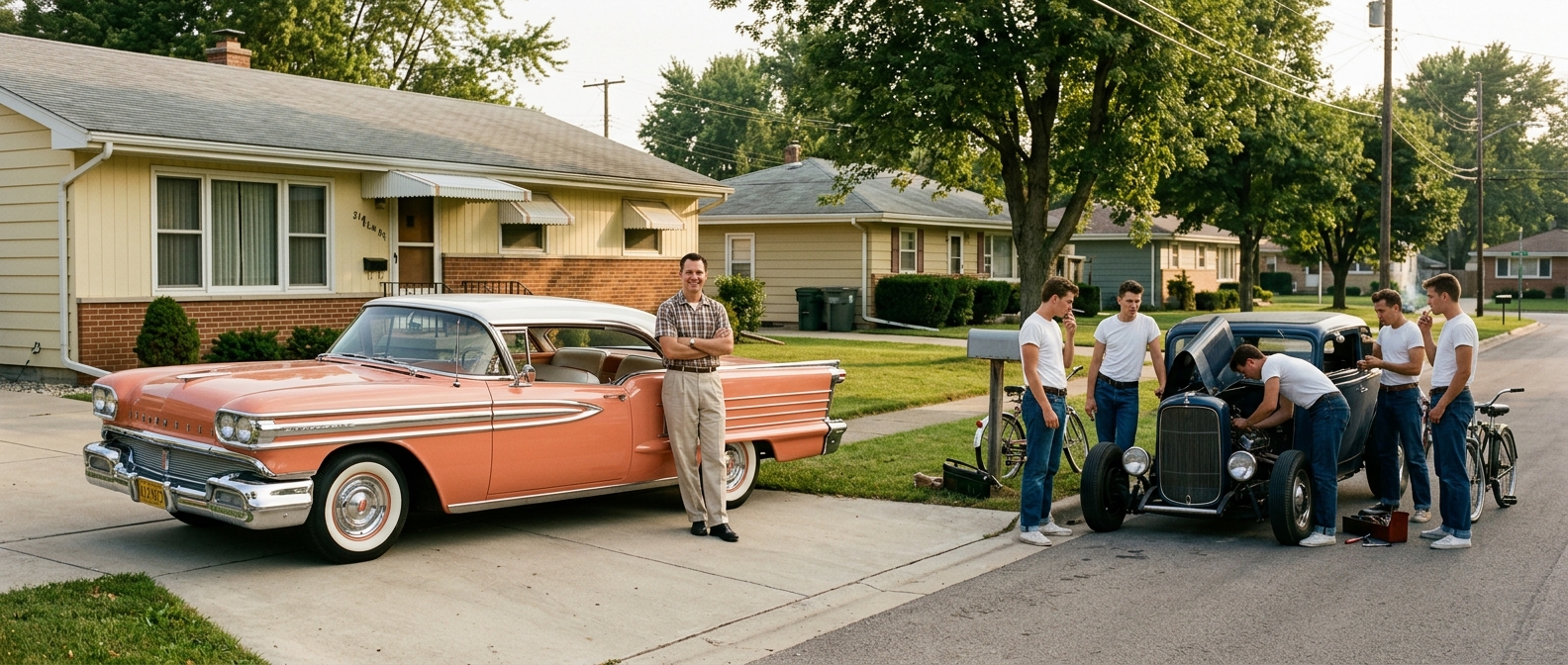
The Cars America Was Driving Before Everything Changed
Picture this: it’s 1958. You walk into a Chevrolet dealership and the salesman steers you toward a shiny new Impala. It’s big. It’s comfortable. It has a V8 under the hood because everything has a V8 under the hood. You drive it home, park it in the driveway, and feel pretty good about yourself. It’s a fine car. A respectable car. A car that gets you from A to B without complaint.
But here’s the thing. That Impala weighs nearly two tons. The suspension is tuned for boulevard cruising, not cornering. The engine makes reasonable power, but “reasonable” is doing a lot of heavy lifting in that sentence. Push it hard through a turn and the body rolls like a ship in a swell. Mash the throttle and you get a polite surge, not a shove. America was building cars for comfort, for size, for the image of prosperity. And for a long time, that was enough.
Then it wasn’t.
The Postwar Dream and What It Built
After World War II, America was in an extraordinary mood. The boys came home, the factories shifted from tanks to Fords, suburbs started spreading across the countryside, and the automobile became the central symbol of the American dream. A car wasn’t just transportation. It was a statement. It said you’d made it. You had a driveway, a garage, a family, and a machine that could haul all of them to the drive-in on a Friday night.
Detroit responded to this perfectly. Automakers built cars that were enormous, luxurious by the standards of the time, and loaded with chrome. Fins got taller through the late 1950s. Wheelbases stretched. Engines grew, but they grew to move mass quietly and smoothly, not to make your neck snap back. The priority was ride quality, interior room, and that sense of effortless glide that felt like success in motion.
The V8 revolution had started in earnest with the 1949 Oldsmobile Rocket 88 and Cadillac’s overhead valve V8 that same year. Overhead valve design was genuinely exciting technology at the time, more efficient and more powerful than the old flathead designs. Chevrolet followed with its iconic small-block in 1955. These were real engineering achievements. But by the early 1960s, even the performance-oriented engines were being tuned for docility. Torque curves smoothed out, compression ratios moderated for regular-grade pump fuel, and the whole character of the American V8 drifted toward the comfortable middle.
The Youth Problem Detroit Didn’t See Coming
Here’s something the executives in Detroit’s corner offices were slow to notice: the teenagers who had grown up watching their dads buy those big, soft Chevrolets and Fords were not impressed.
The postwar baby boom had produced an enormous wave of young Americans who came of age in the late 1950s and early 1960s. They had their own money, their own tastes, their own culture, and they were absolutely not interested in driving their father’s Oldsmobile. They wanted speed. They wanted attitude. They wanted a car that felt alive under their hands.
Hot rodding had been filling that gap since the late 1940s. Young men were taking cheap used cars, pulling the bodies, dropping in bigger engines, stripping weight, and turning dry lakebeds and abandoned airstrips into proving grounds. Drag racing organized itself into a real sport. Car magazines like Hot Rod, which launched in 1948, had circulation numbers that would have stunned the Detroit marketing departments if they’d been paying attention. This wasn’t a fringe hobby. It was a genuine youth movement built entirely around performance that the factories weren’t delivering.
The imports were making noise too. Small, nimble European sports cars were landing on American shores and finding eager buyers among people who wanted something that actually handled. The MG, the Triumph, the Austin-Healey. Then Volkswagen started selling the Beetle in serious numbers and laughing all the way to the bank while Detroit built cars the size of ocean liners. The message was getting harder to ignore.
What the Factories Were Actually Trying
To be fair to Detroit, the engineers weren’t sitting still. There were genuine attempts to build performance into American cars during this period, and some of them were genuinely interesting.
Chrysler’s 300 series, launched in 1955, was probably the most legitimate American performance car of that era. The “Beautiful Brute,” they called it, and it earned the name. It put out 300 horsepower when 300 horsepower was a startling number, and it dominated NASCAR for several seasons. But it was also expensive, large, and aimed at a very specific buyer. It wasn’t for the nineteen-year-old saving up at his summer job.
Pontiac was experimenting too. Semon “Bunkie” Knudsen arrived at Pontiac in 1956 with a clear mission to inject some life into a brand that had been drifting toward the stodgy middle of the market. He brought in Pete Estes and Elliot “Pete” Estes brought in John DeLorean. They started paying attention to NASCAR, started building engines with actual performance intent, and started marketing Pontiac as something more exciting than safe. The 1957 Pontiac Bonneville with its fuel-injected V8 was a preview of things to come.
Chevrolet’s 1957 fuel-injected Corvette showed that American engineers could build a genuinely fast car when they were allowed to. One horsepower per cubic inch was the benchmark that made everybody sit up straight, and the “fuelie” Corvette hit it. But the Corvette was a sports car, a niche product, a separate category entirely. The question nobody had quite answered yet was how you put that kind of energy into a regular production car that regular people could actually afford.
Ford had its own experiments, including the supercharged Thunderbird engines and various performance packages that came and went through the late 1950s and early 1960s. But the corporate culture kept pulling back. Insurance costs were rising. Safety advocates were starting to make noise. The industry had signed a voluntary agreement in 1957 to withdraw from factory racing involvement, which put a damper on the more aggressive development programs.
Why It Still Wasn’t Enough
All those efforts added up to the right instincts in the wrong packages.
The cars were still too heavy. The suspension tuning was still oriented around comfort. The performance options were too expensive, too limited in production, or bolted onto platforms that fundamentally undermined them. You couldn’t go into a showroom with a modest budget and drive out in something that would genuinely embarrass the kid down the street in his hot rod. The gap between what the factories built and what young Americans actually wanted remained wide open.
A few specific things were missing:
- Accessible price points. Performance had to be within reach of someone buying a base-model car, not just executives buying fully-optioned luxury vehicles.
- The right platform. Dropping a big engine into a big car just made a bigger car. What was needed was a big engine in a smaller, lighter car.
- Factory commitment. Winking at performance through limited options wasn’t the same as building a car around it from the ground up.
- A name and an identity. Young buyers needed something they could point to and claim as theirs. Not their dad’s V8 sedan with a sport package. Something genuinely different.
The ingredients existed. The engineers knew what they were doing. The hunger in the market was obvious to anyone paying attention. What was missing was someone willing to break the rules and put it all together.
That moment was coming. It arrived in 1964, with a car from Pontiac that we’ll get into properly later in this series, but it set off a chain reaction that produced the most extraordinary collection of American automobiles ever built. The cars covered in this series, starting with the 1970 Plymouth Hemi ‘Cuda in Part 3, are the end result of that chain reaction. To really appreciate how remarkable they were, you had to understand what came before them and why it left so many people unsatisfied.
The factories were about to stop being conservative.