Frank
Frank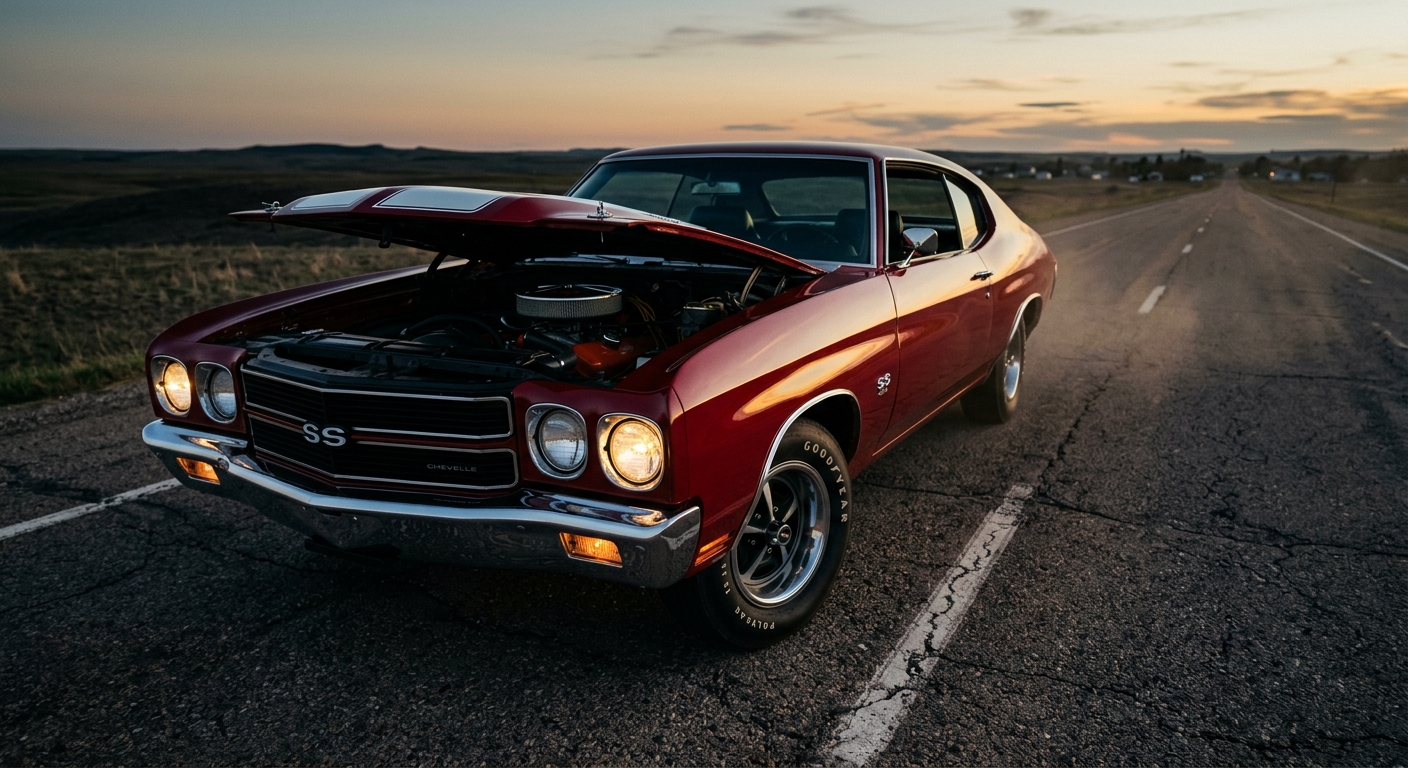
If you want to start an argument among muscle car enthusiasts, walk into any car show and say this out loud: “The LS6 Chevelle was the greatest production muscle car ever built.” Then step back and watch what happens. Someone will immediately throw the Hemi ‘Cuda at you (we covered that in Part 3). Someone else will bring up the Charger Daytona’s dominance at Talladega (Part 4). But here’s the thing: they’re not wrong, exactly. They’re just not right, either. Because the 1970 Chevrolet Chevelle SS 454 with the LS6 engine option wasn’t just a great muscle car. It was a statement. A full stop. A period at the end of a sentence that Detroit had been writing for almost a decade.
This was the car that made Motor Trend plant a flag in the ground. When they tested the LS6 Chevelle in 1970, they called it “the most powerful production car in the United States.” Chevrolet didn’t argue with them. They couldn’t. The numbers spoke for themselves: 450 horsepower, 500 lb-ft of torque, a 0-to-60 time that made grown men quiet and nervous all at once. This was a full-size car by modern standards, built on a mid-size platform, stuffed with an engine that belonged in a different universe entirely. And Chevrolet sold it to anyone who walked through a dealer’s door with a checkbook and a dream.
What follows is the story of how that happened, why it mattered, and why the LS6 Chevelle still occupies a place in automotive history that nothing else has quite managed to fill.
The Engine That Changed the Conversation
Let’s start where everything starts with a car like this: the engine bay.
The LS6 was a 454 cubic inch big-block V8, part of the Gen IV Mark IV family that Chevrolet had been developing through the late 1960s. But calling the LS6 just another 454 is like calling the Grand Canyon just another ditch. The engineers who built it weren’t optimizing for daily commutes. They were building something that would embarrass everything else on the street and still pass emissions long enough to get certified.
Here’s what made it different from the standard 454 LS5 that was also available that year:
- High-compression pistons: The LS6 ran an 11.25:1 compression ratio. That is not a typo. In 1970, premium leaded fuel was still widely available, which made this possible, but it also meant the LS6 was already living on borrowed time before it even went on sale.
- Solid lifter camshaft: While the LS5 used hydraulic lifters for a smoother, more street-friendly idle, the LS6 used a solid lifter cam with more aggressive lift and duration. This is the kind of decision that changes the whole character of an engine. It made the LS6 lumpier at idle, harder to live with in traffic, and absolutely ferocious above 3,500 rpm.
- Rectangular port cylinder heads: Larger, more efficient ports than the LS5, capable of moving more air and fuel at high rpm. This is where the top-end power came from.
- Holley four-barrel carburetor on an aluminum intake: The LS5 came with a Rochester Quadrajet. The LS6 came with a 780 cfm Holley, which is a carb that belongs at a drag strip, not a grocery run.
- Four-bolt main bearing caps: Because when you’re making this much torque, you want the bottom end of your engine held together with more than good intentions.
The official rating was 450 horsepower at 5,600 rpm and 500 lb-ft of torque at 3,600 rpm. But there is a long-standing belief, backed by independent dyno testing over the years, that Chevrolet was deliberately underrating the engine. Some estimates put the actual output closer to 500 horsepower. Whether that’s true or not, the performance numbers didn’t lie. Contemporary road tests put the quarter mile in the 13.7 to 13.8 second range, at over 100 mph, with street tires and a full interior. Those numbers would embarrass dedicated sports cars from the same era.
The Chevelle Platform: Why the Package Worked
The engine is the headline, but the car around it deserves its own conversation. The Chevelle was not a pony car. It was not small, light, or particularly aerodynamic. The 1970 SS 454 weighed in at around 3,800 pounds in street trim. That is a significant animal. And yet it moved like something that weighed far less, which tells you something important about what 500 lb-ft of torque actually feels like in practice.
The A-body platform that underpinned the Chevelle was a proven, well-developed chassis by 1970. It had been refined through several generations of mid-size GM products, and the 1970 redesign gave it one of the most aggressive and cohesive styling packages of the entire muscle car era. The long hood, short deck proportions were executed almost perfectly. The SS package added specific badging, blacked-out grille sections, hood pins (on some configurations), and a hood with a functional or non-functional scoop depending on your option choices. The whole car looked planted. Purposeful. Like it was slightly angry even when it was parked.
Suspension-wise, the SS 454 came with heavy-duty components calibrated for the added weight and power of the big-block. Front disc brakes were available, which was a welcome option given that you were driving something with the stopping requirements of a freight train. The Muncie M22 “Rock Crusher” four-speed manual transmission was the choice of serious drivers, a transmission so robust and so loud at high rpm that it earned its nickname honestly. The Turbo-Hydramatic 400 automatic was also available and no slouch, shifting crisply under hard acceleration and holding up well under the engine’s considerable torque output.
What the Chevelle SS 454 understood, that some of its competitors didn’t always get right, was that the complete package had to work together. You couldn’t just drop an enormous engine into an unprepared platform and call it a day. The Chevelle was sized right, weighted right, and built with enough structural integrity to put the power down without shaking itself apart.
What It Was Like to Actually Drive One
I want to be careful here, because the LS6 Chevelle is one of those cars that mythology has outrun reality in some directions. Let me tell you what it was actually like, not what the legend says it was like.
Below 2,500 rpm, the LS6 was not a pleasant urban companion. The solid lifter cam made for a choppy, slightly ragged idle. The high compression ratio meant the engine wanted to run on premium fuel exclusively, full stop. In slow traffic, with the large Holley carb hunting for the right fuel mixture at low throttle openings, the car could feel almost ornery. It didn’t particularly want to crawl through parking lots.
Get it above 3,000 rpm and everything changed. The engine came alive in a way that is genuinely difficult to describe to someone who hasn’t experienced a properly built solid-lifter big-block V8 at full song. There is a mechanical directness to it, a connection between throttle input and acceleration, that modern electronically-managed powertrains simply don’t replicate. The sound was different too. Not the smooth, refined note of the LS5 or a modern LS engine. This was rawer, more mechanical, with an exhaust note that had texture to it.
The torque was the thing that caught most people off guard. The 500 lb-ft number is abstract until you’re sitting in the passenger seat of one and someone puts their foot down from a rolling 40 mph. The car doesn’t accelerate so much as it translates forward. Physics happens to you rather than the other way around. With the M22 four-speed and a skilled driver, quarter-mile times in the 13-second range were achievable by a car that you could drive to the grocery store and bring home the week’s shopping.
That combination, grocery-getter on the outside, race-built engine on the inside, is exactly what made the Chevelle SS 454 LS6 the definitive expression of what the muscle car concept was supposed to be.
The Number Problem: Rarity and Reality
Here is where things get complicated, and I think it’s worth being honest about this rather than glossing over it.
The LS6 option was expensive. In 1970 dollars, the full SS 454 package with the LS6 engine added significantly to the base Chevelle price, pushing the window sticker into territory that gave some buyers pause. As a result, Chevrolet produced only 4,475 LS6 Chevelles for the 1970 model year. That number includes both hardtop coupes and convertibles, with the convertibles being rarer still.
This rarity has done several things. It has made surviving LS6 Chevelles extraordinarily valuable, with documented, numbers-matching examples routinely selling at auction for $150,000 and up, with particularly clean or significant examples going considerably higher. It has also made the car a prime target for fraud and misrepresentation. More “LS6 Chevelles” exist at car shows than were ever built, because the documentation requirements for verifying an authentic LS6 are complex enough that casual buyers can be deceived by a convincing copy.
The VIN decoding and broadcast sheet documentation process for verifying a true LS6 Chevelle is something that serious collectors and authenticators have spent decades refining. The RPO (Regular Production Option) code L78, actually L89 for the aluminum head variant, and the specific engine suffix codes are the places where true provenance gets established or demolished. If you’re ever in the market, and I mean seriously in the market, you engage an expert authenticator before you spend a dollar. This is not optional.
The scarcity also means that most people who “know” the LS6 Chevelle know it through magazine reprints, YouTube videos, and the stories of people who owned one new. The living memory of these cars is getting shorter every year. Which is, in a way, part of why writing about them matters.
Why 1970 Was the Last Real Year
The LS6 returned for 1971, but it was a diminished version. The compression ratio dropped to 9:1 to accommodate the switch to low-lead and no-lead fuels that the industry could see coming. The official horsepower rating fell to 425, and the real-world performance fell with it. By 1972, GM’s corporate policy of rating engines in net horsepower rather than gross horsepower made comparisons even more confusing, and the muscle car era was effectively over before most people realized it had ended.
The 1970 LS6 Chevelle was, in this sense, the last full expression of an idea. It was built at a moment when the regulatory environment hadn’t yet caught up, when fuel quality was still adequate for high compression engines, when insurance rates hadn’t yet made performance cars economically irrational for young buyers, and when the engineers at Chevrolet were still being allowed to chase the absolute limit of what they could build and certify for public sale.
You can draw a straight line from the pre-muscle car era that we explored in Part 2, through the succession of increasingly powerful and increasingly specialized machines, to this car. The 1970 LS6 Chevelle is what the entire preceding decade of development was building toward. It is the apex. The maximum. The point beyond which the industry could not and did not go for a very long time.
The Weight of the Legend
There are cars in this series that are legends because of what they did on a racetrack (the Charger Daytona from Part 4 comes to mind). There are cars that are legends because of their rarity or their engineering radicalism. The LS6 Chevelle is a legend for a different reason. It is a legend because it was attainable, because it was built in meaningful (if small) numbers, and because it delivered on every single promise the muscle car era had been making since the early 1960s.
When someone says “muscle car,” and they close their eyes, there’s a decent chance the car they picture looks something like the 1970 Chevelle SS. Long hood, aggressive stance, big-block under the hood, Cragar wheels or factory rallies, a color that doesn’t apologize for itself. The Chevelle became the archetype partly because it did everything well and nothing poorly. It was fast enough, handsome enough, available enough, and American enough to lodge itself permanently in the culture.
The cars that come next in this series, the GTO Judge in Part 6, the 442 W-30 in Part 7, the GSX Stage 1 in Part 8, each make their own case. But they all exist in a world where the Chevelle SS 454 LS6 has already established what “enough” looks like. They are measured, whether their builders admitted it or not, against this standard.
That’s what it means to be the benchmark. You don’t have to win every comparison. You just have to be the thing everything else is compared to.
Next up in Part 6: Pontiac answers the question of whether you can build a muscle car with a conscience, and still make it fast enough to matter. The 1969 GTO Judge is waiting.