Frank
Frank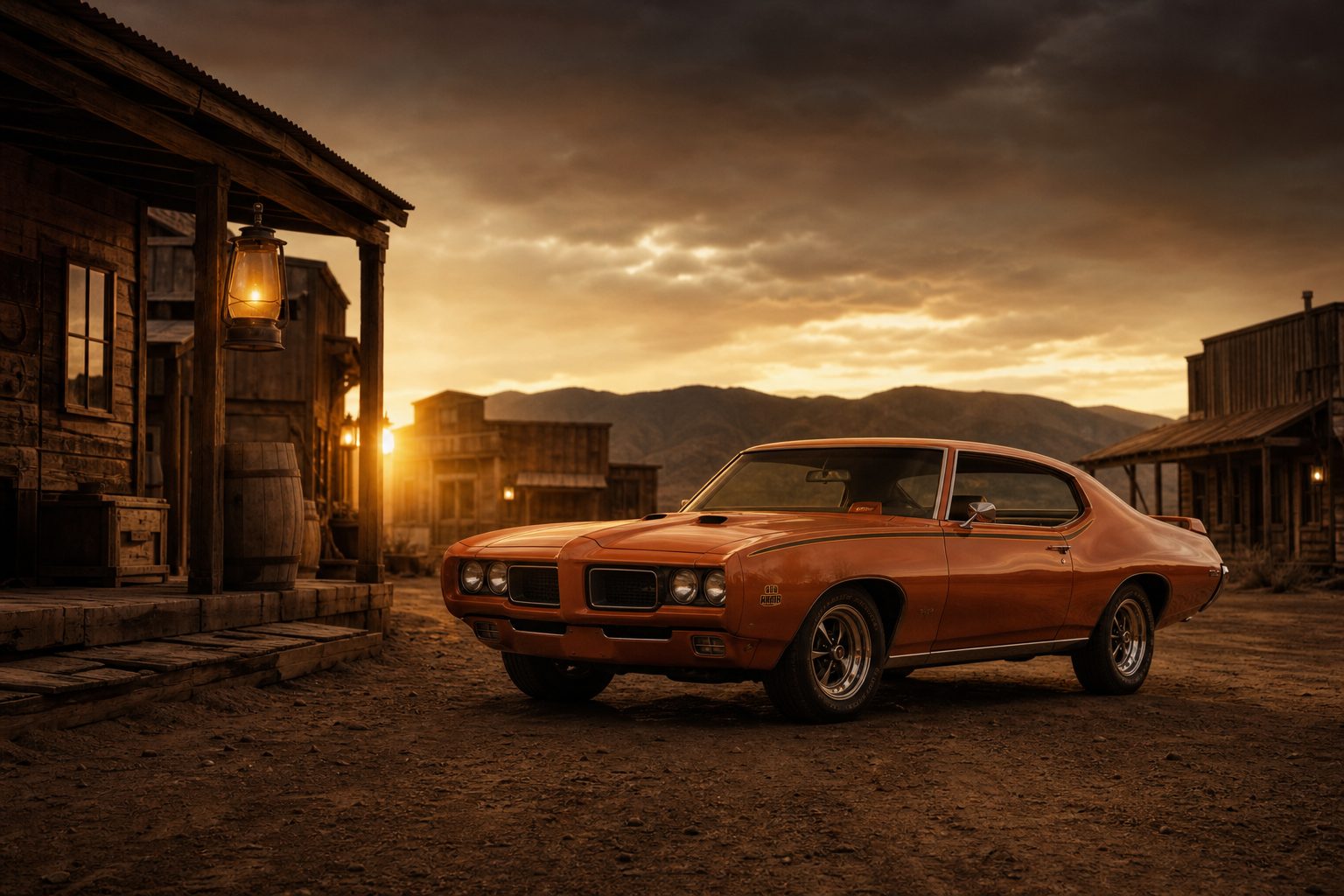
There’s a moment in every era when marketing and machinery align so perfectly that the result stops being a product and starts being a statement. The 1969 Pontiac GTO Judge is that moment. It arrived loud, painted in colors that made your eyes water, plastered with stripes and spoilers and a name borrowed from a comedy sketch, and somehow managed to be one of the most serious performance cars Detroit ever produced. That contradiction is exactly what makes it fascinating. The Judge wasn’t trying to be subtle. Subtlety was never the point. The point was to stand in a dealership showroom and make every sensible person in the room feel like they were missing something important about their own life.
I’ve always had a complicated relationship with the GTO Judge. On one side, it’s pure spectacle, the kind of car that practically dares you to dismiss it as style over substance. On the other side, once you actually get into the engineering, the history, and what Pontiac was trying to accomplish in 1969, it becomes clear this was a machine built with genuine conviction. The Judge deserves to be in this series not just because it was fast, though it was, but because it represented a particular kind of ambition that was specific to its moment in American history.
The GTO That Started It All
Before we can talk about the Judge, we need to talk about what came before it, and I’ll point you back to Part 2 of this series if you want the full picture of the pre-muscle era landscape. But the short version is this: the original 1964 GTO, born from John DeLorean’s calculated rule-bending at Pontiac, essentially invented the muscle car formula. Take a mid-size body. Drop in the biggest engine you can physically fit. Charge a price that working people can actually afford. Watch the world change.
By 1969, that formula was five years old and the competition had caught up ferociously. We’ve already seen in this series what Chevrolet was doing with the Chevelle SS 454 LS6, what Dodge was building with the Charger Daytona, and what Plymouth was unleashing with the Hemi ‘Cuda. The market had exploded. Every manufacturer had a contender, and Pontiac knew the GTO needed to evolve or risk becoming just another name on a long list of fast cars.
The response from Pontiac wasn’t to out-engineer everybody. It was to out-attitude everybody. The GTO Judge was announced in December 1968 as a mid-year addition to the 1969 lineup, and it launched with a marketing campaign that was aggressive even by the standards of an era that practically invented aggressive marketing. The name came from the Rowan and Martin’s Laugh-In catchphrase “Here comes da judge,” which tells you everything you need to know about the cultural temperature of 1969. Nothing was too irreverent. Nothing was too bold. If you could get people talking, you were winning.
What Was Under the Hood: The Ram Air III and the Numbers That Mattered
Here’s where we have to be honest about something. The Judge, in its base configuration, wasn’t the most powerful thing Pontiac was selling in 1969. The standard engine was the 400 cubic inch V8 with Ram Air III induction, rated at 366 horsepower. That’s a real number, not a modest one, but in the context of what Chevrolet was doing with the LS6 and what Chrysler was doing with the 426 Hemi, it wasn’t a headline-grabbing figure.
But here’s what the numbers don’t tell you. The Ram Air III was a tractable, street-friendly engine that made usable power across a broad RPM range. It wasn’t a temperamental race unit that fouled plugs in traffic and required a professional to tune. It was a genuine performance engine that a regular person could live with every day and still go out on a Saturday night and embarrass cars that looked more exotic on paper.
For buyers who wanted more, Pontiac offered the Ram Air IV option on the Judge. The Ram Air IV took the same 400 cubic inch displacement and pushed the output rating to 370 horsepower, which again sounds modest until you understand how conservatively Pontiac rated their engines in this era. The actual output was considerably higher, and the Ram Air IV was a screaming, high-winding unit that transformed the Judge’s character entirely. Pontiac engineers knew exactly what they were building. The conservative ratings were partly liability management and partly a quiet joke between the factory and the buyers who knew how to read between the lines.
A brief breakdown of what the Ram Air IV brought to the table:
- Round-port exhaust heads that significantly improved flow
- More aggressive camshaft profile optimized for high-RPM output
- Functional hood scoops that fed cold air directly to the carburetor under hard acceleration
- A compression ratio of 10.75:1 that demanded premium fuel and rewarded it
There was also a third option that almost nobody ordered and that almost nobody talks about: a Judge with the 428 HO engine. This combination was so rare that verified examples today are essentially museum pieces. The 428 in the GTO Judge is the kind of configuration that makes serious collectors lose sleep.
The Visual Language of a Revolution
You cannot write about the 1969 GTO Judge without spending real time on what it looked like, because the visual design was half the product. Pontiac understood something that a lot of manufacturers were still figuring out: in 1969, the way a car looked in a parking lot was marketing. Every person who walked past a Judge and turned their head was a potential buyer, or at minimum a conversation starter who would tell someone else what they saw.
The Judge launched in a single mandatory color: Carousel Red. Not red, not bright red. Carousel Red, a shade that sits somewhere between orange and red and refuses to be ignored under any lighting conditions. Pontiac’s reasoning was blunt. They wanted the car to be impossible to miss. They succeeded completely. You could be half a block away, not even looking at the car, and the color would reach out and grab your attention.
The graphics package added a flowing tape stripe along the body sides that swept up over the rear quarters, large “THE JUDGE” lettering applied directly to the body, and a rear spoiler that was both functional and theatrical. Later in the year, Pontiac opened up the color options to include the full GTO palette, but many of those colors were equally aggressive. Verdoro Green, Expresso Brown, Goldenrod Yellow. These were not colors chosen by a committee trying to please everyone.
The interior was GTO standard, which meant functional and driver-focused without being luxurious. Pontiac wasn’t selling comfort. They were selling the experience of controlling something powerful, and the interior reflected that priority. The driving position was good, the gauges were readable, and everything was positioned around the assumption that you were there to drive, not to arrive.
The Price Point: Populism as a Performance Strategy
One of the most important things about the Judge that often gets overlooked in favor of the horsepower discussion is what it cost. The Judge package added roughly $332 to the base GTO price, which put the whole car around $3,161 for the coupe. That was real money in 1969, no question, but it was also accessible in a way that true exotic performance cars were not.
Compare that to the cost of entry for a 426 Hemi car from Chrysler, or the premium you paid for the LS6 option on the Chevelle. The Judge wasn’t cheap, but it was priced to be within reach of the audience Pontiac was targeting: young buyers, working professionals, people who wanted to make a statement with their transportation but couldn’t write a blank check to do it.
This was deliberate and it was smart. Pontiac had built the entire GTO brand around the idea that performance shouldn’t be reserved for people with unlimited resources. The Judge doubled down on that philosophy by packaging visual drama and genuine performance at a price that kept the car in conversation for a broad audience. You didn’t have to be wealthy to own a Judge. You had to be willing to commit to something that would not let you blend into traffic.
Production numbers reflect this accessibility. Pontiac built 6,725 Judges in 1969. That’s not a limited-edition exotic number. That’s a real car that real people bought and drove. It’s also why finding an authentic Judge today requires serious homework, because these were driver’s cars and many of them were driven hard.
What the Judge Meant in the Context of 1969
1969 was a year of profound disruption in American culture, and I don’t think you can fully understand any of the cars we’re covering in this series without acknowledging the world they were born into. The muscle car era wasn’t happening in a vacuum. It was happening alongside the Vietnam War, the moon landing, Woodstock, and a generational shift in American values that was rewriting what it meant to be young in this country.
The GTO Judge was a direct response to that cultural moment. It was built for people who didn’t want to be told what was appropriate, who rejected the idea that a car was just transportation, who wanted their machinery to reflect their personality at maximum volume. The name itself was a joke at authority’s expense. “Here comes da judge” was a punchline about power and irreverence and the gap between official dignity and actual street reality.
Pontiac’s marketing team understood their audience deeply. The Judge was advertised with copy that spoke directly to this generational identity. One famous ad described the car as being for people who wanted “the GTO that says something.” The implication was clear: if you bought a regular GTO, you were making a choice. If you bought a Judge, you were making a statement. In 1969, that distinction mattered enormously to the people in the market.
Looking back across the full landscape of the muscle car era, the Judge occupies a unique position. It wasn’t the most powerful car available. It wasn’t the rarest. It wasn’t the fastest in a straight line against the most extreme competition. What it was is perhaps more valuable in hindsight: it was the purest expression of what the muscle car was supposed to be. Accessible, theatrical, honestly fast, and completely committed to the idea that driving should feel like something.
The Legacy and What We Take From It
The Judge lasted through the 1971 model year before Pontiac discontinued it as the combination of insurance surcharges, emissions regulations, and the broader cultural shift away from raw performance began to squeeze the market that had made it possible. Production dropped sharply in 1970 and again in 1971, and when it ended, it felt less like a cancellation and more like a natural conclusion. The moment that had made the Judge relevant was passing.
But the car’s legacy is durable in ways that its production lifespan doesn’t suggest. The Judge became shorthand for a certain kind of American confidence. Bold colors, honest power, a name that didn’t take itself too seriously while taking performance completely seriously. That combination shows up in the automotive culture conversation repeatedly, even decades later, as a reference point for what it looks like when a manufacturer gets the formula exactly right.
For collectors today, an authenticated 1969 GTO Judge with the Ram Air IV is a serious find. Values have climbed significantly as the pool of buyers who remember these cars new has expanded to include younger collectors who know the history but never lived through the era. The Carousel Red cars from the early production run carry a particular premium because they represent the Judge in its most intentional, uncompromising form.
What stays with me about the Judge is the confidence it represents. Pontiac didn’t hedge. They didn’t offer a subtle version for people who were nervous about the commitment. They came out with Carousel Red and “THE JUDGE” written on the body and a rear spoiler that announced itself from a hundred yards away, and they said, essentially, this is who we are and this is what we build. Take it or leave it.
That kind of conviction is rare in any era. In 1969, it produced one of the most memorable cars ever to come out of Detroit.
Next in this series, we’re moving to another GM division that was doing something genuinely remarkable in 1970: the Oldsmobile 442 W-30, a car that combined the corporate muscle car formula with serious engineering refinement and produced something that could embarrass cars with bigger displacement on the right road. The W-30 is a car that rewards attention, and in Part 7, we’re going to give it exactly that.