Frank
Frank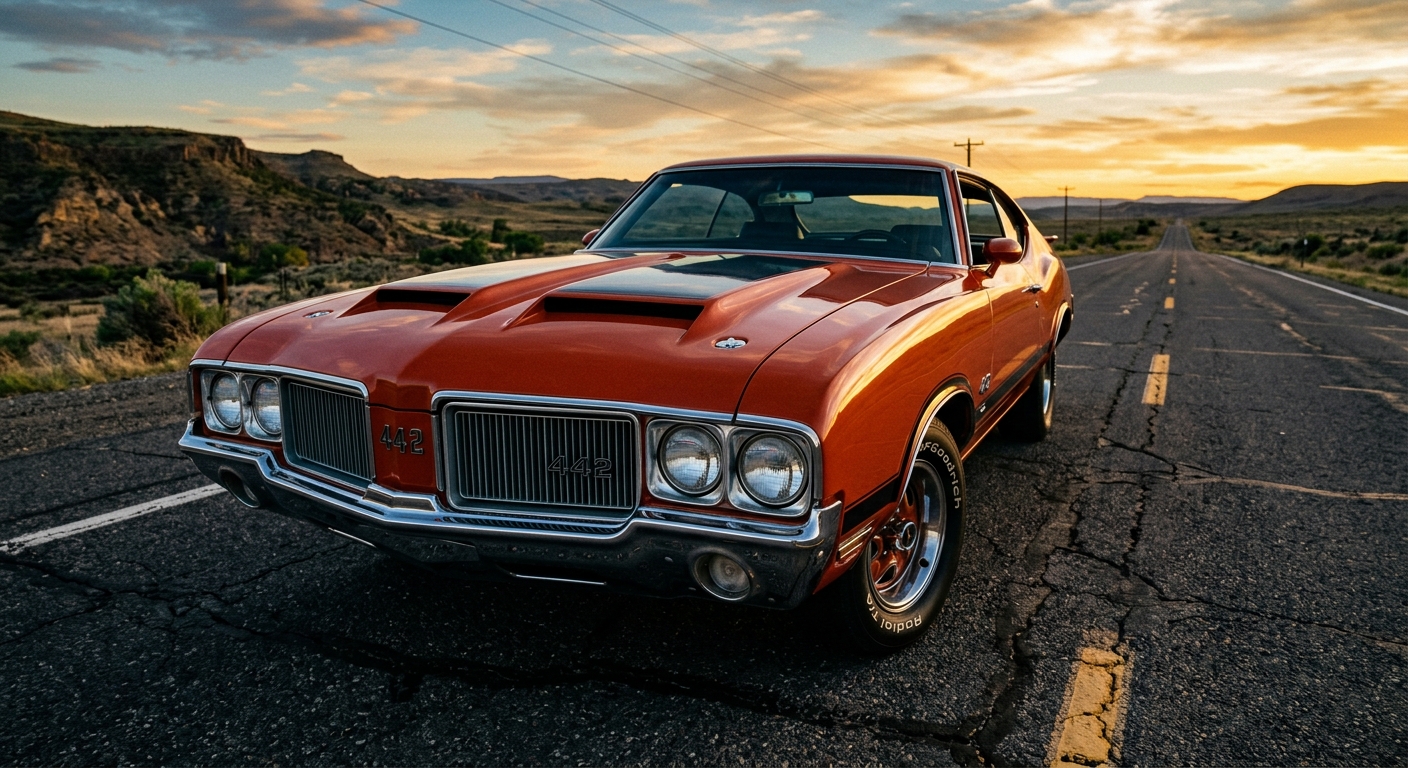
Oldsmobile doesn’t get nearly enough credit.
When people rattle off the pantheon of muscle car greatness, they reach for the Hemi ‘Cuda, the Chevelle SS 454, the GTO. Those are the names that show up on posters, that get the magazine covers, that inspire the tattoos. And look, we’ve covered all of them in this series, and they deserve every bit of that reverence. But there’s a car sitting quietly in the corner of that conversation that I think gets passed over more often than it should. A car that was, in many respects, the most complete muscle car Oldsmobile ever built. A car that could humiliate stoplight challengers, cruise the highway in genuine comfort, and look absolutely menacing doing both.
The 1970 Oldsmobile 442 W-30.
This car is the one I keep coming back to when people ask me what muscle car they should actually want. Not just dream about. Want. The kind of car you could theoretically live with. It has the right balance of raw performance, mechanical sophistication, and visual aggression without tipping over into pure race-prepped lunacy. It was a muscle car built by engineers who understood that horsepower alone doesn’t make a great car. And in 1970, when the muscle car era was hitting its absolute ceiling before the walls started closing in, Oldsmobile delivered something quietly extraordinary.
The Name: What 442 and W-30 Actually Mean
Let’s get the nomenclature straight, because both pieces of this name carry weight and they’re worth understanding.
The 442 designation goes back to 1964, when Oldsmobile first applied it to the F-85 and Cutlass models as an option package. At the time, the numbers stood for a four-barrel carburetor, a four-speed manual transmission, and dual exhausts. It was a formula, not just a badge. As the years went on and the 442 evolved into its own model identity rather than just a package, the numbers became more of a brand than a literal specification. By 1970, you could get a 442 with an automatic transmission and the name still held. But the spirit of that original formula, performance-focused from the factory, purpose-built in a way that other Oldsmobile models were not, remained intact.
The W-30 designation is where things get really interesting. The W-30 was Oldsmobile’s forced-air induction package, and it represented the factory’s acknowledgment that some buyers wanted something beyond the base 455 cubic inch engine. When you optioned a W-30, you were getting an engine package that included a revised camshaft with more lift and duration, special high-flow cylinder heads with larger valves, a fiberglass hood with functional cold-air scoops integrated into the front, a performance-tuned carburetor, low-restriction exhaust manifolds, and a specific air cleaner setup designed to pull cooler, denser air from outside the engine compartment rather than the heat-soaked air sitting inside it.
Cold air is denser. Denser air means more oxygen. More oxygen means a better fuel-air mixture and more complete combustion. It’s thermodynamics applied to muscle cars, and Oldsmobile was one of the early practitioners of doing it right at the factory level.
The result was a 455 cubic inch engine officially rated at 370 horsepower. I say “officially” because, like almost everything from this era, that number was conservatively stated. The real output was almost certainly higher, partly because manufacturers were engaged in a quiet horsepower war with insurance companies and the NHTSA that involved deliberately underreporting figures to keep scrutiny at bay. The torque figure was 500 lb-ft, and that number, at least, felt more honest. The torque was the story. At almost any rpm you could name, the W-30 engine simply pushed.
The 455: Oldsmobile’s Biggest and Most Underrated Engine
People forget that Oldsmobile’s 455 was a different engine from Chevrolet’s 454, Buick’s 455, and Cadillac’s 472/500. General Motors’ divisions shared platforms and bodies but not engines. Each division built and engineered its own powerplants, and the Oldsmobile 455 had its own character that set it apart.
The Olds 455 was known for a few things. Wide bore spacing. Very good breathing characteristics for its era. And torque. An absolute mountain of torque that made it a street driving force of nature. The engine didn’t need to rev to make power. It made power everywhere, and it made the most of it down low where daily driving actually happens.
In W-30 specification, the engineers refined that platform further. The camshaft timing was more aggressive. The W-27 aluminum rear axle housing (available as a companion option) reduced unsprung weight. The W-27 also worked with specific gear ratios to maximize off-the-line performance. Oldsmobile wasn’t just bolting on power, they were thinking about the whole system.
One thing worth noting is the W-30’s red plastic inner fender liners. They might sound like a cosmetic detail, but they were functional, designed to channel air and reduce heat soak in the engine bay. It’s a small thing, but it tells you something about the thinking behind this package. Nothing was there purely for show.
Quarter mile times in period testing consistently put the W-30 in the mid-13 second range at around 103 to 105 miles per hour. That was running with the Chevelle LS6 and the Hemi machinery in real-world terms, even if the official horsepower figures suggested otherwise. Car and Driver, Motor Trend, and Super Stock all ran 442 W-30 tests in 1970 and came away impressed.
The Car Around the Engine
Here’s where the 442 W-30 starts to separate itself from some of the competition covered earlier in this series.
The 1970 Oldsmobile A-body platform was, in many ways, the most refined version of that architecture. The suspension tuning on the 442 was specific to the performance model and involved a heavier front stabilizer bar, stiffer springs all around, and rear control arm geometry calibrated for hard launches without excessive wheel hop. The steering was quicker than the standard Cutlass setup. The front disc brake option (and you wanted front discs in 1970, because the drums on most muscle cars were genuinely concerning at speed) was available and made the car feel more modern than many of its contemporaries.
The interior was somewhere between spartan performance and legitimate comfort. Bucket seats were standard. The gauge cluster was well-organized and gave you actual information rather than dummy lights and a speedometer. The overall cabin quality felt a step above what you got in some of the pure-performance offerings of the era. This wasn’t a strip-prepped car with the back seat deleted. It was a car someone could actually drive every day and enjoy.
The styling in 1970 hit a particular sweet spot. The body was restyled from the 1968-1969 generation, with more sculpted lines, a longer hood, and a more aggressive front end. The 442 got specific striping and badging that was bold without being cartoonish. The optional W-30 exterior package added those hood scoops, which were functional rather than decorative and looked the part. You could get the car in some of the wildest colors of the era, including Sebring Yellow, Rallye Red, and a fantastic shade called Flame Orange that is almost criminally attractive.
Why the 442 W-30 Gets Overlooked (And Why That’s Wrong)
Part of the reason the 442 doesn’t always lead the conversation is Oldsmobile’s brand positioning. In 1970, Oldsmobile was trying to serve multiple audiences. It was selling Cutlasses to suburban families and Toronados to people who wanted personal luxury. The performance image was real, but it competed with other messages the brand was sending simultaneously.
Pontiac had the GTO, which we covered in Part 6, and which benefited from John DeLorean’s genius for marketing and controversy. The Judge package was loud and proud and specifically designed to generate attention. Oldsmobile didn’t play that game as aggressively. The 442 W-30 let the car do the talking and trusted buyers to find it.
That restraint cost the car some cultural real estate. When you’re not manufacturing hype, you don’t always make it into the mythology. But here’s the thing about mythology: it isn’t always right. The 442 W-30 was a legitimate performance machine by any objective measure, and in some ways it was the more complete driver’s car compared to something like the GTO Judge, which leaned heavily on its image.
There’s also the matter of Oldsmobile’s engineering credibility. The W-30 package represented real development work. It wasn’t a sticker and a carburetor jet change. The forced-air induction, the head work, the cam, the exhaust, the suspension calibration, all of it added up to a cohesive performance upgrade rather than a marketing exercise. If you appreciate engineering for its own sake, the 442 W-30 rewards that appreciation.
Production Numbers and What They Mean Today
The 1970 442 W-30 was not a mass-market product. Of the total 442 production for 1970 (which itself was a relatively limited run as muscle cars go), the W-30 option was selected by somewhere in the neighborhood of 3,100 buyers. When you start filtering for specific colors, transmission choices, and option combinations, the numbers get small quickly.
Small production numbers matter for a few reasons. First, they mean that surviving examples are genuinely rare. Unlike a base 442 or even a standard 455-powered car, a documented W-30 is a legitimate find. Second, rarity tends to amplify authenticity concerns. Matching numbers documentation, original build sheets, and broadcast codes matter enormously in this segment of the collector market because the temptation to clone a W-30 from a lesser car is real and the premium attached to the real thing is substantial.
Third, and maybe most interesting, the relative obscurity of the W-30 compared to, say, a Hemi ‘Cuda or LS6 Chevelle means the market for these cars has sometimes offered better value than those headline grabbers. Whether that’s still true depends on when you’re reading this, but historically the 442 W-30 has been a place where serious collectors who do their homework can find real performance pedigree without paying the absolute ceiling prices commanded by the most famous nameplates.
A Machine Worth Remembering on Its Own Terms
I want to close this one with something I’ve been thinking about throughout this series.
There’s a tendency in car culture to rank everything. To make lists. To declare winners and losers and build a hierarchy of greatness that inevitably elevates a few cars above all others and pushes everything else into a supporting role. That tendency makes for lively arguments and clickable content, but it doesn’t always serve the cars well.
The 1970 Oldsmobile 442 W-30 doesn’t need to beat the Hemi ‘Cuda to be extraordinary. It doesn’t need to outrun the LS6 Chevelle to deserve a place in this series alongside those cars. What it needs to do is exactly what it does: demonstrate that in 1970, American performance engineering was operating on multiple tracks simultaneously, and that Oldsmobile’s track produced something genuinely remarkable.
This was a car built by people who understood engines, suspension dynamics, and the complete experience of driving a high-performance automobile. It was built during a window in time when the regulations hadn’t yet arrived, when fuel was cheap, when the insurance penalties hadn’t yet made performance options economically punishing for most buyers. It was built when the freedom to build something like this was at its absolute peak.
And Oldsmobile used that freedom wisely. That’s the story of the W-30. Not flash and mythology, but substance. Not the loudest car in the room, but one of the best.
Spend time with one of these cars if you ever get the chance. Drive it. Feel what 500 lb-ft of torque does when it hits in a car that weighs under 3,800 pounds. Listen to those exhaust notes through the W-30 manifolds. Look at the hood scoops and know they’re actually doing something. You’ll understand why the people who know about these cars know about them deeply.
Next up in the series, we stay inside the GM family for Part 8, where we look at another 1970 car that rarely gets the recognition it deserves. The Buick GSX Stage 1. If you thought the 442 W-30 was underappreciated, wait until we talk about what Buick built that year and why it might have been the most overlooked monster of the entire muscle car era.