Frank
Frank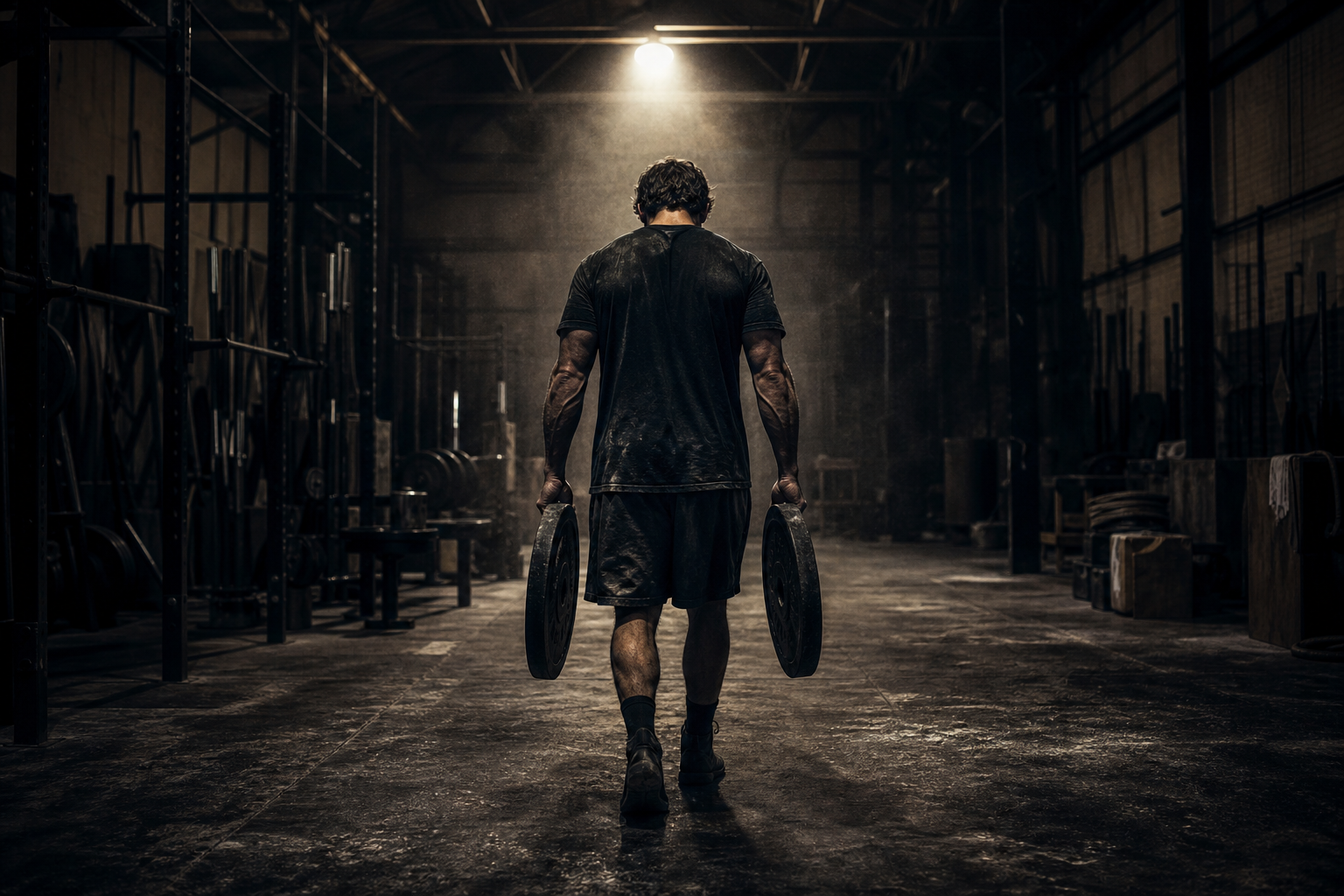
Somewhere around 2018, I was standing in a gym parking lot unable to open my car door properly because my forearms had completely seized up. Not cramped. Seized. Like someone had replaced the muscles with concrete and forgotten to tell me.
I had just done four sets of heavy farmer’s carries. I thought I was in decent shape. I was wrong about what shape actually meant.
That’s the thing about farmer’s carries. They have a way of showing you exactly what you are, without any ceremony about it.
The movement itself is almost insultingly simple. You pick up something heavy. You hold it. You walk. That’s the whole exercise. No technique seminar required, no specialty bar you have to special-order, no debate about stance width or elbow position. You pick it up, you hold it, you don’t put it down until you reach the other end of the room. Repeat until you hate yourself an appropriate amount.
And yet it is one of the most honest pieces of physical work you can do in a gym. Not because it’s elegant. Because it isn’t.
The carry is a metaphor that moves.
Think about what a farmer’s carry actually simulates. It’s not a competition lift. It’s not a sport-specific movement. It’s just carrying a load through space while your body fights to stay upright and your hands fight to keep their grip on the world. That’s labor. That’s what humans did for ten thousand years before we invented machines to do it for us.
When you’re under a bar doing a squat, the bar at least helps organize the weight. It distributes it. It gives you a fighting chance to find your balance and brace properly. A farmer’s carry gives you no such help. Two independent loads, one in each hand, pulling you toward the floor and toward your own weaknesses simultaneously. Your weaker side will tell on itself almost immediately. Your grip endurance, not your grip strength, your grip endurance, will become the limiting factor before your legs or your back even feel tired. And your core, the real one, the one that actually keeps a human being standing upright while moving through space, will work harder than it does during almost any direct core exercise you’ve ever programmed.
The tradeoff nobody mentions up front is this: farmer’s carries will break your grip down so thoroughly that anything requiring hand strength afterward is compromised. Deadlift session followed by carries? Fine. Carries followed by deadlifts? You’re going to find out what your hook grip looks like when your hands are already cooked. I’ve made that mistake. More than once. The order of operations matters more here than in almost any other pairing in the gym.
There’s also the ego thing, and I’ll be honest about it. The farmer’s carry does not look impressive to people who don’t know what they’re looking at. Nobody’s going to film you from across the gym. Nobody’s posting a farmer’s carry as their highlight reel. You’re just a middle-aged guy from Gray, Georgia walking in a straight line with heavy things in your hands, and to a casual observer that’s indistinguishable from a man hauling luggage through an airport. The lift that does the most quiet work gets the least amount of credit. That’s either deeply frustrating or deeply appropriate depending on what you’re actually in the gym for.
I’m in the gym to still be able to do things when I’m 65. That’s the whole program at this point.
The hidden cost that really bites you, though, isn’t grip fatigue or ego. It’s accumulation. The farmer’s carry doesn’t feel catastrophic in the moment. You finish a set and you feel kind of fine. Maybe winded. Maybe your traps are pumped. And then you do it again the next session, and the next, and somewhere around week three or four your traps are not recovering the way they used to and your neck feels like it’s been run through a hydraulic press. That upper trap and neck loading is real and it adds up quietly. You’re not sore after any single session in a way that waves a red flag. You just gradually become a person who wakes up in the morning with a stiff neck and can’t figure out why.
The fix is straightforward but unglamorous: you have to program carries with the same respect you’d program a heavy compound lift. Not as a finisher you tack on when you feel like it, but as a real movement with real recovery requirements. When I’m running them consistently, I treat that next day the same way I’d treat the day after heavy deadlifts. Because that’s what it is.
What the carry gives you in return for all of that is something that doesn’t show up on a max lift chart. It shows up when you’re carrying two cases of water from the car to the garage and your grip doesn’t fail at the end of the driveway. It shows up when you’re helping someone move a couch and you can actually stabilize it through a doorframe instead of just being the guy who’s technically there. It’s a functional return on a functional investment, which means it doesn’t photograph well and it doesn’t make for a good personal record post, but it matters in the actual texture of your actual life.
I’ve come back to farmer’s carries every time I’ve come back to training. Not because they’re flashy or because some influencer told me to. Because every time I do them consistently for a month, I feel more like a person who can handle things. That’s a weird way to describe a gym exercise. I stand by it.
Pick something heavy. Hold on. Walk until it gets uncomfortable, and then walk a little further. There’s a reason it’s still in the program after all these years, and it has nothing to do with how it looks.