Frank
Frank
Nobody handed me a roadmap for how my brain works. For fifty-five years, I’ve been building one in real time, mostly by trial and error, occasionally by spectacular failure. I got the word for it late. The brain showed up right on schedule in 1970 and has been running at full throttle ever since.
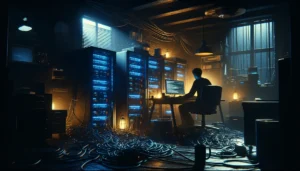
This isn’t a pity post. It’s not a triumph post either. It’s an honest accounting of what it looks like when someone with an undiagnosed AuDHD brain spends three decades in technology, builds a homelab that resembles a small enterprise network, writes apps as a self-described beginner, and only recently got the vocabulary to explain why none of it ever felt like what other people described as “normal.”
1. The Brain Nobody Diagnosed (And the Kid Who Figured It Out Anyway)
Growing up in rural Middle Georgia in the late 70s and early 80s, there was no framework for what I was. The vocabulary didn’t exist in the places I lived. You were either “smart but unfocused” or “a handful” or “just needs to apply himself.” I heard versions of all three. Nobody was looking for autism spectrum traits in a kid who could hold a conversation and fix a broken radio at age twelve. Nobody was clocking the hyperfocus, the sensory stuff, the way social situations required active translation rather than instinct.
The grief that comes with a late diagnosis isn’t dramatic. It’s quiet. It surfaces at strange times. Not “my life was ruined.” Something closer to: what would the path have looked like if someone had caught this at fourteen? Would I have had language for why certain environments felt like static? Would I have stopped blaming myself for the way my attention worked? I don’t dwell there long, but I’d be lying if I said I don’t visit it. The what-ifs don’t dissolve just because you finally have the answer. They just stop running the show.
2. Hyperfocus Is a Superpower With No Off Switch
Hyperfocus is the reason I have 28-plus years of self-taught IT experience without a computer science degree. It’s the reason I’ve built real, functioning applications, HookHouse-Pro, HomeBase, Crumble, as someone who will freely tell you he is not a programmer. When the interest locks in, the depth that follows is genuinely hard to replicate through conventional effort. I don’t study a thing. I inhabit it.
The honest flip side is SunoHarvester, sitting about 70% complete on Scooby right now. Node.js, Puppeteer, bulk downloader for my Suno profile; the concept is solid, the architecture is sound, and I walked away from it the moment a shinier problem appeared. That’s not laziness. That’s exactly how this brain operates when the dopamine from the initial problem-solving phase runs dry and something new fires the same circuit harder. I’ve got a graveyard of 80%-complete projects that were genuinely interesting ideas. The hyperfocus that builds things and the hyperfocus that abandons them are the exact same mechanism. There is no version of this brain that gets one without the other.
3. Curiosity as an Engineering Philosophy
I never approached technology the way someone with a formal education might. I didn’t learn systems top-down, building theory before application. I learned them by breaking things and needing to understand why they broke. That’s not a humble origin story. That’s a methodology. Sixteen years deep in Microsoft Exchange Hybrid. Active Directory. PowerShell scripting that started as “I wonder if I can automate this” and turned into a core part of how I do my job at Advocate Health. None of that came from a textbook. It came from curiosity that refused to stop at “good enough.”
The real-world payoff has been consistent. Nearly 17 years at the same organization. A homelab running Caddy, Authentik, Authelia, Docker containers across multiple VMs, four NAS units, and a project list that keeps growing because the curiosity genuinely never stops. That’s not hustle culture nonsense. That’s what happens when the thing that could have been a liability in a traditional classroom became an asset in an environment where nobody cares how you learned it, only whether it works.
The AuDHD engineering cycle: curiosity fires, hyperfocus takes over, something real gets built, or the dopamine drops and the cycle resets. The 80% graveyard is real.
dark
4. The Chaos Tax — What This Brain Costs You
Here’s the thing. I’m not going to tell you it all balances out and every weakness is secretly a strength. It doesn’t work that way.
The context-switching is real. The guilt when a project stalls is real. The specific flavor of shame that comes from knowing you’re capable of exceptional focus and still watching a task sit undone for three weeks because the right kind of attention never showed up; that’s not something a productivity system fixes. Neither is the way an AuDHD brain can mistake motion for progress. I have spent entire Saturdays in furious activity and produced nothing organized enough to build on. That’s not a character flaw. It took me decades to stop treating it like one.
The regret piece is harder to say out loud. Not having language for any of this for so long meant I developed a pretty efficient internal blame machine. Every stalled project, every career pivot that confused people, every time I felt like I was performing “normal” rather than living it; I wrote those off as personal failures rather than navigation errors made without a map. Getting the vocabulary at 55 doesn’t erase that ledger. It just finally explains what the entries meant.
5. Building Your Own Guardrails (When Nobody Gave You Any)
Here’s what I’ve figured out, mostly by accident and partially by necessity: you don’t fix an AuDHD brain by trying to make it work like a neurotypical one. You build an environment the brain can actually function inside of.
Look at how my homelab is structured and you’ll see the compensatory scaffolding everywhere, even if I never consciously designed it that way:
- Passbolt for credentials, because trusting my memory with 200 passwords is a non-starter
- HomeBase to track every asset on the network, because “I’ll remember where I put that” is a lie I stopped telling myself
- Trilium Notes for my entire music catalog, because the information absolutely will scatter without a container
- Consistent naming conventions across VMs, NAS shares, and Docker stacks, because the chaos tax goes up fast when things don’t have a predictable address
None of that is genius-level organization. It’s basic structure that most people don’t need to build deliberately because their brains provide it automatically. Mine doesn’t. So I built it outside my head and put it where I can find it.
The reality is this: neurodivergent people who make it without a diagnosis don’t succeed by overcoming their brain. They succeed by engineering around it. That’s not a workaround. That’s the actual skill.
6. What I’d Tell the Kid in Gray, Georgia Who Didn’t Know the Word Yet
If I could sit down with the fourteen-year-old version of me, the one taking apart electronics he wasn’t supposed to touch, building things nobody asked him to build, feeling vaguely wrong-shaped for every environment he was put in, I wouldn’t tell him it gets easier. I’d tell him it gets more legible.
The word AuDHD wouldn’t mean anything to him. But I’d tell him that the brain he’s frustrated with right now is going to carry him through 28 years of self-taught IT, across a career at one of the largest health systems in the country, through dozens of homelab projects, real applications, and enough creative output to fill four NAS units. Not despite the way the brain works. Because of it.
Then I’d tell him to write things down. Build the scaffolding early. Stop blaming yourself for the stalls and use that energy to build a system that catches you when the hyperfocus moves on.
If you’re reading this at 40, 50, or 55 and you’re just now getting language for the way your brain has always operated, I want to say this directly: the late diagnosis doesn’t erase what you built. It explains how you built it. That explanation, even arriving decades late, is worth having. You spent your whole life engineering solutions to problems other people didn’t even know you were carrying. That counts. The fact that nobody handed you the right framework early doesn’t mean the structure you built on your own isn’t real.
It is. I’ve got the server racks and the unfinished projects to prove it.