Frank
Frank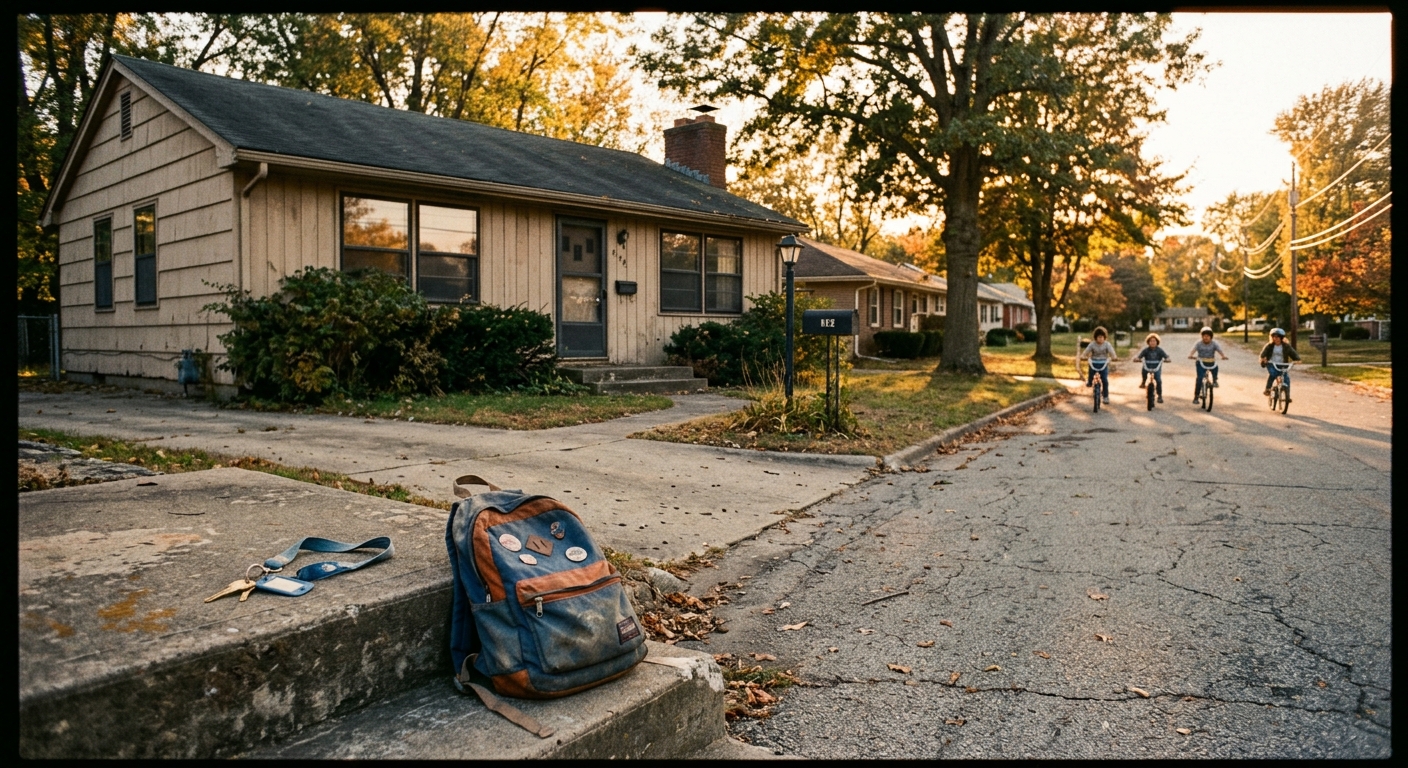
A first-person account from a 55-year-old Gen-X man reflects on growing up unsupervised in Milledgeville, Georgia, examining both the lasting strengths and lasting damage that came from a latchkey childhood. The experience built genuine self-sufficiency, problem-solving ability, and resilience, including through the 1995 line-of-duty death of his older brother.
The same upbringing also produced a deep resistance to seeking help, undiagnosed AuDHD, and underdeveloped emotional regulation skills he is still addressing in adulthood. He concludes that Gen-X emerged capable but quietly wounded, shaped by a cultural gap between old family structures and new economic demands that left children largely to raise themselves.
I was eleven years old the first time I cooked dinner for my brothers. Not mac and cheese from a box. Actual food. Hamburger Helper, maybe, or some variation of whatever was in the fridge that could be assembled into a meal before my parents got home from work. Nobody taught me. I just figured it out. That is pretty much the story of my entire childhood right there.
We grew up on Lakeside Drive in Milledgeville, Georgia. Me, my older brother William, my younger brother Tom, and a rotating cast of neighborhood kids who became something closer to a tribe than just friends. We called ourselves the Lakeside Drive Mafia, which sounds ridiculous now but felt completely real then. Derek, Corky, all of us, loose and unsupervised from the time school let out until well after dark in the summer. Nobody was checking on us. Nobody was scheduling our afternoons or ferrying us to enrichment activities. We were just out there, in the world, handling it.
That was Gen-X. Not the aestheticized, Instagram-filtered version of it that people romanticize now. The actual thing. Parents worked. Kids came home to empty houses. You ate what you could find, watched whatever was on television, and entertained yourself until the adults came back. If you got hurt, you put a paper towel on it. If you got bored, you found something to do. If you got in trouble, you handled the consequences and kept it moving. Nobody was building your self-esteem or validating your feelings. Life was just happening, and you were in it.
Here is what I have figured out as a 55-year-old man who has spent considerable time in therapy and even more time getting diagnosed with things I definitely had as a child but nobody knew to look for: that upbringing made me capable in ways I would not trade, and it broke me in ways I am still discovering. Both things are completely true, and I am not going to pretend otherwise.
Start with the good, because there is real good here.
We learned to be alone without falling apart. This sounds like a small thing until you meet an adult who cannot sit in a quiet room for twenty minutes without reaching for their phone or manufacturing some kind of stimulation. I can be alone. I actually like being alone. Part of that is the AuDHD that nobody identified until I was middle-aged, but part of it is pure conditioning. I spent hundreds of hours in an empty house as a kid, and I learned that silence does not have to be threatening. It can just be quiet.
We learned to solve problems without a committee. I have been doing IT work for 28 years, and I will tell you honestly that the skill I rely on most, the one that separates the people who actually fix things from the people who just escalate tickets, is the willingness to sit with a broken thing until you understand it. You do not panic. You do not immediately call for help. You start at the beginning, work through what you know, eliminate what you can eliminate, and eventually you find the thing. That is not a skill they taught in any class I took. I learned it on Lakeside Drive, figuring out why the TV remote stopped working or what was wrong with my bicycle or how to get the Atari back to the game select screen after it froze. Low stakes, but the methodology is identical. I use it on Microsoft Exchange issues that affect thousands of employees. Same brain. Same process.
We became adaptable. Not “flexible” in the corporate HR sense where everybody gets a gold star for showing up differently. Actually adaptable. You had to be, because the circumstances changed and nobody was buffering you from the changes. Parent got a different shift? Figure it out. Plans fell through? Make new ones. Something broke? Fix it or go without. That constant low-grade problem solving built something in us that I genuinely believe is missing in generations that were more protected. I am not saying that protection is bad. I am saying there are skills you only develop when the safety net is not there.
We built our own entertainment, and it was better for it. The stuff we did on Lakeside Drive, the bike rides, the games we invented, the general mayhem of a bunch of unsupervised boys in a neighborhood, required imagination. It required negotiation and social problem solving and the ability to tolerate boredom long enough to get creative. I still do this. My home lab, my AI music tools, the apps I have built from scratch with nothing but a browser, Claude and sheer stubbornness, that is the same impulse. Nobody handed me a kit. I wanted a thing, so I built it. The only difference between me at twelve and me at fifty-five is that the things I am building are more complicated and the tools are better.
We developed thick skin. Real thick skin, not performed toughness. I have been through things that would end a person who was not built the way I was built. I lost my older brother William in 1995. He was 26 years old, a Deputy in Baldwin County, killed in the line of duty on December 17th of that year. He and I had shared a room growing up. We had lived together as adults. He was my best friend, and then he was gone, and the person who killed him took almost twenty years to be executed, which meant twenty years of trials and appeals and Supreme Court hearings and all of it. Almost two decades of that hanging over the family. It has permanently marked all of us.
I am not going to say that latchkey upbringing prepared me for that, because nothing prepares you for that. But there is something in the Gen-X experience of being toughened up early, of learning to absorb hard things and keep moving, that gave me at least some framework for carrying weight without collapsing. It did not fix anything. William is still gone and I still think about him every single day. But I did not come apart. I kept working, kept raising my kids, kept building things. The toughness was real.
Now the bad. And the bad is also real.
We learned to not ask for help. This one has cost me more than I can calculate. When you grow up in an environment where the adults are not available and you have to handle things yourself, you internalize a pretty simple message: needs are yours to solve alone. That is useful in a lot of contexts. It is actively destructive in close relationships. My wife Kimberly will tell you that getting me to admit I need something, emotionally, medically, in any category of human vulnerability, is like trying to talk a cat into a bath. It is not stubbornness for its own sake. It is conditioning so deep I do not even recognize it most of the time as it is happening.
The AuDHD piece makes this worse. I spent 55 years not knowing that my brain works differently. Not knowing that the anxiety that has chewed on me my entire life, the anger that sits right below the surface, the way I hyper-focus on a home lab project for twelve hours and then cannot start a simple email, all of it has a name and a reason. I just thought I was broken in ways that were my fault. Gen-X kids did not get diagnosed. You were weird, or you were difficult, or you needed to straighten up. You did not get support. You got told to handle it. And so you tried to handle it, for decades, while the undiagnosed thing kept making everything harder in ways you could not explain.
We did not learn to emotionally regulate in healthy ways. I am still working on this at 55. When nobody is teaching you how to process your feelings because the adults are largely absent, you develop work-arounds. Some of those work-arounds are fine. Some of them are not. The anger I carry about William, about the 20 years of the legal system grinding that situation into dust while my family bled, that anger has nowhere clean to go. It does not go anywhere, it just lives in me. I have zero empathy for criminals. Zero. People want to have nuanced conversations about the criminal justice system and I just stare at them. I cannot get there. My brother was killed at 26 by a person who then got to spend 19 years fighting to keep breathing on this earth while William lies in the family plot in Memory Hill Cemetery. My empathy for that situation is exactly what you would expect from someone who was not taught to regulate emotion and then had that deficit hit by something that enormous.
We were under-supervised in ways that led to real risk. I am not going to pretend all of the Lakeside Drive Mafia years were just innocent fun. Kids without adult supervision make bad decisions. Sometimes those decisions have consequences that follow you. Nothing catastrophic for me, but I look back at some of it and wince. We were in situations we had no business being in, making choices we had no framework to evaluate, because there was nobody there to set the boundary. The freedom was real. So was the danger.
We normalized self-sufficiency to the point of isolation. There is a specific Gen-X thing I see in people my age where everybody is handling everything alone and nobody is connected to anything. We moved away from our families, built our own little worlds, and then wonder why it feels lonely sometimes. I have lived in Gray, Georgia since 1998. I know this place. I am rooted here. But the deeper emotional connectivity, the kind where you actually let people into what is happening with you, that is still a work in progress and I am 55 years old.
We missed a lot of development that got skipped over. There are conversations I should have had with an adult when I was twelve, fourteen, sixteen, that just did not happen because nobody was there at all times to have them. Some of those gaps you figure out eventually through living. Some of them you carry as blind spots for a really long time. I am still finding blind spots. My AuDHD diagnosis in adulthood was the equivalent of someone turning on a light in a room I had been fumbling around in for five decades. All these things that I thought were character flaws turned out to be neurology. That is a complicated thing to absorb at this age. Useful, yes. But also a little bit of a gut punch to sit with.
Here is where I land on the whole thing.
I would not trade the capability. I would not trade the self-sufficiency or the problem-solving or the thick skin or the ability to be alone or the stubbornness that has carried me through every hard thing including losing William and watching a killer walk to his execution and still somehow showing up to work and building things and raising two kids and watching my daughter Lauren have my first grandson. That toughness is mine. I built it on Lakeside Drive and in empty houses and in the years since, and it is real.
But the cost was real too. The isolation. The undiagnosed decades. The emotional regulation deficits. The reflexive refusal to need anything from anyone. Those are not character traits. Those are wounds that got covered over rather than treated because covering over is what we learned to do.
Gen-X was not failed by our parents specifically. Most of our parents were doing what their circumstances required. Two incomes were becoming necessary. The culture had not caught up with what that meant for kids. Nobody had a manual. We were the generation that got raised in the gap between the old way and a new way that had not fully arrived yet.
What I know is this: we came out capable and a little bit damaged, and we mostly handled both of those things without making a big deal out of it, because making a big deal about things was not in the playbook. The Lakeside Drive Mafia did not sit around processing our feelings. We rode bikes and got into things and figured it out.
That is still who I am. That will always be who I am.
I just know now that figuring it out alone was not always the right call, and I am working on that part. At 55. Better late than never, I guess.