Frank
Frank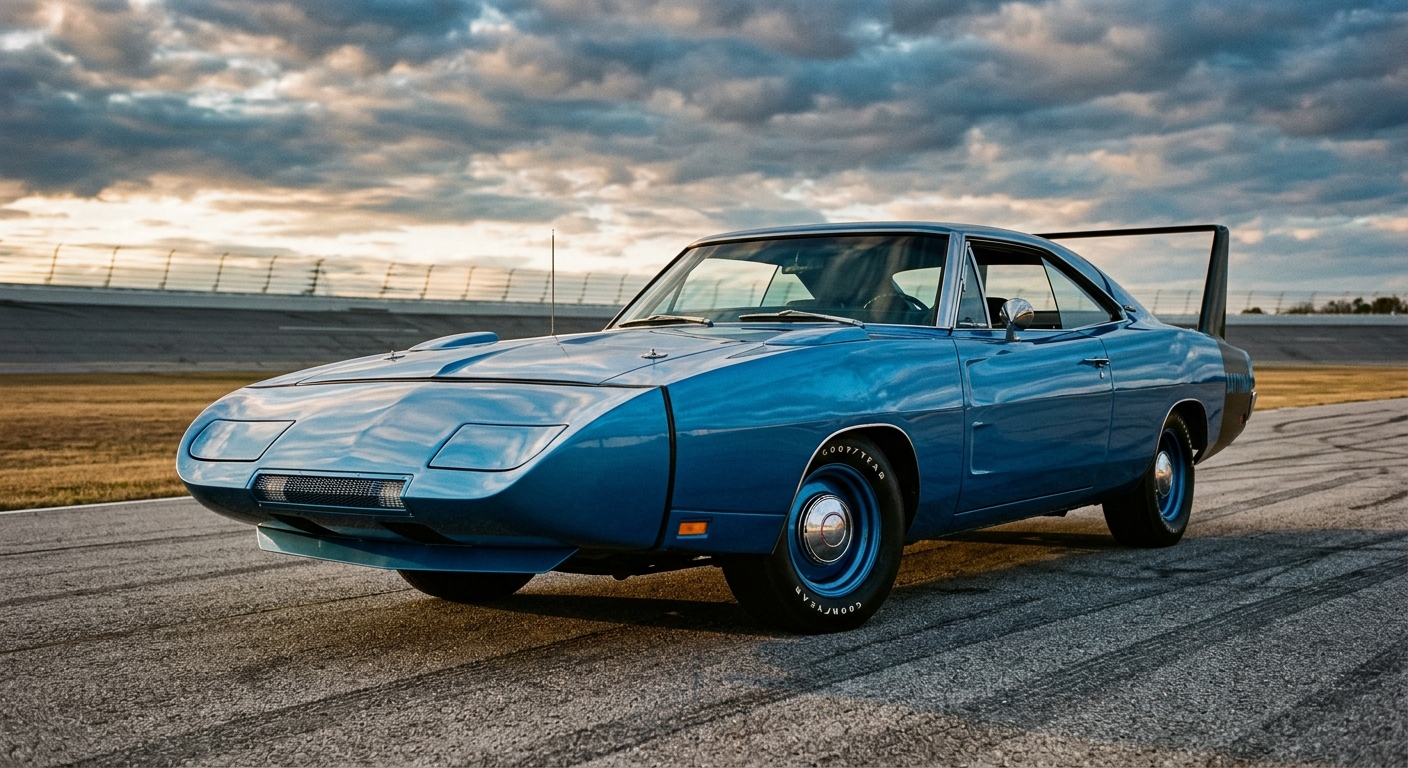
There are fast cars, and then there are cars that changed the physics of what fast meant. The 1969 Dodge Charger Daytona sits firmly in that second category. It didn’t just go fast. It went fast in a way that forced engineers, competitors, and the entire motorsport establishment to rethink their assumptions about what a production-based automobile could do on an oval track. And then, because Dodge was feeling bold, they built 503 street versions and sold them to the public.
That’s the part that still gets me. This wasn’t a pure race car with a thin veneer of road legality. The Daytona was a legitimate, drive-it-to-work machine with a nose cone that stretched 18 inches beyond the standard Charger body and a rear wing tall enough to change gears underneath. It looked like something a ten-year-old drew in the margins of a math notebook. It was utterly absurd. And it worked so well that NASCAR eventually had to ban it.
If the Hemi ‘Cuda we covered in Part 3 was about raw, intimidating muscle, the Daytona was about something different. It was about what happens when racing ambition collides with production-car reality and somebody at Dodge decides not to blink.
The Problem Dodge Was Trying to Solve
To understand the Daytona, you have to understand the context it came from. By 1968, Ford had cracked the superspeedway code with the aerodynamically slippery Torino Talladega (which we’ll get into properly in Part 20). Their fastback body was cutting through air in ways that the standard Charger’s recessed grille and flying buttress C-pillars simply couldn’t match. The Charger was a gorgeous car on the street. On a superspeedway at 180 miles per hour, all those stylistic flourishes created drag and instability that Ford’s engineers were happy to exploit.
Chrysler’s response was to form a dedicated aerodynamics team and tell them to solve the problem without mercy. The engineers wound up collaborating with Chrysler’s own aero division and even consulted with outside aerodynamicists to understand exactly what was happening to the Charger body at speed. What they found wasn’t subtle. The recessed grille created a pressure pocket that pushed the nose up. The rear roofline created lift behind the car. At racing speeds, the stock Charger was fighting itself.
The solution they landed on was radical. They grafted a pointed nose cone onto the front of the car, a flush piece fabricated from steel that smoothed the airflow around the front end and kept the nose planted. Out back, they mounted a massive inverted wing on twin vertical stabilizers, set high enough above the decklid to catch clean air and push the rear of the car down into the pavement. The wing wasn’t decorative. It was generating meaningful downforce at speed, keeping the rear tires in contact with the track when everything else in physics wanted to lift them off.
The result was a car that could run 200 miles per hour on a superspeedway. That number, at the time, was genuinely extraordinary.
Homologation and the 500 Street Car Rule
Here’s where the story gets interesting from a production standpoint. NASCAR required manufacturers to build a minimum number of street-legal versions of any car they wanted to race. The specific threshold that applied to the Daytona was 500 units. Dodge needed to build at least 500 street cars to satisfy the homologation requirement, and they did, clearing the bar with a handful of cars to spare.
Building those 500 cars was not a trivial undertaking. The nose cone and wing were not simple bolt-on accessories. The nose required significant modifications to the front of the car, including a steel plug that replaced the standard Charger hood and front clip. The hidden headlights that were a signature element of the standard Charger had to go, replaced by pop-up units integrated into the nose. The rear wing required its own structural reinforcement. Every street Daytona was essentially a custom conversion performed at a Michigan coachbuilder called Creative Industries, which Chrysler contracted to do the work.
The cars came out looking like nothing else on the road. Literally nothing else. You could be standing on a street corner in any city in America in 1969 and if a Daytona rolled past, you would stop and stare. That wing rose about 23 inches above the decklid. The nose added nearly a foot and a half to the car’s overall length. On the street, the aerodynamic necessity of all that hardware was irrelevant. You weren’t generating meaningful downforce at 45 miles per hour. But you were making a statement that no amount of money could replicate with anything else available.
Dodge offered the Daytona with two engine choices: the 440 Magnum V8 producing 375 horsepower, or the legendary 426 Hemi making 425 horsepower in street tune (and considerably more in reality). Only about 70 of the street Daytonas were equipped with the Hemi, which makes those cars among the most collectible American automobiles ever produced.
What It Was Like to Drive
I want to be honest here because I think the mythology around cars like this sometimes floats free of the actual experience. The street Daytona was not a refined automobile in any modern sense. You were sitting in a late-1960s Dodge Charger interior, which was nice enough for its era but not what anyone would call luxurious. The ride was firm, the steering was heavy, and if you ordered the four-speed manual, you were physically working to drive the thing.
But when you put your foot down on a 440 Magnum or, if you were among the fortunate few, a 426 Hemi, the car delivered something that transcended quibbles about ride quality. The Hemi especially had a presence under the hood that you felt before you heard it. There was a mechanical density to that engine, a sense of barely contained potential, that made the car feel like it was tolerating you rather than serving you. It wanted to run. It was designed to run. Every inch of that nose cone and every square foot of that rear wing existed to serve the running.
On the highway, the Daytona was reportedly more stable than the standard Charger at high speeds. That’s not surprising given what the aerodynamic package was designed to do. But on normal roads, at normal speeds, you were essentially piloting a rolling piece of motorsport theater. Other drivers slowed down to look. Gas station attendants came out of the booth. People took photographs.
There’s something worth sitting with in that. The street Daytona was never going to demonstrate its aerodynamic advantages to anyone who owned one for normal transportation. The wing wasn’t doing anything useful at 70 miles per hour. But the car carried meaning that exceeded its practical function. It was physical proof that Dodge had been willing to go to extraordinary lengths to win. You were buying into that story as much as you were buying a car.
The Racing Program and What It Achieved
The whole point of the Daytona’s existence was NASCAR, and on that front, it delivered results that were genuinely historic. In September of 1969, Charlie Glotzbach qualified a Daytona at Talladega Superspeedway at a speed of 199.466 miles per hour, becoming the first driver to officially qualify a stock car above 199 mph. The car was right on the edge of 200 miles per hour out of the gate.
Bobby Isaac took a Daytona to a closed-course speed record of 201.104 miles per hour later that year, making it the first NASCAR stock car to officially break 200 mph in competition. These were not incremental improvements. These were records that redefined what the category could do.
Richard Petty drove a Daytona to victory in the Talladega 500 in 1969. Petty had actually defected to Ford earlier that year over a contract dispute, which made his return to Plymouth and subsequent Daytona success particularly satisfying for Chrysler. The car won races. It dominated superspeedways in the way that Dodge had designed it to dominate. The aerodynamic solution worked exactly as intended.
It worked so well, in fact, that NASCAR responded by implementing rules that effectively banned the Daytona and its Plymouth sibling, the Superbird (which we’ll cover in Part 16), from competition. The sanctioning body restricted engines in cars with the high-downforce aero packages to a displacement that made them uncompetitive, which was a polite way of saying: you can race them, but you’ll lose. Dodge and Plymouth pulled their factory support, and an era ended.
The Daytona’s NASCAR career was short and brilliant, like a comet that burns itself out making the sky bright.
Rarity, Value, and the Collector Market Today
The homologation minimum of 500 cars means there are relatively few Daytonas in existence, and the attrition of 55-plus years has reduced the number of surviving examples further. A low-mileage, numbers-matching Hemi Daytona in good condition is among the most valuable American muscle cars on earth. We’re talking about auction results that have exceeded a million dollars for the right car. Even 440-powered examples in solid condition command prices that would have seemed absurd just twenty years ago.
Part of what drives that value is pure scarcity. Part of it is the Hemi’s legendary status, which we touched on in the ‘Cuda discussion in Part 3. But a significant part is the Daytona’s visual impact. It is, even today, one of the most dramatic-looking automobiles ever built for street use. It demands attention in a way that more conventionally styled muscle cars simply don’t. You can have a parking lot full of beautiful cars and a Daytona will collect the crowd.
The standard advice for anyone serious about acquiring one is the same advice that applies to any significant collector car: buy the best car you can afford, verify the numbers thoroughly, and understand what you’re getting into for maintenance. These are complex cars with specific engineering, and originality matters enormously to value.
What the Daytona Actually Meant
Step back from the specifications and the racing results for a moment. The Daytona was Dodge’s answer to a question that most manufacturers wouldn’t have had the courage to ask out loud: how far are we willing to go to win?
The answer turned out to be farther than anyone had gone before. They modified production cars at an outside facility to create something that technically satisfied homologation rules but was, in every meaningful sense, a racing machine with license plates. They built an 18-inch nose and a 23-inch wing onto a car that people would have to drive on public roads. They did all of this because they wanted to win on superspeedways badly enough to absorb the cost and the engineering challenge and the genuine uncertainty about whether any of it would work.
And it worked. That’s the part that separates the Daytona from the category of interesting failures. The aerodynamics did what the engineers said they would do. The cars went faster than anything before them in NASCAR competition. Bobby Isaac broke 200 miles per hour. The logic held up under real conditions.
There’s something in that story that I find genuinely moving, which is not a word I expected to use when I started thinking about a 1969 race car with a ridiculous wing. But the Daytona represents a kind of institutional commitment to excellence that doesn’t happen by accident. Somebody at Dodge had to fight for that program. Somebody had to defend the budget, justify the wing, explain the nose cone to people who thought the whole thing looked insane. The car exists because people believed in it enough to push it through.
The muscle car era produced a lot of cars built for bragging rights and stoplight drama. The Daytona was built for something more specific and, in its way, more demanding. It was built to win a very particular kind of race under very particular conditions, and every weird, wonderful inch of it reflects that purpose.
That’s why it belongs on this list. Not just because it’s fast, or rare, or valuable, though it is all of those things. It belongs here because it shows what happens when engineers are given a real problem and told to solve it without compromise. The result was something that looked like science fiction, performed like nothing else in the category, and left a permanent mark on what American performance cars could aspire to be.
Next up in Part 5, we’re moving from Dodge’s aerodynamic experiment to the blunt-force institution that was the 1970 Chevrolet Chevelle SS 454 LS6. No wings. No nose cone. Just an engine so large and violent that Chevrolet’s own engineers argued about whether it should exist. It’s a different kind of legend, and in some ways a more purely American one.