Frank
Frank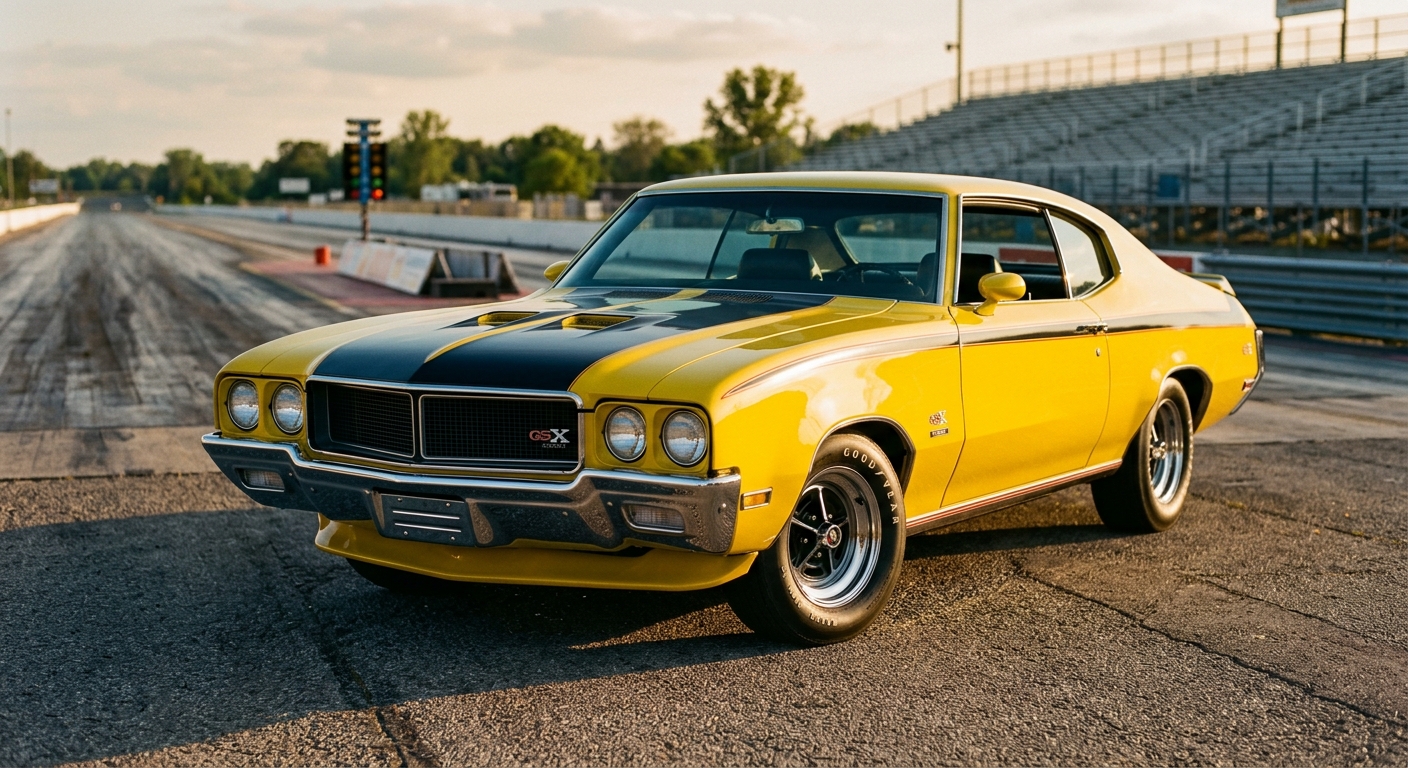
There’s a particular kind of insult that gets handed down through automotive history, and Buick has been on the receiving end of it for decades. The brand built its reputation on comfort, quiet, and the kind of ride quality that made your grandmother feel like she was floating down the highway on a cloud. It was the car your dentist drove. The car parked in the driveway of the house with the well-trimmed hedges and the American flag out front. Respectable. Composed. Thoroughly unsurprising.
Which is exactly why the 1970 Buick GSX Stage 1 hits so differently.
This car didn’t just surprise people. It embarrassed them. It embarrassed the guys at the dragstrip who looked at that big, formal Buick body and assumed they’d picked up an easy win. It embarrassed the journalists who had to rethink everything they thought they knew about what a Buick was supposed to be. And in some quiet, satisfying way, it still embarrasses a few muscle car encyclopedias that list it as an afterthought behind the Chevelle, the GTO, and the ‘Cuda, as if Buick just wandered into the performance party by accident.
The GSX Stage 1 wasn’t an accident. It was a statement. And 1970 was exactly the right moment to make it.
The Odd Duck That Bit Back
By 1970, the GM divisions were in full internal competition with each other, each one trying to out-muscle the next without openly cannibalizing sales. Chevrolet had the Chevelle SS 454 LS6 (covered in Part 5). Pontiac had the GTO Judge (Part 6). Oldsmobile had just dropped the 442 W-30 (Part 7). These were known performance brands. These were the divisions people expected to do this sort of thing.
Buick was the odd one out. The Skylark-based Gran Sport had been around since 1965, and it had always been something of a gentleman’s hot rod, capable and composed but never quite snarling. Buick’s engineers, though, had been quietly cooking something in the background. The 455 cubic inch big-block engine had been in development, and when it arrived, the performance division got their hands on it and started tuning it the way performance engines are supposed to be tuned, for torque, for real-world thrust, for the kind of power that doesn’t need a racing slick to make itself useful.
The GSX was the Gran Sport taken to its logical extreme. Available only in Apollo White or Saturn Yellow (both aggressive, neither subtle), wearing a hood-mounted tachometer, front and rear spoilers, stripes, and a stance that communicated something very different from what the Buick badge suggested, the GSX was Buick’s way of saying they could play this game too. The Stage 1 package, which cost around $113 on top of the GSX’s already premium price, turned the whole thing from “interesting” into “genuinely frightening.”
Only 678 GSX Stage 1 cars were built in 1970. That number alone should tell you something about what this car is.
The 455 Stage 1: What That Engine Actually Meant
Let’s talk about the Stage 1 engine, because this is where the mythology earns its weight.
The base GSX came with a 455 cubic inch V8 rated at 350 horsepower. That’s already not a car you want to embarrass yourself against at a stoplight. But the Stage 1 package modified that engine in ways that matter on paper and even more on the road.
The factory rated the Stage 1 at 360 horsepower. If that number seems close to the base engine’s output and therefore unimpressive, understand two things. First, factory horsepower ratings in 1970 were conservative. Manufacturers were beginning to feel the heat from insurance companies who had started pricing muscle cars off the road by calculating premiums based on horsepower. So you understated. You played the game. Second, and far more importantly, horsepower isn’t the whole story here. The Stage 1’s torque output was rated at 510 lb-ft. Five hundred and ten pound-feet of torque.
To put that in perspective, the legendary 426 Hemi (the engine covered in Part 3 under the ‘Cuda) was rated at 490 lb-ft. The LS6 454 in the Chevelle came in at 500 lb-ft. The Stage 1 Buick 455 outpulled them both by the factory’s own conservative numbers, and nobody seemed to notice.
The engine featured specific cylinder heads with larger intake and exhaust ports, a high-lift camshaft, a Quadrajet carburetor fed by a low-restriction cold-air induction system, and an exhaust system designed to flow rather than strangle. Everything about the Stage 1 package was aimed at torque delivery across the usable rev range, not a peaky top-end rush that only matters on a racetrack. This made the GSX Stage 1 something of a different animal from the Hemi or the LS6. It was brutal off the line and it stayed brutal through the midrange, which is exactly where street driving lives.
The quarter mile times that came back from testing ranged between 13.3 and 13.8 seconds at around 104 to 107 mph depending on conditions and driver. That’s not a car that won every dyno shootout in a magazine. It’s a car that was quick in the real world, in a way that made it deeply uncomfortable to race against.
The Car Nobody Expected
Here’s what’s interesting about the cultural position the GSX Stage 1 occupied in 1970. It wasn’t celebrated the same way the GTO or the Chevelle was. It didn’t have the mythology built up around it from years of racing heritage. Buick wasn’t Pontiac with its Motor Trend wins and its “Wide Track” reputation. Buick wasn’t Chevrolet with its Corvette credibility.
What Buick had was the element of surprise, and in the street racing culture of 1970, that was worth something.
There’s a reason drivers talk about sleepers with a kind of reverence. A car that looks like it shouldn’t be fast, that carries the visual baggage of a brand associated with comfort and convention, and then absolutely walks away from something more expected, that car lives in the memory in a different way. The GSX wasn’t really a sleeper in terms of looks. The Apollo White with the black stripes and the spoilers was loud enough. But it was a sleeper in terms of reputation. Nobody talked about Buick the way they talked about Dodge or Chevrolet in the performance context, and the GSX Stage 1 fed on that underestimation.
Accounts from the era describe drivers pulling up to the line against GSX Stage 1s and laughing. Not laughing afterward. The GSX’s torque advantage meant it launched hard and flat, without a lot of drama, without the tire-shrieking theatrics of a car that was working harder to get the power to the ground. It just moved. Decisively and with very little fuss. Which made it even more disorienting to lose to.
Buick’s Engineering Philosophy vs. The Rest of the Pack
This is worth digging into, because it separates the GSX from its peers in a meaningful way.
Pontiac built the GTO around a culture of performance, a marketing narrative that started with the original 1964 car and built on itself year after year. Chevrolet had racing infrastructure and the Corvette as an anchor to its performance credibility. Dodge and Plymouth had the direct connection to drag racing and NASCAR. Their engines were built to be recognizable, celebrated, and slightly terrifying.
Buick’s performance philosophy was quieter. Their engineers came from a tradition of refinement, of making power feel smooth and controllable, of building engines that produced their output without making you feel like you were managing an explosion. The 455 Stage 1 reflected that. It was not the most exotic engine in the GM stable. It did not rev like a racing engine. It was not designed to be disassembled by a weekend wrench-turner and pushed further on a budget.
What it was designed to be was effective. Every modification in the Stage 1 package had a specific purpose. Every component worked in service of the torque curve. There was no excess, no showmanship in the engineering. Just a very deliberate, very serious set of choices made by people who understood what they were doing and didn’t particularly need the validation of the crowd.
This is one of the reasons the GSX Stage 1 holds up so well historically. The cars that were built around image often look their age. The cars that were built around engineering tend to age differently.
Rarity, Value, and What It Means to Be Overlooked
Let’s circle back to those production numbers.
In total, only 678 GSX Stage 1 units were produced in 1970. For comparison, the ‘Cuda Hemi saw 652 units in convertible and hardtop combined, and it commands prices that make financial advisors dizzy. The LS6 Chevelle was built in higher numbers but is still one of the most coveted muscle cars on the auction block. The GSX Stage 1 exists in rarer company than most people realize, and historically, it hasn’t always been priced to reflect that.
This has been changing. As the muscle car market has matured and collectors have moved beyond the obvious legends to look harder at what was actually built, the GSX Stage 1 has gotten a second look. Clean, documented examples in Saturn Yellow or Apollo White have crossed significant auction thresholds, and that trend isn’t reversing. Rarity plus genuine performance plus the increasing sophistication of the collector market is a combination that always eventually moves the needle.
But there’s something a little sad about a car only being fully appreciated through its auction price. The GSX Stage 1 deserves recognition on its own terms, not just as an investment vehicle. It was a genuinely remarkable piece of engineering from a division that wasn’t supposed to produce genuinely remarkable engineering, and it competed directly with the best the era had to offer. That story is worth telling for its own sake.
The Gentleman’s Muscle Car, and Why That Label Fits
People sometimes describe the GSX Stage 1 as a “gentleman’s muscle car,” and I have complicated feelings about that phrase. On one hand, it captures something real about the car’s character. It wasn’t rough around the edges the way some of the Mopars were. The interior quality was superior. The ride, even in performance trim, retained something of the Buick refinement that the brand was known for. It was a car you could drive daily without feeling like you were being punished.
On the other hand, “gentleman’s muscle car” can become a way of putting a ceiling on a car’s reputation. As if being refined means it wasn’t really serious. As if the cars that felt brutal and demanded skill were somehow more legitimate.
The Stage 1 engine numbers don’t support that reading. Five hundred and ten pound-feet of torque isn’t a gentleman’s torque figure. It’s a serious, competitive, on-its-own-terms performance figure that belonged in any conversation about the fastest cars of 1970. The fact that Buick wrapped that engine in a more composed package doesn’t diminish what it was capable of. If anything, it made it more capable in the real world where most driving actually happens.
There’s a lesson in that. The loudest car at the party isn’t always the most dangerous. Sometimes the one in the corner, well-dressed and saying very little, is the one you shouldn’t bet against.
The Quiet Legend
The 1970 Buick GSX Stage 1 is a car that rewards attention. It doesn’t demand it the way the ‘Cuda does, or the Charger Daytona, or the Judge. It sits in the lineup of this series like a well-kept secret, which is appropriate, because for a long time that’s exactly what it was.
What Buick proved with this car is that the performance conversation of 1970 wasn’t just between the expected players. There was room for a brand that knew how to build engines to come in at the end of the party and make everyone reconsider their assumptions. The GSX Stage 1 is the reason you don’t count out the quiet one.
In a year of extraordinary machines, this car was extraordinary in a way that didn’t ask for applause. It just went and proved itself in the quarter mile and on the highway, and then drove home in relative comfort while the Hemi ‘Cuda vibrated at idle in the driveway.
That’s not weakness. That’s a different kind of confidence. And in 1970, that confidence was backed by 510 lb-ft of reasons to believe it.
Next up in this series, we head deep into the territory of the truly outrageous. The 1969 Chevrolet Camaro ZL1 is a car that almost didn’t exist, built through a backdoor ordering process that circumvented GM’s own corporate rules, powered by an all-aluminum 427 engine that was never supposed to be in a street car. Part 9 gets into the COPO program, what it was, how it worked, and why it produced one of the most audacious automobiles ever to carry a Chevrolet bow tie.