Frank
Frank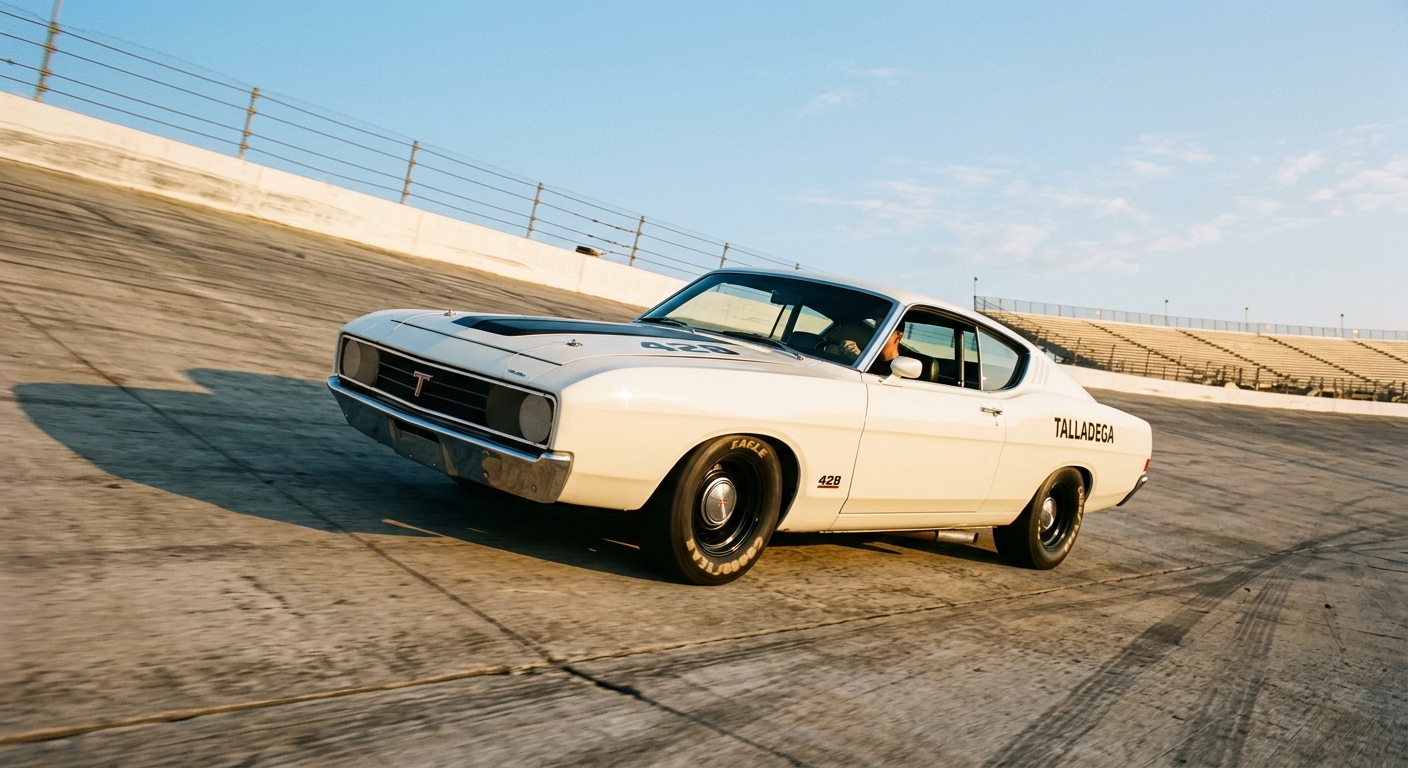
There’s a certain kind of legend that doesn’t announce itself. It doesn’t growl at you from a showroom floor or dare you to look away. It earns its place quietly, through purpose and precision, through doing exactly what it was built to do and doing it better than anyone expected. The 1969 Ford Torino Talladega is that kind of legend.
Most casual muscle car fans will rattle off the Hemi ‘Cuda, the Charger Daytona, the LS6 Chevelle without pausing for breath. The Talladega rarely makes that list. It should. Because while everyone else was building cars to win stoplight races, Ford built this one to win at 200 miles per hour on the high banks of NASCAR’s most punishing superspeedways. And it worked. Brilliantly.
This is a car that exists at the intersection of homologation engineering and genuine racing ambition. It’s a car that most people have never sat in, a car that was never meant to be glamorous, and a car that changed the aerodynamic calculus of NASCAR racing in a single season. If you’ve followed this series from the beginning, you know I have a soft spot for the cars that did something genuinely different. The Torino Talladega did something different.
The Aerodynamic Arms Race That Made It Necessary
To understand why the Talladega exists, you have to understand what was happening in NASCAR in 1968 and 1969. The superspeedways were getting faster. Talladega Superspeedway had just opened in 1969, and it was unlike anything drivers had seen. Banked at 33 degrees, with a 2.66-mile oval, it was designed for pure flat-out speed in a way that exposed every aerodynamic flaw in every car on the circuit.
Ford’s standard Torino Fastback was already a decent platform, but it had a problem. The front end was blunt. At racing speeds, the nose created lift and drag that hurt both stability and top speed. Chrysler was deep in development on what would become the Charger Daytona (which we covered back in Part 4), a car that would arrive with a massive nose cone and a towering rear wing. Ford needed a response.
The approach Ford took was different from Chrysler’s, and in some ways more elegant. Rather than bolting on aerodynamic theater, Ford’s engineers focused on reshaping the production body itself. They worked with NASCAR’s homologation rules, which required that a certain number of street-legal versions be built before a car could race. Five hundred units was the number. Ford committed to building at least that many Talladegas for public sale, which gave them the green light to run the modified body on the superspeedways.
The result was a car that looked almost stock to the untrained eye but had been carefully massaged in ways that made a meaningful difference at racing speeds. This wasn’t wing-and-nose-cone spectacle. This was precision.
What Ford Actually Changed, and Why It Mattered
The specific modifications to the Talladega body are worth spending some time on, because they tell you a lot about how seriously Ford approached this project.
The most significant change was to the front end. Ford’s engineers extended the roofline slightly and, more critically, reworked the front fascia. The standard Torino’s front bumper was flush with the grille in a way that created an aerodynamic stumbling block at speed. On the Talladega, the front end was reshaped to be more tapered and flush. The bumper was rolled inward and the snout was extended roughly five inches. The result was a much cleaner entry point for air at high speed.
They also eliminated the rain gutters along the roofline. That sounds trivial until you understand that at 180-plus miles per hour, every protrusion creates turbulence, and turbulence creates drag. Small details mattered enormously.
The roofline itself was borrowed from the Ford Torino Sportsroof configuration, which had a long, sloping fastback profile. This wasn’t an accident. The fastback shape was inherently more aerodynamically efficient than the notchback, and Ford knew it.
On the street cars built for homologation, these changes were present in exactly the same form as on the race cars. Ford didn’t build a watered-down street version and a separate race version. The street Talladega had the reshaped nose, the clean roofline, all of it. In that sense, every Talladega owner got the real thing.
Power on the street cars came from Ford’s 428 Cobra Jet, rated at 335 horsepower in official figures that were, in the tradition of the era, somewhat conservative. The Cobra Jet was a strong, well-sorted engine, torquey and durable, though the Talladega wasn’t really marketed as a drag strip weapon. It was a highway car, a grand tourer in a muscle car’s skin, built for sustained high speed rather than quarter-mile sprints.
The Racing Season That Justified Everything
The 1969 NASCAR season is the proof of concept. Ford put the Talladega on the superspeedways and let it do its work, and the results were hard to argue with.
David Pearson won the 1969 NASCAR Grand National championship driving a Torino Talladega for Holman-Moody. Pearson was one of the craftiest drivers in the sport’s history, a man who understood how to manage a race rather than just run fast laps. But craft needs equipment, and the Talladega gave him equipment worth crafting with.
Richard Petty, who had famously run Plymouths for most of his career, actually drove Ford Talladegas in 1969 after a contract dispute with Chrysler. The fact that Petty, whose name was synonymous with Mopar, chose to run the Talladega says something significant about how competitive the car was. He won ten races in a Ford that year, which is not the footnote history sometimes treats it as. It is a testament to how good the package was.
The car’s specific advantage was on the superspeedways, the tracks where aerodynamics mattered most. At Talladega, at Daytona, at Michigan, the reshaped nose and clean body allowed Ford’s drivers to carry more speed through the corners and down the straightaways than the blunter Dodges and Plymouths could initially match. Chrysler’s answer, the Charger Daytona with its dramatic aerodynamic appendages, arrived later in the season and changed the equation again. But for a significant portion of 1969, the Talladega was the car to beat.
That’s the whole point of this car. It was engineered with a specific problem in mind, deployed with specific intent, and it delivered specific results. There’s a satisfaction to that kind of purposefulness that a street-only muscle car, however fast, can’t quite replicate.
The Rarity Problem and Why It Adds to the Mystique
Ford built exactly 754 Torino Talladegas for public sale in 1969. Some sources cite slightly different numbers, but the figure hovers right around there. For context, that’s a fraction of the production numbers for the Mach 1 Mustang or the Torino GT that filled dealer lots the same year. The Talladega was never meant to be a volume seller. It was a racing homologation special, and it was priced and positioned accordingly.
The color choices for the street Talladega were deliberately limited. Ford offered it only in three colors: Presidential Blue, Royal Maroon, and Wimbledon White. No wild stripes, no contrasting hoods, no visual shouting. The understated appearance was partly a product of the car’s racing origins and partly just Ford being Ford in an era when Mercury and Shelby were doing most of the flamboyant marketing.
That rarity has created a situation where original, numbers-matching Talladegas are genuinely difficult to find in good condition and command serious money when they do appear. This is a car that wasn’t glamorized in its own time the way the Mustang or even the Torino GT was, so fewer people thought to preserve them. The ones that survived did so because someone, somewhere, understood what they had.
There’s a Mercury version of this story worth mentioning, too. The Cyclone Spoiler II was Mercury’s companion to the Talladega, built on the same principles and for the same homologation purposes. Cale Yarborough ran the Cyclone Spoiler II with great success in 1969, giving Ford’s Lincoln-Mercury division its own piece of the superspeedway glory. If you see the Talladega as the A-side, the Cyclone Spoiler II is the B-side, equally worthy, even less frequently discussed.
What the Talladega Tells Us About Ford’s Engineering Culture
There’s a line of thinking in muscle car circles that goes something like this: Chrysler was the racer, GM was the innovator, and Ford was the marketer. Like most generalizations, it’s not entirely wrong and not entirely right. The Talladega complicates it.
The decision to pursue aerodynamic efficiency through body reshaping rather than add-on components reflects a specific kind of engineering discipline. It’s the kind of thinking that says, let’s solve the problem at the source rather than compensate for it downstream. The Cobra Jet engine program, the Boss 429 (which we explored back in Part 12), the GT40 program at Le Mans, the Talladega: these are all expressions of a Ford that was capable of serious, focused engineering when the goal was clear enough.
The Talladega also reflects something about NASCAR’s relationship with the automobile industry in this period. The manufacturers were genuinely invested in winning. Not in a sponsorship-and-decal way, but in an engineering resources, factory support, serious money way. The homologation rules forced that investment onto the street, which is why ordinary buyers could walk into a Ford dealer in early 1969 and drive home in a car that shared its aerodynamic DNA with a championship-winning race machine.
That relationship between factory and racetrack is different now. It’s been different for a long time. The Talladega is partly a document of a period when it existed in its most pure form.
A Quiet Legacy on Loud Tracks
I’ve always found something compelling about the cars in this series that were built for a single, specific purpose and executed that purpose without compromise. The Talladega wasn’t trying to be everything. It wasn’t a comfort car, it wasn’t a drag racer, it wasn’t a show car. It was a superspeedway weapon wearing street clothes, and it won races.
When you stand next to a Talladega today, the subtlety of it is the first thing you notice. The nose extension is obvious once you know what you’re looking at, but it doesn’t announce itself the way a Charger Daytona’s nose cone does. The car looks almost like a regular Torino Sportsroof until you start examining the details. And then the details start to add up, and you begin to understand what Ford was actually thinking.
That restraint, that willingness to solve the problem quietly rather than dramatically, feels very much like a particular strain of American engineering confidence. Not the confidence that shouts from a hood scoop or a wing. The confidence that knows the math works and doesn’t need to explain itself.
In a series that has celebrated some of the loudest, most dramatic machines Detroit ever produced, the Talladega earns its place by being something different. It’s the one that won championships by thinking differently, by approaching the aerodynamic problem from a different angle than the competition. It belonged on the same tracks as the Daytona and the Superbird, and it traded wins with them through a full season. That’s enough. That’s more than enough.
Next up, we close out the series with Part 21, where I want to pull back from the individual cars and ask the bigger question: what did this era actually leave behind? Not just the metal, not just the memories, but the ideas, the culture, and the lessons that still matter for anyone who cares about what automobiles can be when the people building them are genuinely trying to make something extraordinary. It’s the conversation the whole series has been building toward.