Frank
Frank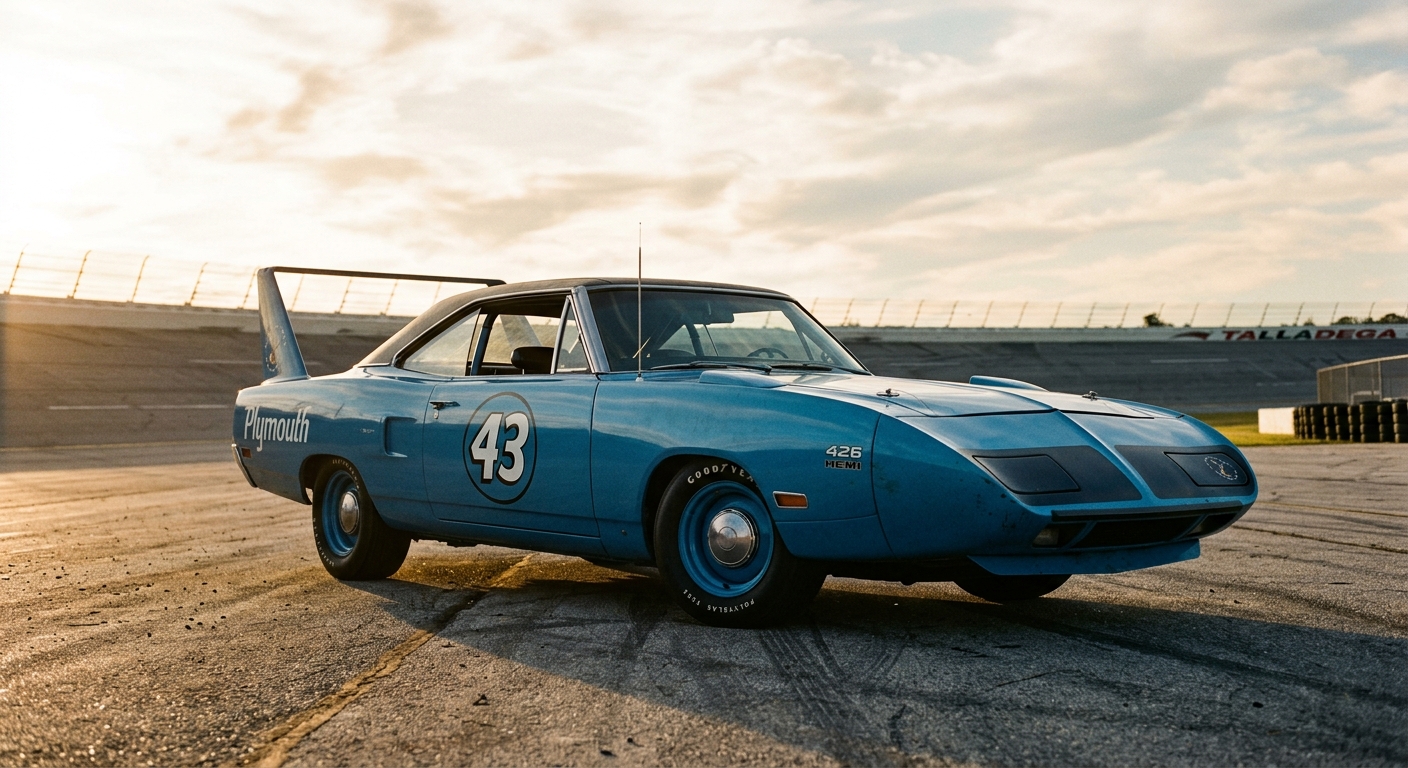
There are cars that exist to win races. There are cars that exist to sell showrooms. And then, occasionally, you get a car that exists to do both at the same time, built under circumstances so specific and so strange that it almost shouldn’t exist at all. The 1970 Plymouth Superbird is exactly that kind of car. It is absurd in the best possible way. It is engineering taken to a logical extreme that nobody asked for and everyone should be grateful happened. It is a winged monument to a moment in American motorsport history when the rules hadn’t quite caught up to the ambitions of the people building the machines, and Plymouth decided to exploit every inch of that gap.
I’ve written about winged cars before in this series, specifically the 1969 Dodge Charger Daytona back in Part 4. If you haven’t read that one, go do it. The Daytona was the first of the aero warriors, the car that proved the concept worked, the car that put Buddy Baker and Charlie Glotzbach into territory no stock car had ever reached. The Superbird is the Daytona’s younger sibling, built one year later, carrying the same philosophy but wearing a Plymouth badge and carrying a very specific political story underneath all that aerodynamic drama. Understanding why the Superbird exists requires understanding not just NASCAR, but the human drama behind it. And that drama starts with one name: Richard Petty.
The Richard Petty Problem
By 1969, Richard Petty was already a legend. Two-time NASCAR champion, face of the sport, son of Lee Petty who’d been racing since the beginning. And he drove Plymouths. Had for years. He was Plymouth’s guy, the embodiment of their motorsport ambitions, the king of the superspeedways in Petty blue.
And then Dodge released the Charger Daytona, and Petty watched Ford’s drivers take their Talladega and Torino machines to the front while his Plymouth wasn’t competitive. Dodge got the aero treatment. Plymouth didn’t. Petty made a business decision that must have felt like a gut punch to Plymouth’s executives: he left. For 1969, Richard Petty drove a Ford. He won races in a Ford. The man whose name was synonymous with Plymouth was putting wins on the board for the competition.
Plymouth needed him back. Not just because of what Petty meant on the track, but because of what he meant to the brand. His wins sold cars. His face sold cars. His Petty blue Plymouth sold cars. So Plymouth engineering got to work on something that would bring him home. They built the Superbird, and they built it specifically to make Richard Petty an offer he couldn’t refuse.
It worked. Petty came back for 1970, drove the Superbird, and won eight races. The plan succeeded on every level. But the car Plymouth had to build to make it happen is where things get genuinely fascinating.
The Aerodynamics and Why They Look the Way They Look
Let me be direct about something. The Superbird looks ridiculous. That nose cone extends nearly two feet beyond the standard Road Runner front bumper. The wing rising off the tail sits so high that you could open the trunk with the wing in place, which was actually a functional requirement, not an aesthetic one. The flush rear window replaces the standard Road Runner’s fastback with a smoother surface. Every single one of these elements was put there for a reason, and none of them were styling exercises.
The standard Road Runner body created massive aerodynamic lift at speed. At 150 miles per hour, lift is dangerous. At 200 miles per hour, it’s potentially lethal. The extended nose cone was borrowed from the Dodge Charger 500 program and refined: it smoothed the airflow transition from the front of the car into the hood and reduced the high-pressure zone that had been causing instability. The flush rear window eliminated a turbulence-generating step in the roofline. These two changes alone made the car significantly more stable at superspeedway speeds.
But the wing is where most people’s eyes go, and it deserves explanation. The wing isn’t primarily about downforce, though it provides some. At the heights these cars were running, the wing’s main job is to create a low-pressure zone above the rear deck that balances the aerodynamic forces across the car. It also cleans up the turbulent wake that would otherwise develop behind the tail. The reason it sits so high is that it needs to operate in clean air, above the disturbed airflow coming off the roof and rear window. An engineer who understood what they were doing put that wing exactly where it needed to be. It just happens to look like something from a science fiction film.
Wind tunnel testing confirmed that the Superbird was faster than the Road Runner it was built upon, and competitive with the Charger Daytona at superspeedway speeds. The aerodynamic drag coefficient was reduced significantly, and top speed climbed accordingly. On the banking at Talladega, these cars were approaching 220 miles per hour. In 1970. With drum brakes on some configurations. The wing wasn’t for show.
What Plymouth Had to Do to Go Racing
Here’s where the story gets genuinely interesting from a regulatory standpoint. NASCAR required that homologation cars be built in numbers proportional to dealers: specifically, one car for every two dealerships in the network. Plymouth had more dealerships than Dodge. That meant Plymouth had to build significantly more Superbirds than Dodge had built Daytonas. The final production number came to approximately 1,920 cars. Every one of them had to be sold through dealer networks to actual customers.
This was a genuine challenge. Plymouth built a car with a two-foot nose extension and a wing that stood eighteen inches above the trunk lid, and then had to convince regular Americans to buy it. Some dealerships reportedly struggled. The stories of Superbirds sitting on lots with the wings removed, converted back to something resembling a normal Road Runner, are real. People wanted a fast car. Some of them weren’t sure they wanted that car.
To sweeten the deal, Plymouth offered the Superbird with multiple engine options. The 440 cubic inch Super Commando V8 was the base engine, available either as a single four-barrel or the triple two-barrel “Six-Pack” setup. The 426 Hemi was optional. We covered the Hemi extensively back in Part 3 with the ‘Cuda, so I won’t retread all of that ground here. But it’s worth noting that a street Superbird with the Hemi was a legitimate performance machine beyond its aerodynamic drama. The 440 Six-Pack cars weren’t far behind, and they were more tractable for everyday use.
The interiors were Road Runner-based, which meant they were reasonably well-appointed by muscle car standards of the era without being luxurious. Plymouth understood their buyer. The Superbird wasn’t meant to compete with the Buick GSX we covered in Part 8 for interior refinement. It was meant to make the person sitting inside feel like they were driving something from another planet. It succeeded.
On the Track Where It Mattered
The 1970 NASCAR season is one of the most remarkable single seasons in the history of American motorsport. Plymouth and Dodge between them were running Superbirds and Daytonas, essentially aero-warfare machines that made everything else on the grid look like it was standing still on the superspeedways. Petty won eight races. Bobby Isaac drove a Dodge Charger Daytona to the championship. Pete Hamilton, driving a Superbird, won the Daytona 500 and both Talladega races. The aero cars dominated so completely that NASCAR had no choice but to respond.
They did. For 1971, NASCAR restricted the wing cars to smaller engines if they wanted to compete, making them essentially uncompetitive. The rule change was pointed. NASCAR needed competitive balance. The manufacturers, seeing the writing on the wall, began retreating from factory-supported racing programs. The era of the winged superspeedway warriors ended in essentially one season. The Superbird was built for 1970. It raced in 1970. And then it was done.
There’s something almost poetic about that compressed timeline. A car conceived, engineered, homologated, raced, and retired in a window so narrow it feels less like a product program and more like a specific act. The Superbird exists entirely within a single year of racing, which gives it a purity that longer-running programs don’t quite have. It was exactly what it needed to be, exactly when it needed to be it, and then the rules changed and it was over.
The Street Version’s Strange Legacy
The Superbirds that didn’t go racing, which was most of them, went to people who wanted the fastest, strangest car Plymouth made. Some of those buyers were performance enthusiasts who understood exactly what they were getting. Some were just attracted to the spectacle. And some were genuinely confused by what sat in their driveway.
Contemporary road tests were somewhat conflicted. Writers appreciated the power, noted the improved high-speed stability versus a standard Road Runner, and then spent several paragraphs trying to make sense of the nose cone and wing for buyers who would never see 150 miles per hour. The quarter mile times were good but not shocking by 1970 standards. The Hemi car ran in the high 13s, consistent with other Hemi-equipped Mopars of the era. The 440 Six-Pack was close behind. The aerodynamic magic only revealed itself at speeds the highway patrol had opinions about.
What the street Superbird gave you that numbers don’t fully capture was presence. Nothing looked like it. Nothing has looked like it since. You could be in a parking lot full of muscle cars, Chevelles and GTOs and Mustangs all lined up, and the Superbird would command every set of eyes. The proportions are so committed, so utterly specific to a purpose, that the car looks aggressive from angles where most cars look parked. It doesn’t rest. It points.
Collectors eventually figured this out. For years, Superbirds were undervalued. The wing was polarizing, the nose cone was weird, and plenty of buyers preferred the cleaner lines of a standard Road Runner or a ‘Cuda. Then something shifted in the cultural understanding of these cars. People began to grasp what Plymouth had actually built: a purpose-engineered racing homologation vehicle that they’d had to sell to the public. A racing car wearing street clothes and a VIN. Values climbed accordingly. Today, a documented Hemi Superbird in good condition is one of the most valuable American muscle cars in existence. The market figured out what the factory had known all along.
The Last of the Winged Warriors
I want to close by saying something about what the Superbird represents in the broader context of this series. We’ve covered a lot of ground together across these sixteen parts. We’ve talked about cars built for the strip, cars built for the street, cars built to shock the competition and wake up the showrooms. The Superbird is different from all of them in one important way: it was built because a set of rules required it to exist.
NASCAR said you have to sell these to the public if you want to race them. Plymouth said fine, we’ll sell them to the public. The result was one of the most extraordinary production vehicles Detroit ever created, born not from market research or styling exercises but from the intersection of aerodynamic necessity and regulatory compliance. It is a loophole made steel and fiberglass. And it is magnificent.
There’s a lesson in that somewhere about what constraints can produce. The Superbird didn’t exist because Plymouth decided it would be cool to make a winged Road Runner. It existed because the rules forced Plymouth to build a road-legal version of a race car, and Plymouth committed to doing it properly. The wing is the right height because engineers calculated the right height. The nose is the right length because wind tunnels said so. Nothing about it is arbitrary, which is maybe why it reads as so visually honest even when it reads as visually insane.
Richard Petty drove it to eight wins. Pete Hamilton won Daytona in it. Bobby Isaac ran 200 miles per hour in related machinery. And then the rules changed and it was over, leaving behind fewer than 2,000 street cars and a legacy that only grew in the decades that followed.
The Superbird is proof that sometimes the craziest solution is the right one. That sometimes you should trust the engineers completely, follow the data wherever it leads, and build the thing with the two-foot nose and the wing that looks like it belongs on a different vehicle entirely. Sometimes the answer really is that wing. You just have to be brave enough to put it on.
Next up, we’re shifting from aerodynamic excess to raw power wrapped in leather, as we turn our attention to the 1968 Shelby GT500 KR, a car that represents Carroll Shelby’s final, most ferocious collaboration with Ford before the original partnership ended. It’s a very different kind of legend, built on a very different kind of ambition, and it deserves every word we’re going to give it.