Frank
Frank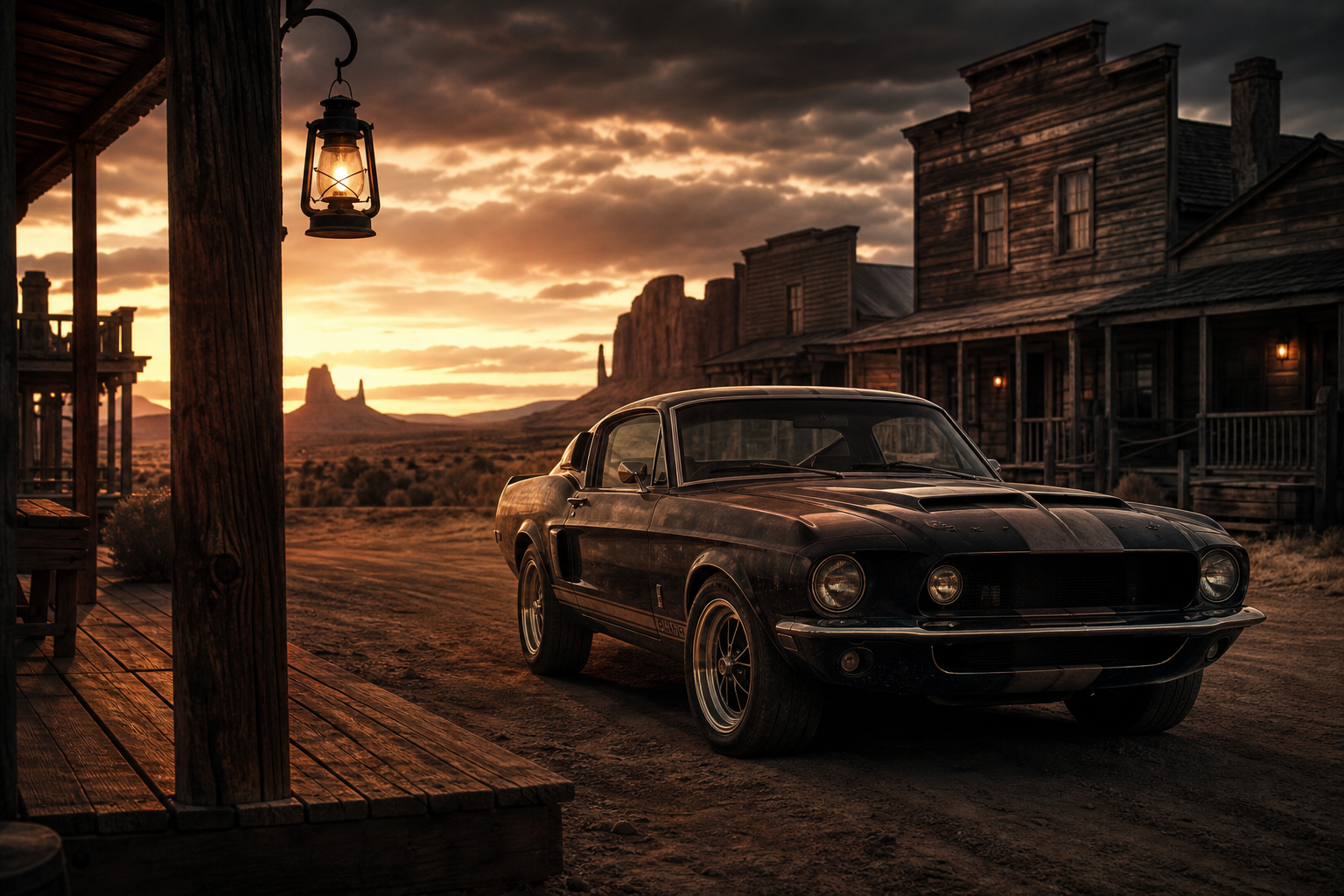
There’s a moment in the history of the muscle car era where a name stops being a badge and becomes a statement of intent. By 1968, “Shelby” was one of those names. Carroll Shelby had already rewritten what an American performance car could be, first with the original 289 Cobras, then with the early GT350s that took a Mustang and turned it into something genuinely fearsome. But the GT500 KR, introduced mid-year in 1968, was something different. It wasn’t just a performance upgrade. It was a declaration.
KR stood for “King of the Road.” And if that sounds arrogant, well, it was. Deliberately, unapologetically arrogant. Because in 1968, if you wanted to argue the point, you’d better bring something serious to the conversation.
What the KR Was Built to Prove
By 1968, the muscle car war was fully underway. We’ve already covered some of the combatants in this series: the Dodge Charger R/T, the GTO Judge, the Chevelle SS in its various forms. The competition was fierce, the horsepower numbers were climbing, and Ford found itself in an interesting position.
The Mustang was the car that had invented the ponycar segment back in 1964. It was a cultural phenomenon before it was a performance car. But as the decade rolled on and the big-block wars heated up, the original Mustang’s sporty-but-modest character was starting to look a little thin against the tire-shredding machines coming out of Pontiac, Dodge, and Chevrolet.
Ford’s solution was to let Carroll Shelby loose on the problem.
The standard GT500, which had debuted for 1967, used Ford’s 428 cubic inch FE-series big block. Competent, but not exactly lighting the world on fire in stock trim. For the KR, Shelby and Ford reached into the parts bin and pulled out something considerably more serious: the 428 Cobra Jet. This wasn’t just a displacement number with a different name. The Cobra Jet was a genuine high-performance engine, developed partly in response to pressure from within Ford itself after the company realized how badly some of its street equipment was getting beaten in the stoplight drags.
Ford rated the Cobra Jet at 335 horsepower. In 1968, that number means you need to immediately apply the same skepticism we’ve talked about throughout this series. The actual output was widely estimated by automotive journalists and enthusiasts at the time to be considerably higher, somewhere in the 400-plus horsepower range. Ford was playing the same game everyone else was playing, keeping official numbers conservative to avoid attention from insurance actuaries and fuel cost calculators.
The point is, the KR arrived with the kind of engine that matched the arrogance of its name. And it was fast enough to back it up.
The Engine That Changed the Conversation
The 428 Cobra Jet deserves a moment of focused attention because it’s genuinely significant, not just in the context of the GT500 KR but in the broader story of the era.
Ford had been running the 427 as its top performance offering, a race-developed engine with real competition heritage. The problem with the 427 in street applications was that it was finicky, expensive to produce, and not particularly well-suited to daily driving. The 428, by contrast, was a larger-bore, more street-friendly architecture that Ford had been using in various forms through the mid-1960s. The Cobra Jet version took that foundation and added serious breathing capability.
What made the 428 Cobra Jet work:
- Larger intake ports carried over from the 427 high-performance heads
- A more aggressive camshaft profile than standard 428 applications
- A free-flowing exhaust manifold design that actually let the engine breathe properly
- A Holley four-barrel carburetor that could move sufficient air at high rpm
- An oil cooler on Ram Air equipped versions, acknowledging that this engine was expected to work hard
The result was an engine that made real power across a broad rpm range, not a peaky racing unit that demanded constant shifting and driver attention, but something with genuine authority that you could feel pulling hard from relatively low in the rev range all the way to the top end.
In the GT500 KR, this engine was backed by either a four-speed manual or a Ford automatic, and the whole package was wrapped in what was, for 1968, a genuinely sophisticated chassis. Shelby had worked with Ford’s suspension engineers to tune the handling, adding front and rear anti-roll bars, using Gabriel adjustable shock absorbers, and fitting wider wheels and tires than the standard Mustang. This wasn’t just a straight-line car. It could handle, at least by the standards of the era.
Motor Trend tested a 1968 GT500 KR and ran the quarter mile in the 13-second range. That was genuinely quick for a production car in 1968. The magazine named it the “Car of the Year,” which was the kind of endorsement that money couldn’t buy.
The Shelby Identity: More Than Just Performance Numbers
Here’s where things get interesting, and where the GT500 KR separates itself from being merely a fast Ford and becomes something with its own distinct character.
Carroll Shelby wasn’t just bolting on horsepower. He was creating a specific identity, one that drew on his racing background, his time with the Cobras, his success at Le Mans. A Shelby wasn’t supposed to feel like a regular car with a bigger engine. It was supposed to feel like something that had been through a different development process, one that took performance seriously in a way that the standard production line didn’t quite have the patience for.
The GT500 KR delivered on this in several specific ways.
The bodywork was modified from the standard Mustang fastback with fiberglass hood extensions, a Shelby-specific front fascia, functional hood scoops, and side scoops. Some of these were more aesthetic than functional, but the overall effect was a car that looked genuinely purposeful. The interior got Shelby-specific gauges, a wood-rimmed steering wheel, and a rollbar in convertible versions that wasn’t just a styling element.
More importantly, the car had a feel to it. The steering was heavier and more communicative than a standard Mustang. The suspension was stiffer in a way that you noticed. When you pressed on the throttle, the Cobra Jet didn’t just respond, it asserted itself. There’s a difference between a car that goes fast and a car that makes you feel like you’re driving something serious, and the GT500 KR landed firmly in the second category.
This mattered enormously to the people who bought them. Shelby buyers in 1968 weren’t just purchasing a performance specification. They were purchasing a lineage, a connection to something that had actually been raced and developed by people who knew what performance really meant. That’s a powerful thing to sell, and Shelby sold it without apology.
The Convertible Factor
One thing worth noting about the 1968 GT500 KR that often gets overlooked in the straight horsepower conversation: Ford and Shelby offered a convertible version. Not just offered it as an afterthought, but built it as a genuine part of the lineup.
Now, in the context of a serious performance car, a convertible is always a compromise. You lose structural rigidity when you cut the roof off, and no amount of chassis reinforcement fully gets it back. The GT500 KR convertible was heavier than the fastback, slightly less rigid, and theoretically the lesser choice if all you cared about was track times.
But real life is more complicated than that.
The GT500 KR convertible represents something that the muscle car era didn’t always get credit for: the understanding that performance and enjoyment aren’t always the same thing. Dropping the top on a 428 Cobra Jet car and feeling that engine’s sound wrap around you without a roof to muffle it, that’s a different experience than simply being fast. It’s an immersive one.
Production numbers for the KR convertible were relatively low, which makes them particularly collectible today. But more than their rarity, they represent a specific kind of confidence. You don’t put a convertible top on your top-of-the-line performance car unless you’re secure in what you’ve built. Shelby was.
How It Fit Into the Broader War
We’ve spent a lot of time in this series talking about the competitive context of specific cars. The GT500 KR existed within that same battlefield, but it occupied a slightly different position than most of the machines we’ve covered.
The Chevelles, GTOs, and 440-powered Mopars were generally positioned as pure muscle cars, their appeal built almost entirely around what they could do in a straight line and what that implied about your status at the local cruise night. The GT500 KR had that muscle car credibility, but it also carried something else: a sports car pedigree that the Chevelle SS simply couldn’t claim.
This created an interesting dynamic. Against a 1968 Dodge Charger R/T, the KR was a legitimate threat in a straight line, and it had the handling credentials to back up a broader performance claim. Against a 1968 Corvette, it wasn’t going to win on a road course, but it cost considerably less and carried five people instead of two.
The GT500 KR occupied a space that was genuinely its own, positioned above the standard ponycar segment, competitive with the true muscle cars on their own terms, and carrying a credibility from its racing heritage that added a dimension of seriousness to the whole package. There weren’t many cars in 1968 that could make all of those claims simultaneously.
Ford’s decision to let Shelby build this car rather than develop it entirely within the standard corporate structure was smart for exactly this reason. The Shelby name brought something that Ford’s internal marketing department couldn’t manufacture. It brought authenticity.
What the KR Left Behind
Only 1,053 GT500 KR fastbacks and 518 convertibles were built for the 1968 model year. Those are small numbers, especially compared to the Chevelles and GTOs and Road Runners being produced in the tens of thousands. But production volume was never the point.
What the GT500 KR left behind was a specific proof of concept. It demonstrated that an American performance car could have genuine identity beyond raw displacement. It showed that a name could carry real meaning if it was backed up by real performance and real racing heritage. And it made a case for the idea that the muscle car and the sports car didn’t have to be entirely separate conversations.
Carroll Shelby would continue building high-performance cars in various forms for decades after 1968. Ford would continue building Mustangs right through all of the difficult years of the 1970s and into the present day. The Cobra Jet name would come back in later years for special performance editions because that name had earned its own gravity.
But the GT500 KR stands as the high point of a specific vision: the Shelby-modified Mustang at its most confident, most powerful, and most fully realized. After 1969, production of Shelby Mustangs effectively ended. The partnership between Carroll Shelby and Ford wound down, the cars stopped being built at Shelby American, and the era of the true Shelby-modified Mustang essentially closed.
So the 1968 model year, and the GT500 KR specifically, represents something with genuine finality to it. Not just a great car, but the fullest expression of a specific collaboration between one of America’s most consequential automotive figures and the company whose car he made legendary.
King of the Road wasn’t just marketing. In 1968, it was an earned title.
Next up in the series, we turn to a car that came from within the Chevrolet house and took a completely different approach to building a performance legend. The 1969 Camaro Z/28 wasn’t about maximum cubic inches or outrageously powerful big blocks. It was about balance, precision, and what a smaller displacement engine could do when everything else was engineered right. After the KR’s hammer-down Cobra Jet muscle, the Z/28 is going to make a different kind of argument. It’s one worth hearing.