Frank
Frank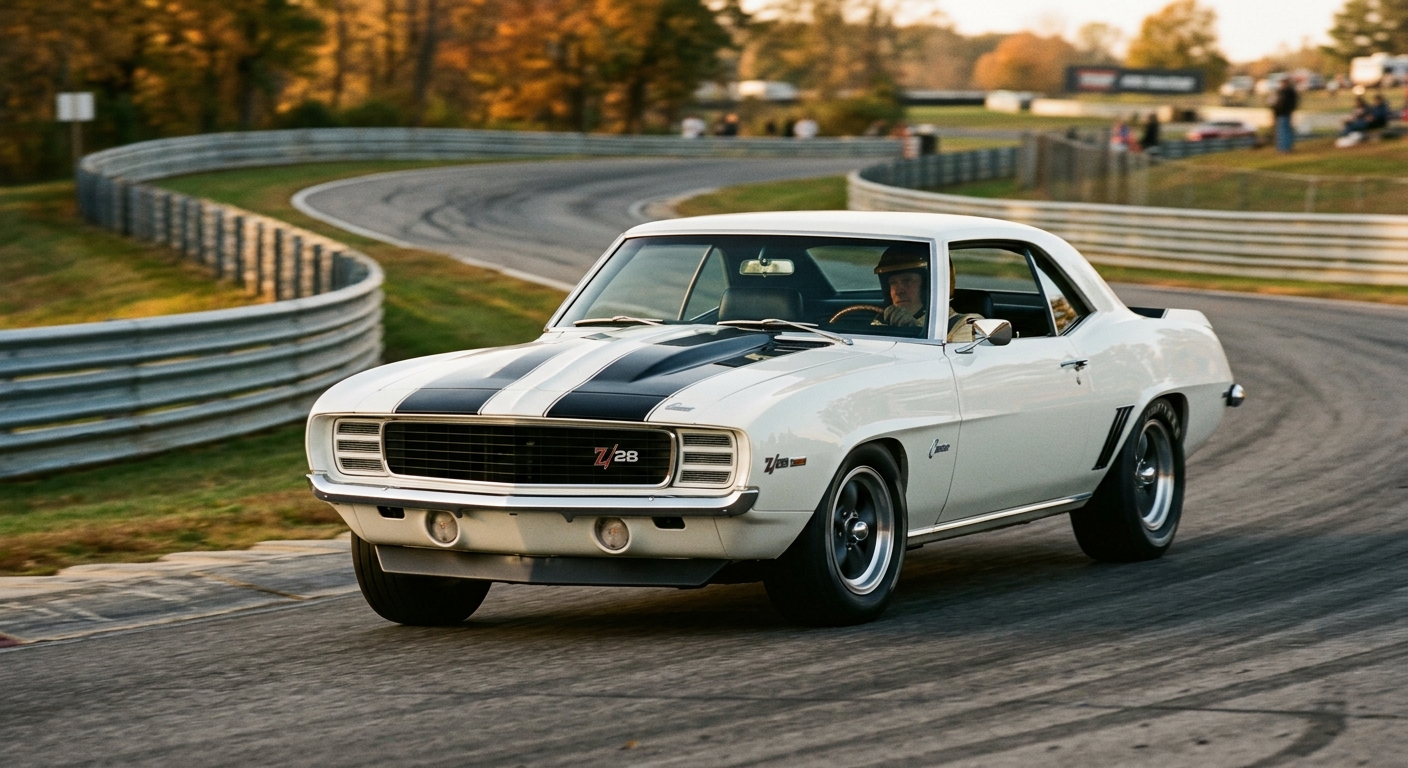
There’s a version of the Camaro story that gets told a lot, and it usually involves drag strips, big blocks, and the kind of horsepower numbers that make insurance actuaries reach for the antacids. That story is true. We’ve already lived it in this series, covering the ZL1 and the COPO 9561 in Parts 9 and 15. But there’s another Camaro story, quieter in some ways and louder in others, and it belongs to the Z/28.
The 1969 Chevrolet Camaro Z/28 wasn’t built to win at the drag strip. It was built to win at the track, to handle, to breathe, to respond like a sports car while still wearing the badge of an American pony car. In a year when Detroit was obsessed with cubes and torque, Chevrolet built something that went after cornering instead, and the result was one of the most tactile, driver-focused machines the muscle car era ever produced. It didn’t have the biggest engine in the lineup. It didn’t have the most straightforward appeal. But for the driver who wanted to actually feel the road instead of just launch away from a stoplight, the Z/28 was the answer before anyone had fully thought through the question.
This is the car that proved you didn’t need 500 cubic inches to be a legend.
Born on the Track, Sold on the Street
The Z/28 didn’t start as a marketing exercise. It started as a homologation solution.
Chevrolet wanted to go road racing. Specifically, they wanted to compete in the Sports Car Club of America’s Trans-Am series, which had a 305 cubic inch displacement limit. The 327 didn’t qualify. The 302 small block, built by combining a 327 block with a 283 crankshaft, did. So that’s what engineers built, and they built it to rev.
The first Z/28 arrived in 1967, but by 1969, the recipe had been refined, the body had been restyled into one of the cleanest shapes American design ever produced, and the package had become something genuinely special. Chevrolet sold 20,302 Z/28s that year, up dramatically from the 602 units in 1967. The word had gotten out.
What made the Z/28 special wasn’t just the engine. It was the philosophy behind it. While most of Detroit was chasing displacement, the Z/28 chased balance. You got a high-revving small block, stiffened suspension, wider wheels and tires, quick-ratio steering, and front disc brakes, which still weren’t standard equipment on most American performance cars in 1969. The whole package was engineered to work together rather than just overwhelm. That was unusual. That was almost un-American by the standards of the era.
The 302: An Engine That Wanted to Be Pushed
Let’s talk about that engine, because it’s central to understanding what the Z/28 was.
The 302 cubic inch V8 was never going to win a torque war. With its short stroke and high-compression design, torque came in at around 290 lb-ft, modest compared to the big blocks being shoved into everything else on this list. But peak horsepower was rated at 290 horsepower, which everyone who actually drove one knew was a conservative fiction. The real number was likely closer to 350-360 at the crank, but GM was under self-imposed pressure to keep numbers from spiraling into territory that alarmed regulators and insurers. They weren’t the only manufacturer playing that game.
What made the 302 special wasn’t the number. It was the character. Solid lifters. High-flow cylinder heads borrowed from the L79 327. An 800 cfm Holley double-pumper carburetor sitting on a high-rise aluminum intake. A radical camshaft profile that made the engine lumpy and unhappy below 3,000 rpm and absolutely ferocious above 5,000. The engine idled with a loping, purposeful chop that sounded like it was barely tolerating being at rest.
Drive one and you understood immediately that this was not a commuter car that happened to have a performance badge. The 302 demanded commitment. You had to work through the tach, get it above 4,500 rpm, and then it transformed. The powerband from 5,000 to 7,000 rpm was unlike anything else in the pony car segment. It pulled hard, it screamed, and the rev limiter felt almost like a disappointing interruption rather than a safety measure. This was an engine that rewarded the driver who understood it and punished the one who didn’t.
It also made the Z/28 a genuinely different experience from, say, the 375-horsepower SS 396 or the COPO cars we covered earlier. Those cars hit you immediately, with low-end torque that felt like physics slamming you backward. The Z/28 asked you to earn it. It asked for revs, for attention, for driving. That’s a more demanding ask, and it’s exactly the thing that made Z/28 drivers evangelical about the car.
The Body and What It Meant
The 1969 Camaro body deserves its own moment here, because it’s one of those designs that gets better with time rather than worse.
Chevrolet had facelifted the Camaro for 1969, and the result was a more muscular, more chiseled shape than the softer 1967-68 cars. The hood was more pronounced, the front end had more aggression to it, and the proportions had tightened up. On the Z/28, you got a specific hood stripe treatment, a front spoiler that was functional rather than decorative, and rear spoiler options that had actually been tested in the wind tunnel. These weren’t styling cues bolted on to look fast. They were parts that did something.
The Z/28 was also available with the RS package, the Rally Sport, which added hidden headlights and additional trim. The combination of Z/28 performance and RS appearance gave you a car that looked composed and almost understated until you heard it idle, at which point the composed look became slightly menacing. There was something satisfying about a car that looked sharp rather than wild and then proceeded to humiliate everything on the road.
Inside, the 1969 Camaro had the kind of interior that reflected its era, which is to say it was functional without being particularly luxurious. The gauges were right in front of you, the floor-mounted Muncie close-ratio four-speed shifter fell to hand naturally, and the driving position was low enough to feel planted. You sat in a Z/28, not on top of it. For drivers who cared about the feel of driving, that mattered.
Trans-Am Domination and What It Proved
The whole reason the Z/28 existed was to go racing, and it did exactly that.
In the 1969 Trans-Am season, the Penske-Sunoco Camaros driven by Mark Donohue were the cars to beat. Donohue, one of the most technically sophisticated racing drivers of his era, helped develop the race car and understood what it could do. The Z/28 package, translated to race spec, was quick, balanced, and reliable in ways that pure drag-oriented muscle cars were not.
Trans-Am wasn’t a drag race. It was road racing, with corners, elevation changes, braking zones, and the requirement that a car work as a complete system. The fact that a street-legal version of the Z/28 was close enough to the race car that the two could credibly share a name was a significant engineering accomplishment. Most manufacturer-backed race cars of the era bore little resemblance to what you could actually buy at a dealership. The Z/28 was different.
What Trans-Am proved, for Chevrolet and for buyers, was that American cars could handle. This sounds obvious now, but in 1969 it was still a contested point. European sports cars had spent years occupying the “handling” category while American performance cars occupied the “straight-line power” category. The Z/28 refused to accept that division. It was quick in a straight line and equally impressive when the road bent. That was the argument it made, and the argument held up.
For buyers who were paying attention to racing, the Z/28’s track record was a real selling point. You weren’t just buying a sports package. You were buying something that had been proven under race conditions, developed by engineers who cared about what happened after the traffic light.
The Competition and Why the Z/28 Won on Its Own Terms
In 1969, the Z/28 existed alongside some fierce pony car competition. Ford had the Boss 302 Mustang, their own Trans-Am homologation special with a similar philosophy and a similar high-revving small block. We covered the Boss 429 in Part 12, but the Boss 302 was the more direct competitor to the Z/28, and the rivalry between them was genuinely close.
The Boss 302 made a strong argument. It had better low-end response, a slightly more tractable powerband, and the Mustang’s long heritage. But most observers who drove both cars, then and now, give the edge to the Z/28 on pure driving feel. The Camaro’s suspension tuning was more sophisticated, the steering had more feedback, and the overall balance felt more intentional.
Against its own stablemates in the Camaro lineup, the Z/28 occupied a specific and unusual position. It was neither the fastest Camaro in a straight line nor the most comfortable nor the most practical. It was the most rewarding to drive, which is a harder thing to advertise and a much harder thing to explain to someone who hasn’t experienced it. Chevrolet’s marketing team made a decent attempt, emphasizing the racing heritage and the Trans-Am connection, but the Z/28 ultimately sold itself to the people who drove it and then couldn’t imagine driving anything else.
It was also significantly cheaper than the COPO cars, more available than the race-spec options, and actually drivable on public roads without requiring mechanical sympathy most buyers didn’t have. The ZL1 that we covered in Part 9 was a genuine exotic that demanded expertise and rewarded it. The Z/28 was more accessible while still being rewarding. That’s a harder balance to achieve than it sounds.
What the Z/28 Represents
We’re near the end of this series now. We’ve covered everything from the Hemi ‘Cuda to the Superbird to the Shelby GT500 KR, and one thread that runs through all of them is the idea that these cars were expressions of a particular kind of confidence. American manufacturers believed in displacement, in power, in the simple physics of more cubic inches producing more forward motion.
The Z/28 believed in something slightly different. It believed in the driver.
That’s the distinction that makes it matter. When you built a car around a high-revving, driver-dependent small block instead of a torque-rich big block, you were making a bet on the person behind the wheel. You were saying: give the driver the tools, make the tools responsive and balanced and communicative, and the result will be faster and more satisfying than simply overwhelming them with power. That’s a sports car philosophy. It’s an unusual thing to find wearing a Chevrolet badge in 1969.
The 1969 Z/28 was also the last of its kind in some respects. The original Z/28 program, with its Trans-Am focus and its uncompromising small-block philosophy, would evolve into something broader and more comfortable in the years that followed. Emissions regulations, insurance costs, and shifting market demands would change what the Z/28 meant. The 1969 car sits at the peak of what that original vision produced, before the compromises started stacking up.
If you want to understand what the muscle car era was actually capable of when the engineers went after the total driving experience rather than just the dyno sheet, the 1969 Camaro Z/28 is the car that makes that case most clearly. It’s the answer to the question of whether American performance cars could be sophisticated. Turns out they could. It just took a racing series, a creative displacement calculation, and an engine that didn’t care how it sounded below 3,000 rpm to prove it.
Next up, we’re crossing town to Plymouth’s other legend: the 1970 Dodge Challenger R/T Hemi. After the Z/28’s precision and balance, we’re going back to the world of maximum displacement and maximum attitude, Mopar’s answer to the question of what happens when you put the biggest engine available into one of the most beautiful bodies Detroit ever drew. The contrast couldn’t be sharper, and that’s exactly the point.