Frank
Frank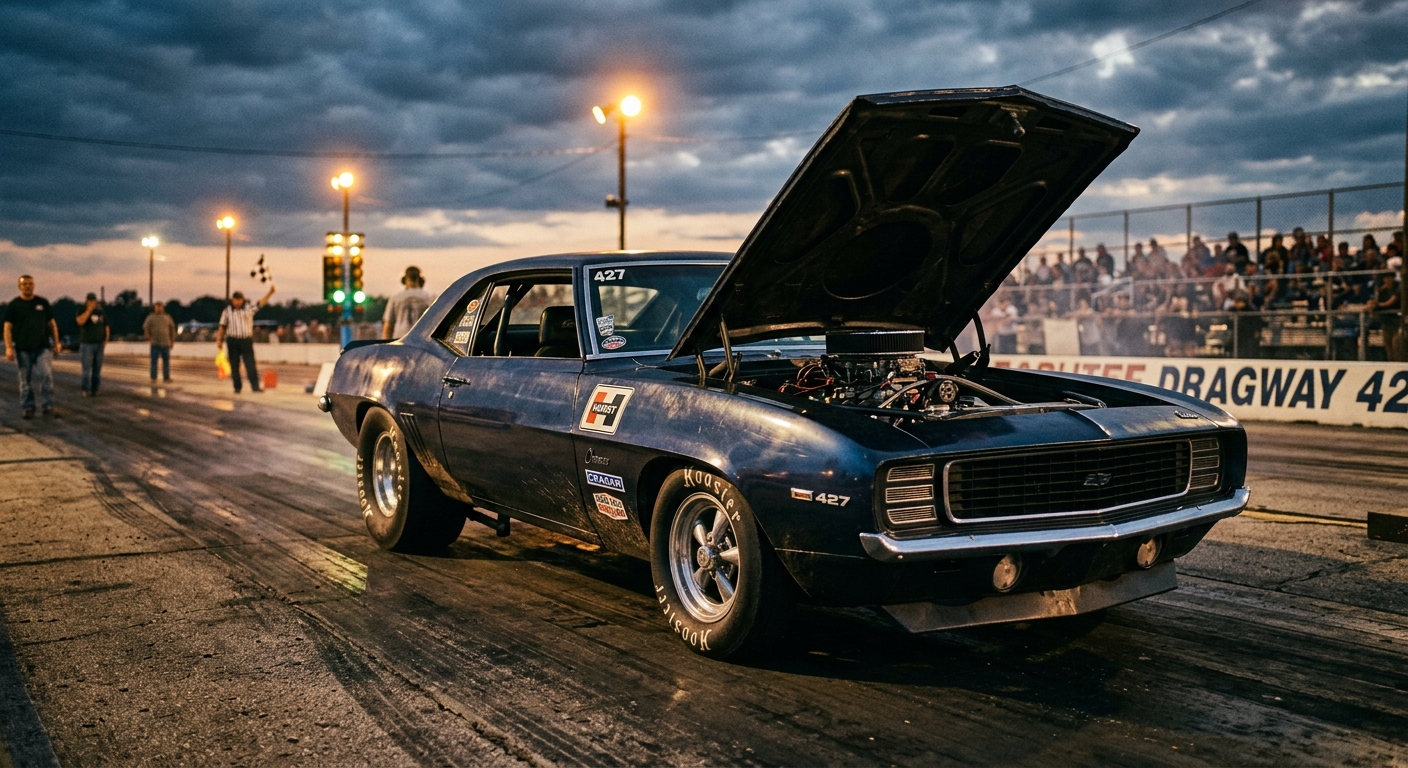
There’s a version of this story most people know. The ZL1. The all-aluminum big block Camaro that Don Yenko wrestled out of GM’s corporate machinery one careful phone call at a time. We covered that car in Part 14, and if you haven’t read it, go back. It deserves your full attention.
But here’s what most people don’t know: the ZL1 wasn’t the only COPO Camaro.
While everyone was busy talking about the all-aluminum 427 and the sixty-nine units that wore the COPO 9560 designation, there was another order code running parallel to it. Quieter. Less celebrated. Built in far greater numbers and, in many ways, more accessible to the working-class kid who wanted to go fast but couldn’t swing the price tag of a small aircraft. The COPO 9561. The iron-block 427 Camaro. The one that actually made it to the street in serious numbers and changed the game for anyone who understood what they were looking at.
This is that car’s story. And it’s a good one.
Why Two COPO Camaros Existed at All
To understand the COPO 9561, you need to understand the problem both it and the ZL1 were trying to solve. General Motors had a corporate policy in place by 1969 that prohibited any passenger car from being equipped with an engine displacing more than 400 cubic inches. This rule came down from the insurance industry’s growing pressure on Detroit, combined with internal concern at GM about the public relations fallout from building essentially street-legal race cars. The suits wanted cover. The engineers and performance-minded dealers wanted power.
The Central Office Production Order system was the crack in that wall.
COPO was never designed to be a performance loophole. It existed so that fleet customers, municipalities, taxi companies, and commercial buyers could order vehicles with specific configurations that weren’t available through the standard order book. Special paint, different mechanical setups, unique combinations. Legitimate business stuff. But a handful of dealers looked at that system and saw something else. They saw a way to get an engine into a car that GM’s own rules said shouldn’t be there.
Don Yenko was the most famous architect of this scheme, but he wasn’t alone. Fred Gibb Chevrolet in La Harpe, Illinois was deeply involved. Berger Chevrolet in Grand Rapids. Dealer networks that understood drag racing, understood their customer base, and understood that the COPO system didn’t require executive sign-off the same way a standard performance option did.
The COPO 9560 got you the ZL1, the aluminum block, the exotic, the expensive. Starting price around $4,900 on top of the base car, which pushed the total transaction well past $7,000. For context, you could buy a house in many parts of this country for what that Camaro cost.
The COPO 9561 got you the iron-block L72 427. The same 425 horsepower rating, the same 11.0:1 compression, the same mechanical lifters and the same aggressive cam. The price difference was substantial. The performance difference on the street? Negligible to most drivers. The 9561 was the working answer to an expensive question.
What the L72 Actually Was
Let’s talk about the engine, because this is where the COPO 9561 earns its keep.
The L72 427 was not a new creation. Chevrolet had been building this engine in various forms since the mid-1960s, and it had proven itself in Corvette applications and in drag racing contexts. By 1969, it was a well-understood piece of machinery. Proven. Reliable in the way that iron-block engines are reliable, which is to say: they take punishment, they respond to modification, and they don’t quit when things get hot.
Key specifications:
- Displacement: 427 cubic inches (6,997 cc)
- Compression ratio: 11.0:1
- Horsepower: 425 bhp at 5,600 rpm (factory rated, widely believed to be conservative)
- Torque: 460 lb-ft at 4,000 rpm
- Induction: Single Holley 780 CFM four-barrel carburetor
- Valvetrain: Mechanical lifters, aggressive camshaft profile
- Block: Cast iron
That last point is what separated it from the ZL1. Iron instead of aluminum. The iron block added weight, roughly 160-175 pounds compared to the ZL1’s exotic aluminum architecture. But iron also meant the engine was denser, more forgiving of heat cycles, easier to rebuild, and far more comfortable in the hands of someone who didn’t have a race shop’s worth of specialized knowledge.
The 11.0:1 compression ratio made it decidedly unhappy on low-octane fuel. This wasn’t a car for the gas station that stocked only regular. But run it on the high-test pump gas of the era, which had actual tetraethyl lead in it and octane ratings to match, and the L72 rewarded you with brutal, linear acceleration that made the Camaro’s nose point at the sky and the rear tires search desperately for traction.
Quarter mile times in the low 13-second range were achievable out of the box with a competent driver. Tune it, put decent slicks on it, get the suspension sorted, and this car was threatening 12-second passes without major modifications. In 1969, that was serious business.
The Dealer Network and the Numbers Game
Here’s where the COPO 9561 story gets interesting from a historical standpoint. Production numbers are not perfectly clean on these cars, because the COPO system wasn’t designed with future collectors in mind. It was designed to process orders.
Best estimates put COPO 9561 production somewhere between 1,015 and 1,100 units for the 1969 model year. Compare that to the 69 ZL1s, and you’re talking about a car produced in roughly fifteen times the volume. That sounds like a lot until you remember that Chevrolet built over 240,000 Camaros in 1969. The 9561 was still a needle in a haystack, just a slightly larger needle.
The dealer network that ordered these cars was concentrated in the Midwest and Southeast, regions with strong drag racing cultures and knowledgeable customers who knew exactly what they were asking for. Fred Gibb Chevrolet ordered a significant batch specifically for drag racing customers. Yenko’s operation ordered cars that he would further modify and rebadge under his own Yenko Super Car program, sometimes stripping the COPO documentation in favor of Yenko badging and paperwork. This has created some interesting authentication challenges for collectors in the decades since.
The cars came with Muncie close-ratio four-speed manual transmissions in most configurations, though some were ordered with the Turbo-Hydramatic 400 automatic. Heavy-duty clutches, upgraded cooling systems, and the Positraction limited-slip rear axle were common companions to the engine package. These weren’t stripped drag cars. They were, at least in theory, street-legal transportation that happened to be terrifyingly fast.
Living With the COPO 9561 in 1969
I want to spend some time here, because this is the part of these cars that gets lost when we talk about specifications and production numbers.
Imagine you’re twenty-two years old in 1969. You work at a factory, or maybe you’re out of the service, or maybe you’ve been saving money for three years with one specific goal in mind. You walk into Fred Gibb or Berger or a Yenko dealer and you order this car. You know what you’re getting. You’ve done your homework in the pages of Hot Rod and Car Craft and Super Stock magazine. You know the L72 is a serious piece of hardware. You know the Camaro’s platform is better balanced than most people give it credit for.
The car arrives. It is not subtle. The 427 at idle has a lope to it, a mechanical chatter from the solid lifters, a sound that tells everyone within earshot that something unusual is under the hood. You drive it on the street and you learn quickly that the 11.0:1 compression doesn’t love stop-and-go traffic, that the mechanical cam wants to be above 2,500 rpm to feel happy, that the car is fundamentally designed to go fast in a straight line and is enthusiastically not designed for anything else.
But when you get it onto a strip of empty highway, or when you pull up to the line at the local track on a Friday night, everything clarifies. The transmission snicks into first gear. The clutch engagement point is hair-trigger sensitive because it has to be. You rev it, you drop the clutch, and the iron block 427 does what it was built to do.
There is something about the character of an iron big block that aluminum doesn’t fully replicate. The sound is different. More dense, more authoritative, less exotic. It shakes the car in a way that feels like a working engine rather than a precision instrument. The ZL1 was a racetrack solution. The L72 was a street brawler.
Many of these cars led hard lives. They were bought to be used, not preserved. They went to the strip, they got modified, they wore out clutches and rear ends and tires at a rate that made the total cost of ownership significantly higher than the sticker suggested. A good number of them are simply gone. Not wrecked dramatically, just used up. Which is a kind of honest ending for a car that was always meant to perform.
Authenticity, Survival, and What These Cars Are Worth Today
The COPO 9561’s place in the collector market is complicated, and that’s worth addressing plainly.
Authentication is genuinely difficult. The COPO paperwork, when it survives, is the critical document. Trim tags, broadcast sheets, and the presence of the correct engine stampings matter enormously. There are cars in the market that have been represented as COPO 9561s that are not. The margins on these cars are significant enough that fraud has been an ongoing problem in the hobby. If you are considering buying one, independent authentication from someone with deep Camaro expertise is not optional. It is the price of admission.
Legitimate, documented COPO 9561 Camaros in strong condition have sold at auction in the $150,000 to $250,000 range in recent years, depending on options, provenance, and originality. That number has been trending upward as the supply of authentic cars continues to shrink and the demand from collectors who grew up in the era of these cars remains steady.
What’s interesting is how the 9561 compares to the ZL1 in this market. The ZL1, with its rarity and its exotic aluminum block, commands significantly more. But the 9561 represents something that some collectors find more compelling: it was the performance car actual racers used. It was the car you drove to the track, beat on, and drove home. Its history is written in race results and in the memories of people who watched them run.
That’s a different kind of value, and not everyone agrees on how to price it.
The COPO 9561’s Place in This Series
We’ve been building toward something throughout this series. Look at the cars we’ve covered and a pattern emerges. The factory was constantly working against itself, trying to satisfy performance customers while appeasing insurance companies and corporate risk managers and a regulatory environment that was beginning to tighten its grip on the American automobile.
The COPO system was the most direct expression of that tension. The factory technically didn’t build these cars. The dealers ordered them, the factory fulfilled the order, and the paperwork stayed in the Central Office Production Order system rather than appearing in standard order records. It was a performance program that officially didn’t exist, delivering horsepower that GM’s own policy said shouldn’t be in the car.
The COPO 9561 sits alongside its more famous sibling, the ZL1 from Part 14, as evidence of just how creative the ecosystem of performance got when the front door was locked. Dealers and engineers and racing customers found a back door, propped it open, and sent 427 cubic inches through it in quantity.
There’s something worth admiring about the ingenuity of that, even if the workaround was never meant to last. It didn’t. By 1970, the loopholes were closing, the insurance companies were winning, and the pure displacement era was already beginning its decline.
But in 1969, someone at Fred Gibb Chevrolet was signing order forms for iron-block 427 Camaros, and the factory was building them, and the racers were running them, and for one specific moment in American automotive history, the system worked exactly the way a generation of performance enthusiasts needed it to.
That’s the COPO 9561. Not the most exotic car in this series, not the rarest, not the most expensive. But one of the most honest. A car built to race, bought by people who knew how to use it, and remembered by anyone who ever saw one run.
Next up in Part 16, we leave the drag strip behind and head to Daytona, where Plymouth built something so aerodynamically extreme that NASCAR had to change its rules because of it. The 1970 Plymouth Superbird was not subtle, was not cheap, and was absolutely not designed with practicality in mind. It was designed to win races at 200 miles per hour, and it very nearly succeeded at exactly that.