Frank
Frank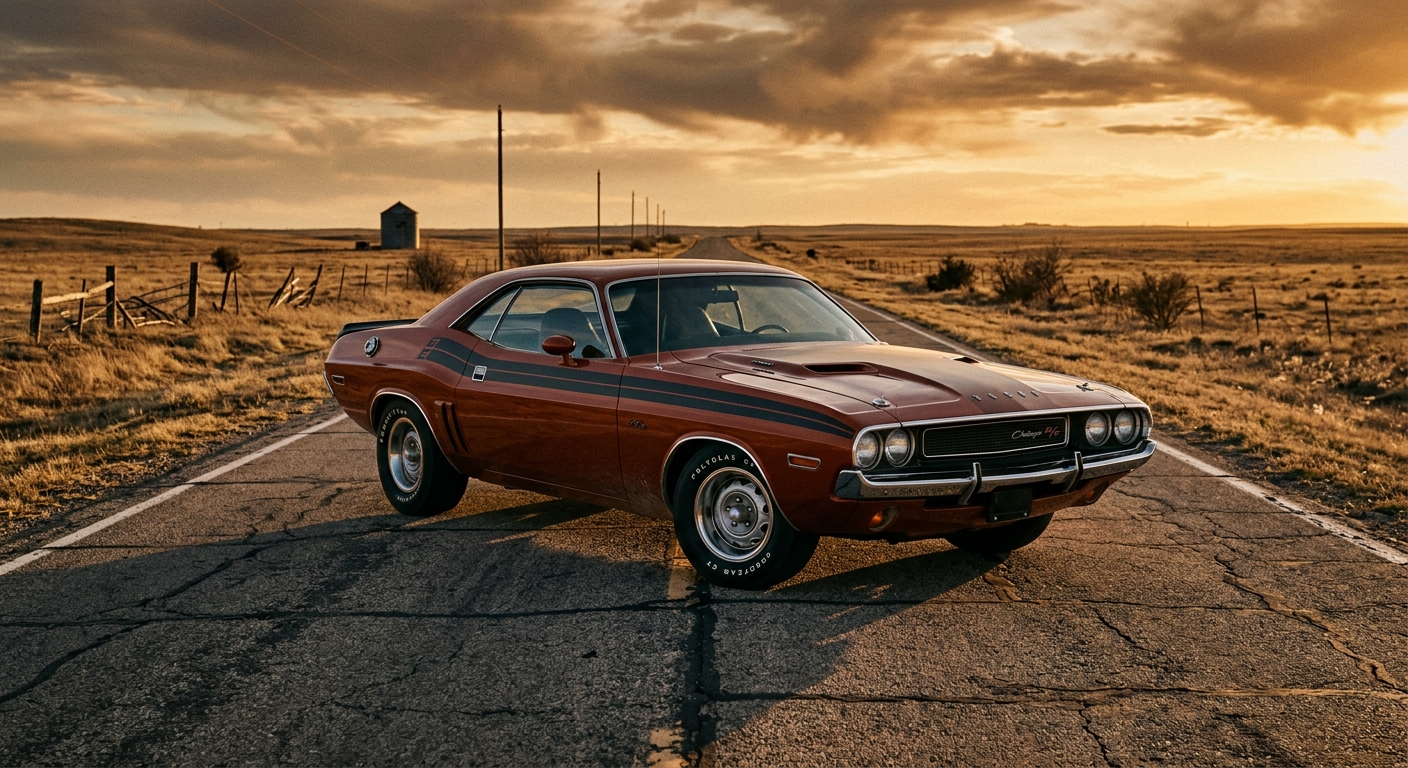
There are cars that arrived at exactly the right moment, and cars that arrived one moment too late. The 1970 Dodge Challenger R/T Hemi sits squarely in that second category, and somehow that makes it more compelling, not less. It rolled onto showroom floors as the insurance industry was sharpening its knives, as emissions regulations were gathering on the horizon, and as the cultural appetite for raw, unfiltered horsepower was about to be legislated and taxed into submission. Dodge built it anyway. They built it big, they built it bold, and they stuffed a 426 cubic inch Hemi into its engine bay like they had something to prove. Maybe they did.
The Challenger was Dodge’s answer to the pony car wars, arriving two years after the Camaro and Mustang had already staked their ground. But Dodge didn’t arrive apologizing for the delay. They arrived with a wider stance, a longer wheelbase, and one of the most recognizable engine options in American automotive history. The R/T Hemi wasn’t the most common Challenger you could buy. Fewer than 300 were built in 1970 with that engine. But it was the one that defined what the Challenger could be, and in doing so, it became a legend that outlived nearly everything around it.
The Challenger’s Place in the Mopar Family Tree
Before we get under the hood, it helps to understand where the Challenger sat within Dodge’s lineup and why it existed at all. We’ve already spent time with the 1970 Plymouth Hemi ‘Cuda back in Part 3, and that relationship is worth revisiting here. The Challenger and the ‘Cuda shared their E-body platform, but calling them twins would be a disservice to both. They were more like siblings raised in the same house who developed very different personalities.
The Challenger rode a longer 110-inch wheelbase compared to the ‘Cuda’s 108 inches. That extra length gave it a more relaxed, grand touring character. The interior was roomier. The proportions were more flowing. Plymouth aimed the ‘Cuda at the street fighter crowd. Dodge aimed the Challenger at someone who wanted performance wrapped in a bit more refinement. Not luxury, exactly, but presence. There’s a difference between a car that wants to pick a fight and a car that doesn’t need to.
Dodge also gave the Challenger a broader range of body configurations and interior options than the ‘Cuda received, targeting buyers who were cross-shopping Mustangs and Camaros rather than just Plymouth’s own performance lineup. This made the Challenger somewhat schizophrenic in its identity, spanning from mild base models to the absolute violence of the Hemi R/T. That range of options is part of why the Hemi cars are so rare today. Most buyers didn’t go to the top of the mountain. The ones who did left us something extraordinary.
What the R/T Package Actually Meant
The R/T designation, Road/Track, had been part of Dodge’s vocabulary since the late 1960s, and by 1970 it carried real meaning. On the Challenger, the R/T package wasn’t cosmetic fluff. It signaled a performance-oriented suspension tune, heavy-duty drum brakes (with front discs available as an option), a stiffer chassis setup, and the availability of serious engine choices that the base Challenger couldn’t touch.
Standard on the Challenger R/T was the 383 Magnum, a strong motor by any reasonable standard that put out 335 horsepower. You could step up to the 440 Six Pack if you wanted more, and plenty of buyers did. But at the very top sat the 426 Street Hemi, and it occupied that position the way a cathedral occupies a city skyline. Everything else was built to support it. The Hemi was the reason the R/T package existed in its fullest, most realized form.
The R/T also came with distinctive visual cues that separated it from lesser Challengers. The bumblebee stripe across the tail, available in body-color delete or in stark contrast colors. The R/T badge on the grille and decklid. The hood with its power bulge, sitting above whatever engine you’d checked the box for. On a Hemi car, that hood wasn’t decoration. It was honest advertising.
The 426 Hemi: Engineering as a Statement of Intent
We’ve talked about the Hemi in various forms throughout this series. It appeared in the ‘Cuda, it powered the Charger Daytona and the Superbird on the superspeedways. But every time it shows up, it demands fresh attention, because it never quite stops being remarkable.
The 426 Street Hemi produced 425 horsepower at 5000 rpm and 490 lb-ft of torque at 4000 rpm, at least on paper. Those numbers were conservative. Chrysler underrated the Hemi, as they underrated most of their serious engines during this period, partly to keep insurance costs from scaring away buyers and partly because the corporate culture treated advertising claims with a degree of restraint that the dyno numbers didn’t quite require. Real-world Hemi output was almost certainly north of 450 horsepower in a properly set-up example.
The architecture that produced those numbers was a study in deliberate over-engineering. Two four-barrel carburetors sitting on an aluminum intake manifold. Hemispherical combustion chambers that gave the engine its name and its efficiency. A forged steel crankshaft. High-flow cylinder heads with massive ports that breathed better than anything else Detroit was bolting onto production cars at the time. The Hemi wasn’t a bored-out, stroked version of something gentler. It was purpose-built for performance from its earliest design stages.
In the Challenger’s engine bay, the Hemi fit, but only barely. The car’s wider engine compartment helped, one area where the Challenger’s longer dimensions paid a direct performance dividend. Maintenance wasn’t casual. Getting to the plugs on the inboard side required patience and specific tools. The engine demanded premium fuel, ran hot, and required careful attention to cooling. These weren’t flaws exactly. They were the terms of the agreement. You got one of the most powerful naturally aspirated engines ever installed in an American production car, and in return, you treated it seriously.
1970 as a Time and a Place
Context matters enormously when you’re talking about the muscle car era, and 1970 was a specific kind of year. We’ve covered this territory from a few angles throughout the series, but it bears repeating here because the Challenger R/T Hemi cannot be fully understood outside of it.
By 1970, the insurance industry had begun rating vehicles by engine displacement, and the Hemi’s presence under a policy could nearly double a young buyer’s premiums. Chrysler was aware of this. Every manufacturer was aware of it. The 440 Six Pack was, in some ways, a response to this reality. It offered almost as much real-world performance as the Hemi with lower displacement numbers that the actuaries hadn’t yet flagged as severely. The Hemi buyer in 1970 was someone who either didn’t care about the insurance cost or could absorb it. That narrowed the field considerably.
At the same time, the Clean Air Act was already signed into law, and engineers throughout Detroit were beginning the slow, grinding work of strangling their engines with emissions hardware. The horsepower peak would come in 1970 and then recede with astonishing speed. Within two years, the muscle car era as it existed in 1970 would be essentially over. The engines would carry the same names but make a fraction of the power.
The Challenger R/T Hemi arrived at the apex of this moment knowing, in some sense, what was coming. Not that Dodge’s product planners were sentimentalists. They were building and selling cars. But history has a way of giving objects made at moments of transition a quality that objects made in more stable times don’t possess. The 1970 Challenger R/T Hemi is one of those objects. It carries the weight of everything that came after it simply by virtue of being one of the last of its kind made without apology.
What It Was Like to Drive
Pure speculation on my part regarding the specific driving experience, but we have enough recorded testimony and mechanical evidence to reconstruct it honestly.
The Hemi started easily when cold if you knew the ritual, which involved no pumping of the throttle and patience while it settled into a lumpy, aggressive idle. At low speeds in traffic it was not pleasant. The engine wanted to be above 3000 rpm. Below that threshold it was surly, abrupt, given to loading up if you weren’t careful. The four-speed manual, a Hurst-shifted TorqueFlite four-speed on cars so equipped, demanded commitment. You didn’t slip into gears. You placed them.
Once you got moving, once the tachometer was in the range where the Hemi breathed freely, the experience transformed completely. The acceleration was not violent in the way that word is sometimes applied to fast cars. It was more like momentum becoming inevitable. The Hemi built power in a way that felt less like an explosion and more like something enormous deciding to move, and there being nothing available to stop it. Torque steer was present but manageable. The suspension, tuned for the muscle car era’s version of handling, kept the car composed through corners if you respected its limits.
The sound was its own reward. The deep, authoritative note of a Hemi under hard acceleration is not something that photographs or describes easily. It’s one of those sensory experiences that belongs to the car in a way that no recording has ever quite captured.
The Numbers Behind the Legend
The production numbers for the 1970 Challenger R/T Hemi are stark. Of the roughly 19,000 Challenger R/Ts produced for 1970, only 356 were built with the 426 Hemi. That breaks down further by transmission: 287 with the automatic and just 69 with the four-speed manual. Sixty-nine four-speed Hemi Challengers. In the entire world. That is a number that gives any serious collector pause.
Values have reflected this rarity for decades. A numbers-matching 1970 Challenger R/T Hemi in good condition commands prices that put it firmly in the upper tier of American muscle car collectibles, regularly exceeding half a million dollars at auction for the best examples. The manual transmission cars trade even higher when they surface, which isn’t often.
But the rarity isn’t the point, or at least it isn’t the whole point. Plenty of cars were built in small numbers without achieving the Challenger R/T Hemi’s cultural status. The Hemi Challenger became a legend because it represented the full expression of what Dodge was capable of in that specific window of time. It wasn’t a limited-production special built solely to win a racing homologation requirement. It was a car you could walk into a dealership and order, if you had the money and the nerve. That accessibility, even in its scarcity, is what gives it meaning.
The Weight of Perfection
Here is what I keep coming back to with the 1970 Challenger R/T Hemi. It is not the most powerful car in this series. We covered the Camaro ZL1 back in Part 9, an engine that outgunned even the Hemi on the dyno in its most extreme form. It is not the most track-focused car in this series. It is not the most technologically adventurous or the most aerodynamically sophisticated or the most purposely extreme.
What it is, is complete. It is a car that achieved exactly what it set out to achieve with no compromises visible from the outside and very few detectable from the driver’s seat. The proportions were right. The power was right. The sound was right. The moment was right, even if the moment was ending.
There’s a particular kind of melancholy that attaches to beautiful things built at the end of an era. The Hemi Challenger carries that quality without being diminished by it. If anything, knowing that this was one of the final expressions of the muscle car at its most unrestrained makes each existing example feel more significant. These cars survived decades of use, abuse, neglect, modification, and the general entropy that cars are subject to. The ones that remain, the numbers-matching originals with documented histories, are historical artifacts as much as they are vehicles.
Dodge built the Challenger R/T Hemi as a statement about what American performance could be at its freest and most confident. That statement still reads clearly more than fifty years later. That is the definition of a legend.
In Part 20, we move away from Chrysler’s stable and back to Ford country with the 1969 Ford Torino Talladega, a car built not for the street but for the superspeedways and the very specific set of circumstances that made NASCAR’s aerowars one of the most fascinating engineering competitions in motorsport history.